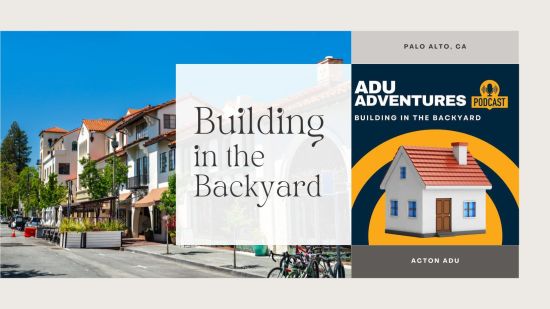
Close to Home
Palo Alto takes the spotlight in the latest episode of ADU Adventures, and what the show finds here says something quietly flattering about the town, and about the way its families build.
Ask around Palo Alto and you'll hear a familiar set of questions, usually raised quietly, often at the kitchen table. Where will Mom and Dad live as they get older, close enough to help but still independent? Where does a grown child land while saving for a place of their own in one of the most expensive markets in the country? How does a family stay close, actually close, without anyone giving up the neighborhood they love? More and more, the answer is taking shape in the backyard.
That answer has a name: the accessory dwelling unit, or ADU. You may know it as a backyard home, a granny flat, a cottage, or an in-law unit. Whatever you call it, it's a complete, independent second home built on the same lot as the main house, with its own kitchen, its own bath, and its own front door. Not a trailer, not a shed, and not a temporary fix. It's a permitted, permanently built home, made to residential standards and designed to stand for generations. In a region where space is scarce and moving away is the last thing most families want to do, that small second home has become a surprisingly large idea.
Which may be why, of all the places a podcast about backyard homes could plant its flag, the newest episode of ADU Adventures: Building in Your Backyard chooses this one. Palo Alto. Host James gives the whole episode over to a single town, and it's hard not to take it as a compliment. He didn't pick Palo Alto for its price tags. He picked it because, better than almost anywhere, it makes a quiet point impossible to miss: this is a community that notices the difference between good and good enough.
Here's the question James keeps turning over. When someone builds cheap and fast, we tend to assume they're trying to save money. Palo Alto complicates that. Here, plenty of homeowners who could easily put up the most basic backyard structure and never feel the difference choose, instead, to take their time and build something meant to last. That choice, and what's behind it, is what the episode is really about. Not Palo Alto's real estate, but its instincts.
Beyond luxury, toward something the whole family can use
Across California, more families are rethinking what the backyard is for, and Palo Alto households are often out ahead of it. That second home turns out to be one of the more flexible tools a family has. The same building can hold an aging parent close enough for Sunday dinner, with their own front door. A few years on, it can be where an adult child lands while saving toward a place of their own. Later still, it can be where the parents downsize, handing the main house to the next generation without anyone leaving the street they love.
One structure, many chapters. That adaptability, the ability to shift to whoever the family needs to house next, is what has turned the backyard home from a novelty into a long-term plan. It's the heart of what Acton ADU calls Family Integrity Planning: keeping generations close while building lasting value in the place a family already calls home.
The long view
What makes the episode worth your time is that James doesn't stop at the sentiment. He walks through the story of one family, step by step, and lets their experience illustrate why building well tends to look smarter the longer you hold it. He's careful and conservative about it, never overselling, which is part of why it lands.
The throughline is simple, and it's something Palo Alto homeowners seem to understand intuitively. In a place where neighbors, renters, and future buyers all have a trained eye, a thoughtful, well-made home gets noticed, and a corner-cutting one gets noticed too. Build for the next thirty years rather than the next thirty days, James suggests, and the backyard home quietly does more for the family than its square footage would imply.
The part of the episode that stays with you, though, isn't a spreadsheet. It's the recognition that the same backyard home a family plans around is where someone's mother will live, where someone's daughter will start out, where a family quietly stays whole across three generations. As James puts it, the most respectful choice tends to be the most rewarding one, too.
A hometown thread
There's a local connection running underneath all of this. Stan Acton, the founder of Acton ADU, grew up right here in Palo Alto, spending his boyhood building forts and wooden contraptions in backyards not far from where this story is set. Decades later, the company he built still focuses on these same neighborhoods, which is part of why a Palo Alto episode, and a Palo Alto seminar, feel less like outreach and more like coming home.
Two ways to go further
Listen to the episode. The latest episode of ADU Adventures: Building in Your Backyard is available now wherever you get your podcasts. It's an unhurried, thoughtful conversation about what it really means to build for the long term.
Come think it through in person. Acton ADU is hosting a free ADU seminar in Palo Alto on the evening of Thursday, June 25, 2026, starting at 6:00 PM at the Bryant Community Center, 429 Bryant St. Specialists Kevin Lee and Jesse Soares will walk through the genuine risks and rewards of building an ADU here, drawing on more than 35 years of designing and building across California, followed by a relaxed Q&A and meet-and-greet. Seating is limited. Reserve your spot here.
To explore your own options anytime, visit ActonADU.com or call (408) 539-1908 for a free consultation.