There are three coffee trees growing inside Moonwake Coffee Roasters, and they are not decoration. They are three different varietals, planted the way a vineyard plants different grapes, and they are there to settle an argument about what coffee actually is.
"Coffee is not a commodity but a living thing, a fruit, that changes with the season, reflects the environment and care put into it, and is diverse and complex," Ming Wood and Mabel Yeung say.
Most people never see that. Coffee arrives as a bag of dark beans with a logo on it.
Moonwake began in 2020, when Wood and Yeung started roasting at home for friends and family during the shutdown, hoping to hand a little ordinary pleasure to the people around them. It was their friends' encouragement, they say, that turned it into something meant to reach past the people they already knew. In 2023 the couple carried a single-group espresso machine to the Cupertino Farmers' Market and started serving espresso and pour-over to strangers.
The customer base grew faster than the equipment could. They wanted two machines and a full pour-over bar, which meant a commercial setup, which meant more electricity than a farmers' market stall is built to carry. So they powered the whole setup off the Cybertruck, which they describe as having turned out to be an excellent fit.
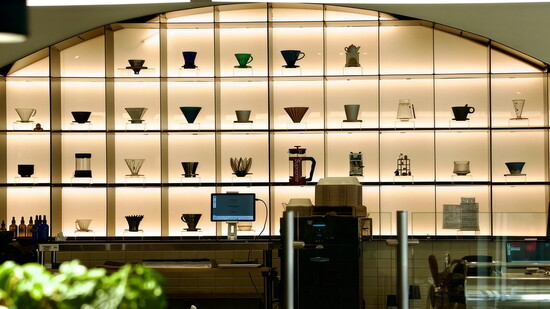
Those market years were a testing ground for everything that came after. By the time the cafe roastery opened on Saratoga Avenue in West San Jose, the customers followed them to it. The room they built has a slow bar for hand-brewed pour-overs, a roaster working in the back, and the three trees standing where nobody can miss them.
Wood came to this from Tesla, where he was an engineer. Asked what took him from that to coffee, he does not talk about the engineering at all.
"What I found most fulfilling at Tesla was the people, the opportunity to work alongside incredibly passionate and curious individuals," he says. "Some of my favorite moments were the small breaks we'd spend brewing coffee together, talking, learning about one another, and ultimately just being human." He wanted to build the room those breaks happened in, and make it bigger.
He is also a Q-Grader, which means rigorous testing against a standardized international framework. He describes the value of it in a way that has nothing to do with credentials. It gave him a shared language with other coffee professionals, producers especially, so conversations about quality, flavor and value can be precise. The standards tell him what the industry has historically wanted, and he treats that as context rather than a rulebook.
Yeung runs the rest of it. Marketing, HR, finance, procurement, the day-to-day operation. Her background is business and his is engineering, and by her account the split reflects that. The roles are different, and they complement each other.
You will usually find Wood in the back, cupping new samples and roasting. You will find Yeung at the slow bar, brewing pour-overs and talking to whoever is in front of her.
Moonwake never blends. Every coffee is a single origin, and where possible a single lot from a single farm, chosen because the producer is doing something particular with terroir or fermentation. The roasting aims at clarity, the trade's word for a cup where you can taste what makes that lot itself.
The regulars run a wide range, from enthusiasts who go deep on varietals and processing, to people who make Moonwake part of a daily routine with a familiar drink. What Wood and Yeung say they were building was a third place.
They are blunt about why any of it matters. Someone hand-picked those cherries at the right ripeness. Someone managed the fermentation and the drying and made a hundred decisions that show up in the flavor. Their team spends hours dialing in a roast profile for each lot. Then a barista has to brew it properly and hand it to a person who has some reason to care.
Specialty coffee is still very undervalued, they say, given how much has already happened before a cup reaches the bar, and rewarding producers fairly is what keeps it sustainable. The trees are the short version of that argument, and they say the trees are where the conversation with a guest usually starts.
What comes next points further upstream. They want to do more work at origin, reach further across the Bay Area, and build out a team. They call themselves a small part of something with a long history and a lot of people in it, and say they think of themselves as stewards of it. It is a large way to talk about a coffee shop on Saratoga Avenue.
"Coffee is not a commodity but a living thing. A fruit."
"A small part of something with a long history and a lot of people in it."
WHAT TO ORDER
Ask Ming Wood and Mabel Yeung what a first-timer should order and they will not answer straight away. They want to know where you are starting from and where you want to go.
Then they will point at the slow bar, which is the part of the shop they are proudest of, and where the pour-overs are brewed by hand one at a time.
If you are willing, ask for whichever coffee on the rotation is most expressive that day. When it is on the menu, that is often a watermelon-yeast inoculated ombligon grown by Deiro Garcia at Finca Lord Voldemort in Huila, Colombia, which is as strange as it sounds. Nothing here is a blend, so whatever is on today will not be on forever.