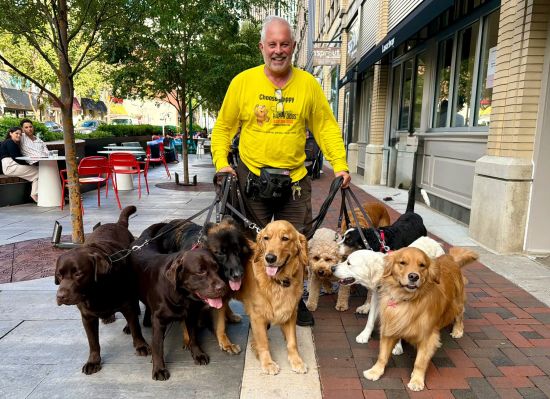
Community Happy Dogs is a dog walking, training and pet sitting company based in Chevy Chase, Maryland, serving Bethesda, Chevy Chase and Northwest Washington, DC. Founder Tom Simpson, a former marketing executive, started it in 2018. Its exercise-focused walks cover about 3 miles an hour and are GPS-tracked.
Three loose dogs were charging. Tom Simpson had eight leashes in his hands and very little time to decide what came next.
We'll get back to that.
If you have seen a man in bright yellow moving calmly up Connecticut Avenue with eight dogs in tow, you have probably met Tom Simpson. He makes it look easy. It is not.
"Pause and think twice before sending your pup just anywhere," Tom says. It is the first thing he tells new clients, and the reason Community Happy Dogs exists.
From the boardroom to the leash: who is Tom Simpson?
Before the leashes, Tom built a career in executive marketing. He calls the move to dogs his "ultimate pivot." The turning point came at the Humane Rescue Alliance in Washington, DC, where he volunteered more than 200 hours and rose to the shelter's top volunteer level.
In 2018 he founded Community Happy Dogs. His goal was to raise the standard of dog walking, training and pet sitting in his own neighborhood. A percentage of the company's income still goes to canine charities and rescue groups.
Miles, not minutes: how far should you walk your dog?
Tom's short answer: far enough that your dog comes home tired, which for most healthy adult dogs means miles, not a lap around the block.
Most walk services sell time. Tom sells distance. A 30-minute outing covers roughly 1.5 to 2 miles, and an hour-long walk logs about 3.3 miles, tracked by GPS so owners can see it.
"Dogs come into the world with their eyes and ears shut, but their nose open," he explains. A real walk lets a dog use that nose, burn energy and come home settled. Tom treats it as a workout, not a stroll around the block.
He is constantly educating owners, too. In his view, steady exercise solves many of the problems people expect to fix with medication. "Fall into the rhythm of the dog," he says, "and a lot of behavior takes care of itself."
Eight leashes, one leader: what do you do when another dog attacks?
Walking eight dogs at once takes leadership and strength. Tom borrows from The 7 Habits of Highly Effective People when he describes it. Calm, consistent direction is what the pack follows.
Remember those three charging dogs? That was the moment the calm got tested. Tom read the warning signs early and gave a firm command to stand down. The situation ended without a fight.
"Authority with intense purpose," he says of that moment. "It's not ego. It is just knowledge, used to defuse the situation."
Why is my dog so stressed at home? Bringing calm back
Tom knows a dog can bring real stress into a household. Pulling on the leash, lunging at neighbors, chewing through the sofa: it adds up. His answer is to bring calm back into the home, starting with what happens outside it.
Clients often call with the same worries. My dog doesn't like people. My dog doesn't get along with other dogs. Tom starts with two questions: what do you do with your dog outside the home, and how does your dog get outside? The answers usually explain the aggression.
For Tom, a happy dog is a tired, well-led dog. And a calmer dog means a calmer home for everyone in it.
Ask Tom
"My dog doesn't like people. Or other dogs." Start outside the house. How does your dog get out the door, and what do you do once you are out there? Pent-up energy and unclear leadership often show up as aggression. A structured, mile-heavy walk is Tom's first step.
"What should a good walk look like?" Distance and purpose, not just time on the clock. Let the dog use its nose, keep a steady rhythm and lead calmly from the front. An hour should cover around three miles.
"My dog has sudden, explosive diarrhea. What's going on?" Tom points owners to the gut first, because it sits at the center of a dog's immune system. Watch water intake and diet closely. If it lasts more than a day, or your dog seems lethargic, call your veterinarian.
"How do I choose a walker or sitter?" Think twice before sending your pup anywhere. Ask about insurance, background checks, pet first aid training and how they handle a confrontation with another dog.
Frequently asked questions
What dog walking services are available in Chevy Chase, MD?
Community Happy Dogs offers dog walking, dog and puppy training, and in-home pet sitting in Chevy Chase, Bethesda and Northwest Washington, DC. Founded in 2018 by Tom Simpson, the company runs GPS-tracked, exercise-focused walks and sends owners photo and text updates after each visit.
How far should I walk my dog?
Most healthy adult dogs need enough exercise to come home tired, not just a quick loop. Community Happy Dogs plans walks by distance: about 1.5 to 2 miles in 30 minutes and roughly 3.3 miles in an hour. Ask your veterinarian about puppies, seniors and dogs with health conditions.
How do I stop my dog from being aggressive toward other dogs?
Start with what happens outside the home, says trainer Tom Simpson of Community Happy Dogs. Pent-up energy and unclear leadership often show up as aggression. Structured, mile-heavy walks with calm, consistent direction come first, then focused training on leash pulling, lunging and reactivity.
How do I choose a trustworthy dog walker or pet sitter?
Think twice before sending your dog anywhere. Ask whether the walker is licensed, insured and background-checked, and whether staff hold CPR and First Aid certification. Ask how they handle loose or aggressive dogs. Community Happy Dogs meets all of these and offers GPS-tracked walks.
Why does my dog have sudden diarrhea?
Sudden diarrhea in dogs often traces back to the gut, which plays a central role in a dog's immune system. Common triggers include a diet change, something eaten on a walk, or stress. Keep your dog hydrated, and call your veterinarian if it lasts more than a day or your dog seems lethargic.