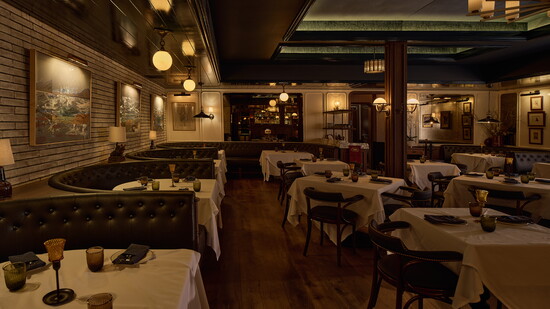
“It’s a little bit British and a little bit Yiddish,” says owner Dana Slatkin of her new Brentwood Village restaurant, The Wilkes, a concept that feels like a handsome steak-and-martini supper club wrapped in the warmth of an English tavern. The name pays tribute to architect Alfred T. Wilkes—mentor to Frank Gehry, colleague of Frank Lloyd Wright and designer of the streamlined 1954 brick building on S. Barrington that housed favorite neighborhood spot The Brentwood for decades. For so many locals, that corner space was a place where the lights stayed low, friendships were formed and the bar was always lively.
In reimagining the location, Slatkin stayed true to that legacy. LA-and-UK design firm Fettle preserved the original bar placement—now finished with polished black Rossi marble beneath a stained-glass fanlight—establishing the room’s commanding welcome. The martinis are just as good as regulars will remember, overseen by beverage director Charles Miller, who previously collaborated with Slatkin at her Westwood Village staple Violet bistro.
The menu leans into nostalgia with refinement. Chef Brian Rigsby—another Violet alum who also worked at Craft and Jon & Vinny’s—has curated a selection of timeless dishes such as bone marrow, fish and chips, classic salads and steaks, along with the fast-favorite latke chicken schnitzel. Slatkin guided menu development alongside Rigsby, blending technique with warmth in a way that reflects her long history of creating meals tied to memory. She began her Los Angeles hospitality career with a home-kitchen cooking school, The Beverly Hills Farmgirl, which ran for 12 years. “I also had a little shop where I sold things that we used in the classes,” she recalls. “That was kind of a warm-up for Violet and its cooking school component.”
Slatkin’s fondness for Brentwood began back in high school while living in Cheviot Hills and attending Marlborough in Hancock Park. “I was hanging out in Brentwood with my friends from school since most of them lived here,” she says. “I have such fun memories of going to the Country Mart, and I could spend all afternoon in Dutton’s Books.”
But her love of hospitality didn’t blossom until she was in college at Berkley studying rhetoric and heading to law school. “My parents got divorced and I quickly realized I couldn't bear being in the middle of people's arguments for the rest of my life,” she says. “I needed to pivot quickly.” Slatkin loved to cook, and friends gravitated to her dorm room for baked treats and the comfort of communal meals. Her life-changing moment happened on a junior-year trip to Venice, Italy when she fell in love with café culture and never looked back. “I loved how the whole neighborhood would gather at the local café from breakfast until late at night,” she says. “I came back to Berkeley with a mission to create some sort of similar hub.”
After graduating, Slatkin headed to the Culinary Institute of American in Hyde Park, New York, to learn the nuts and bolts of the business. With Alice Waters at Chez Panisse in Berkley as an early mentor, Slatkin demonstrates many of the same qualities and aesthetic in her current restaurants. “My parents would bring me to Chez Panisse and I would just take in all the details,” she says. “I loved Alice’s attention to décor, the china and how she used fruit arrangements when you walked in. It was all about making you feel warm and taken care of.” That ethos now defines both Violet and The Wilkes. “I guess I gravitate to places that feel personal, homey and soulful,” she says.
Slatkin currently lives nearby in Bel Air with her husband, Steve Ramras and their collective five children. “Steve is one of the best hospitality builders in the city,” she says of Ramas, who worked on Shutters and Casa del Mar (owned by her ex-husband’s family), among others. Slatkin knew she would hire him if she ever built her dream restaurant and did just that during the development of Violet—an experience that led to a partnership both personal and professional. “Yes, it’s a little restaurant romance,” she adds.
At The Wilkes, it was equally important for Slatkin to remain true to the original bones of the 75-year-old building, so she brought in longtime Marlborough friend Toni Lewis and her husband Marc Schoeplein, whose firm Lewis/Schoeplein Architects specializes in historic renovation. “What I loved about The Brentwood is that it never felt trendy. It was just timeless,” she says. “And it was the blueprint for the restaurant I wanted to open there.”
Designer Tom Parker of Fettle carried that intention through the interiors, layering leather banquettes, vintage lighting, curated artwork and market-found treasures into a space that feels lived-in rather than newly made. The adjoining former sushi space has been transformed into the Hearth Room centered around a glowing fireplace and softened with collected pieces.
The culinary experience mirrors that same cozy sensibility. Slatkin points to the crispy “pup fries” served with black ketchup, rich creamed spinach and the classic wedge salad finished with a light vinaigrette as examples of comfort reinvented. Responsibly sourced proteins and produce from the Santa Monica Farmers Market bring integrity to every plate and bread comes from Clarke’s Street bakery across the street, including a molasses loaf rooted in Chef Rigsby’s grandmother’s recipe.
The wine list also carries emotional resonance thanks to consulting from Steve Wallace—one of the former co-owners of The Brentwood, founder of Wally’s and a friend of Slatkin’s late father. “He’s the G.O.A.T.,” she says. “I’m honored to have him consult on our wine offerings and to be able to connect with my dad through him.”
The Wilkes has already reclaimed its place as a neighborhood gathering spot. Guests settle into booths they return to weekly, the staff greets them by name and the feeling is immediate and lasting. “I want The Wilkes to feel easy, comforting and civilized,” Slatkin says. “That is something that never gets old.”
The Wilkes
148 S. Barrington Ave.
310-474-3030
thewilkesla.com
“What I loved about The Brentwood is that it never felt trendy. It was just timeless. And it was the blueprint for the restaurant I wanted to open there.”