No matter the age or stage of life, many men find themselves drawn back—again and again—to making something with their hands. Whether it’s shaping clay, building furniture, assembling a collage, painting on a canvas, or designing something entirely new, the impulse is often less about the finished product and more about the act itself.
“It’s all in the practice,” said artist Keith Losh. “If you’re not doing the work, you’re not going to be inspired.”
Artist and inventor Don McCauley describes it as a process of discovery. “You have to let the work develop and see where it goes.”
For Calvin Powell, ceramicist and instructor, it’s simpler. “If you love what you’re doing, it doesn’t feel like work,” he said. “You’re just having fun.”
And for Peter Servis, lifelong woodworker, the reward is immediate: “There’s a real satisfaction in creating something with your hands.”
Across generations, their perspectives converge. For these men, art and craftsmanship are not just creative outlets—they’re ways of staying engaged, solving problems, building identity, and sometimes working through life’s more difficult chapters.
Calvin Powell represents the youngest of the group—a hands-on maker building both a craft and a livelihood.
Now based in South Venice, Powell moved to the area about a year ago with his wife and two children. His career path has varied—custom knife making, construction, personal training—but creativity has always been the throughline.
During COVID, that instinct found a new outlet. After watching The Great British Pottery Throw Down, Powell decided to try pottery. What started as a hobby quickly became something more.
Working under the name Plunder Pottery, Powell creates functional ceramics—mugs, bowls, espresso cups—balancing artistry with what sells. His wife, Jaclyn, supports both the creative and business sides. “I’m more of an artist than a salesman,” he noted.
Powell leans into the process, experimenting, refining, and teaching others along the way. In his classes at Venice's Artistic Flair Studio, he encourages beginners to “embrace the wonkiness”—to see imperfection not as a flaw, but as the point.
For Don McCauley, creativity has always meant crossing boundaries.
Originally from upstate New York and now based in Venice, McCauley’s work spans illustration, photography, graphic design, and 3D modeling. With a B.F.A. from Ringling College of Art & Design, his influences also range from classical art to emerging digital tools, shaping an approach that is both technical and exploratory.
Through his business, he takes on a wide range of projects, often saying yes to challenges others might avoid. “My approach is figuring out what something is—and then pushing it beyond that,” he said.
Whether it's imagining an illustrated children’s book or building a large-scale installation, his work is driven by curiosity—an ongoing effort to see what’s possible.
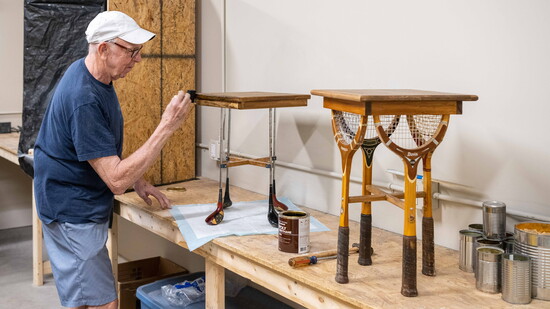
For Peter Servis, woodworking has been a constant for more than 60 years.
A resident at Venice's Village On The Isle, Servis learned the craft from his father as a teenager and has returned to it throughout his life. Today, he spends much of his time in the community woodshop—building, repairing, and mentoring others.
“I hate to see things thrown away that can be fixed,” he said.
While he has built furniture of all kinds, much of his work now involves restoring meaningful items for fellow residents—chairs, tables, heirlooms—bringing them back into use.
After the loss of his wife, the workshop has taken on deeper meaning. “It’s like going to church,” he said. “It gives you purpose.”
Keith Losh offers a perspective shaped by stepping away—and returning—to his artwork.
A fifth-generation Floridian, Losh earned a B.A. in Fine Arts from New College in the early 1980s and spent years immersed in the field. He's worked as an art handler for The Ringling, collaborated with renown artist John Chamberlin, and ran his own company. Losh also worked with Jimmy Ernst—the artist son of Max Ernst—whose images first sparked his artistic vision at age 12.
Later, Losh pivoted into drafting for engineering firms for more than two decades. “I didn’t walk away completely,” he said. “But I put it down.”
As retirement approached, he returned to his art with intention. “I felt like I still had something to say.”
His process begins with collage—drawing from images he’s collected over the years—before translating them into oil paintings. He has also reengaged with Sarasota’s arts community. “Being part of that reminds you you’re not alone,” he said.
That recommitment has already paid off: he’s been tapped for a solo exhibition at 502 Gallery in downtown Sarasota this November.
Different materials. Different generations. Different paths.
But the throughline is clear.
For these men, creating is a way to stay connected—to themselves, to others, and to the world around them. It’s a steady, grounding practice that doesn’t require perfection, only participation.
In the end, it’s not just about what they make. It’s about the act itself—the focus, the persistence, and the quiet satisfaction of doing the work.
“It’s all in the practice,” said Keith Losh. “If you’re not doing the work, you’re not going to be inspired.”