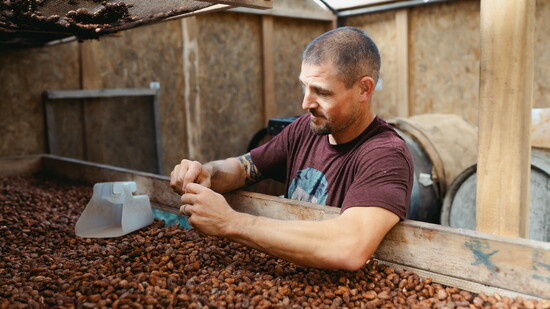
When a 65-acre parcel of land in Pahoa drastically dropped in price, veteran Adam Potter could not have anticipated that saying yes to the purchase would amount to a company spanning the entire island of Hawaiʻi—and eventually becoming the largest cocoa farmer in the United States.
Puna Chocolate Company, founded by Adam Potter and Benjamin Vanegtern, now boasts of 8 cocoa farms and 5 locations open to the public.
After purchasing the Puna property in 2011, Potter and Vanegtern experimented with growing a variety of crops, until a fateful conversion in a farmers stand in Pahoa. A local farmer introduced Adam to the idea of growing chocolate in Hawaiʻi. “Why are we not growing cocoa? Chocolate is the number one thing people want!” Potter said.
Potter brought his business degree from Stanford while Vanegtern was studying tropical plants and soil sciences at University of Hawaiʻi at Mānoa. Combining their talents and capacities, they began to map out the possibilities of large-scale chocolate production.
They started planting hundreds of seedlings and observing the results. After a couple of years, the co-founders were confident in expanding their operations in Pahoa. Though the area was located in a lava zone, volcanic flow had been predictable for decades.
In 2015, just as they prepared to plant several thousand more seedlings, a new eruption altered the lava’s path, and it was headed toward their farm. This was the first moment where the force of nature drove them to pivot.
Potter and Vanegtern posted online, offering their unplanted seedlings to local farmers. The response was overwhelming. Farmers from Hakalau to Kurtistown stepped forward, planting cocoa trees across East Hawaiʻi and forming what would become Puna Chocolate’s first distributed farming network. This major shift in the production process proved transformative. By collaborating with local growers, Puna Chocolate tapped into native expertise, expanding its cocoa footprint while strengthening community ties.
In 2017, the company opened its first shop in Hilo and purchased another farm in Hāmākua. By May 2018, they were preparing to build their own factory. Before they were able to do so, a greater plan was unfolding as Fissure 8 erupted. This natural phenomenon and its aftermath led the founders to reconsider their plans. When an unexpected opportunity arose in Kona, they took it, opening a factory and second retail location on the island’s west side.
Another defining moment arose from the 2020 global pandemic. In a point in history where many companies struggled, Puna Chocolate grew stronger by answering to the needs of local farmers who lost their cocoa exporting deals.
The company opened its doors to displaced growers, purchased locally grown beans and expanded production. The move stabilized farms, kept families afloat and revealed a deeper network of cocoa growers across the island.
Through those relationships, Puna Chocolate connected with an aging farmer unable to maintain his coffee farm. The company purchased the Holualoa property, fulfilling a long-held dream of expanding into coffee production.
Adaptability has long defined Hawaiian agriculture. For generations, farmers have selected crops that thrive in volcanic soil and unpredictable conditions. Puna Chocolate aims to carry that legacy forward by working closely with local growers to develop organic, site-specific farming practices.
“We’re confident with what people have achieved farming-wise,” Potter says. “As we grow cocoa, we tap into what has worked the best. Our starting point is to use what has been proven by the people who have more experience than us.”
In 2023, the company bought a 14-acre farm along Hawaiʻi Belt Road, planting 2,000 coffee trees and 1,000 cocoa trees. Now known as Hale Cocoa, the property has become their main attraction, featuring a storefront, farm tours, a Polynesian garden, café and cocktail bar.
Additionally, they have opened their first restaurant right next to it, called Theatery.
Puna Chocolate aims to provide an authentic experience that fits into the local DNA of each region. The shop in Hilo features products infused with noni and seaweed, while Kona offerings highlight coffee and macadamia nuts.
“Each time you walk into one of our locations, I want you to have unique experiences. I don't want you to assume that it's gonna be the same.”
By appealing to customers who are attuned to the quality of locally sourced chocolate, Puna Chocolate continues to provide stability for Hawaiʻi’s cocoa farmers. The company’s community-centered model ripples outward—supporting local agriculture and offering visitors a deeper connection to the island.
Explore Puna Chocolate’s finely crafted products and services at BigChocolateIsland.com.
Potter and Vanegtern posted online, offering their unplanted seedlings to local farmers. The response was overwhelming. Farmers from Hakalau to Kurtistown stepped forward, planting cocoa trees across East Hawaiʻi...
“I want you to have unique experiences. I don't want you to assume that it's gonna be the same.” —Adam Potter.