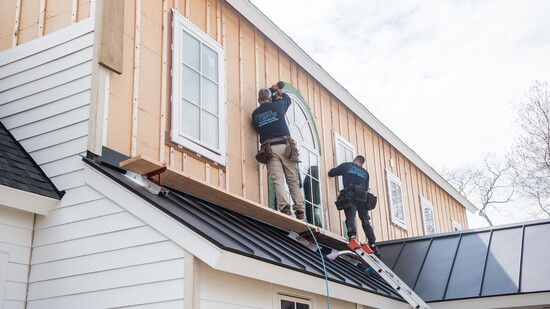
In Ridgefield, you’d be hard-pressed to find a contractor with as much experience as Dan Musolino.
Dan has been swinging a hammer since 1977, and he’s never stopped learning. After graduating from Ridgefield High School in the late 1970s, he headed west.
“I moved to California in 1979 and joined the Carpenters’ Union,” Dan tells us. “That’s where I learned framing and building. I worked with a lot of experienced builders and gained a tremendous amount of knowledge.”
Dan moved back to the East Coast in the early 1980s and started his own business—a framing company that built out custom homes for builders throughout Fairfield County.
“As the building business changed, we evolved with it,” he says.
His company went on to handle everything from commercial projects and gas station remodels to apartments and work at the Danbury Fair mall.
Custom homes, commercial builds, full gut renovations, additions—Dan has worked across nearly every type of construction project. After nearly five decades in the trade, he brings hard-won expertise shaped by experience on job sites of all sizes.
After a stretch with a larger company, friends encouraged him to start again on his own. He founded Dannick Carpentry LLC over 20 years ago.
Licensed in both Connecticut and New York, Dannick’s crews work throughout Fairfield County, Westchester County, and beyond. Much of their day-to-day focus is remodeling—kitchens, bathrooms, additions, and full renovations.
Increasingly, clients are coming to Dannick for something more specialized: deep energy retrofits (DERs), or energy-efficiency remodels. These projects are especially relevant in today’s volatile energy market.
“It’s not the same as traditional building,” Dan tells us. “There are a lot of nuances that go into it.”
We’re chatting with Dan in the Dannick Carpentry office on Bailey Avenue, a light-filled space with high ceilings on the second floor, next door to Trillium Architects. While not formally affiliated, the two firms often work closely together. Recently, they both attended a conference in Boston hosted by the New England Sustainable Energy Association—part of an ongoing effort to advance green building standards in the region.
The deep energy retrofit, he explains, is a multilayered, whole-house process that starts outside and moves inward, ultimately reducing a home’s energy consumption by 40 to 50 percent.
The siding is removed, the house is rewrapped with a vapor barrier, and exterior insulation is added to meet current energy codes. Windows are replaced with high-performance double- or triple-pane units, HVAC systems are upgraded to electric heat pumps, and an energy recovery ventilator (ERV) is installed.
Dan describes the ERV as “the lungs of the house”—it pulls out stale air and draws in fresh air continuously. This is something older homes did naturally through their gaps and cracks, but that a tightly sealed, super-insulated house needs to do intentionally.
The result is a home that not only looks better—but works better.
“It’s about balancing the house,” he says. “Making it greener—trying to create healthier environments, keep the moisture out, keep the mold out, keep the heat or air conditioning in.”
One thing Dan avoids is adding foam insulation under siding. Foam can off-gas, it’s difficult to dispose of responsibly, and it often ends up buried in the ground.
Instead, he opts for dense-packed cellulose—a high-performance insulation made from recycled paper—or rockwool, a durable material spun from basalt and steel slag.
“We try to make sure we’re building a healthy environment in the home,” he says. “Using cellulose or rockwool is a big part of that.”
He’s not anti-foam entirely—he’ll use it along foundations where other materials can't reach—but he pays close attention to evolving materials and adjusts as better options emerge.
“They’re constantly developing new processes,” he says. “Eventually I think they’ll hit a good spot.”
It’s a science many contractors aren’t deeply versed in, and one he’s spent years refining—a discipline of its own, requiring a different kind of fluency. In a way, that same straightforward logic extended beyond the jobsite.
When it came time to name the business, the answer was right in front of him: combine his name with his wife Nicole’s. Dan. Nick. Dannick.
“People remember it,” he says with a smile.
Nicole is the other half of the operation in more ways than one. While Dan is running job sites—sometimes up to six at a time, with eight carpenters and a full roster of trusted subcontractors—Nicole handles the books, the spreadsheets, the paperwork, and, as he puts it, “taking care of Dan.”
That trust carries into every client relationship, too.
“I like to keep everything transparent from the beginning,” he says. “From the first meeting, I explain how I do business. You want to see how I quoted the job? I’ll show you the breakdown. There are no hidden agendas.”
In a trade where corners can be cut quietly and clients don’t always know the right questions to ask, that kind of openness is rarer than it should be. Dan’s business runs almost entirely on referrals—no splashy marketing, no undercutting on price.
When something goes wrong mid-project—as it inevitably does in construction—he addresses it directly, with integrity. In this business, reputation is everything.
“If something isn’t done right, we fix it. My goal is to keep the customer satisfied with the progress of the project—and, more importantly, the final outcome.”
Dan has been doing this long enough to have seen every version of the industry: the boom years, the lean years, the COVID-era material shortages that sent lumber prices into the stratosphere and never quite came back down.
Through all of it, he’s built and kept a tight roster of local subcontractors—Mulvaney Plumbing, Bellagamba Electric, Total Comfort for HVAC, Villalba Excavating, Risko Foundations, O’Brien Painting—working with many of them for decades. It’s a network that allows Dannick to take on projects of virtually any scope, with people Dan trusts completely.
Ask him what kind of projects he loves most, and Dan doesn’t hesitate. Old houses. Antiques. The ones with surprises behind the walls and history in the bones.
“You never know what you’re going to find,” he says. “And you’re not tearing it down—you’re taking it, reconditioning it, and bringing it back to life.”
That instinct—to restore rather than replace, to improve rather than demolish—runs through everything Dannick does, from the cellulose they pack into walls to the 1959 house in South Salem they recently transformed into a super-insulated, energy-efficient home without touching the original footprint.
New construction brings its own rewards too: different challenges, different constraints, and a front-row seat to how the industry keeps changing. An energy-efficient, custom-built farmhouse nearing completion in Lewisboro is a recent example—modern in every way, but built with the same care.
That balance—honoring what’s already there while staying open to what’s next—is, in a way, the story of Dan Musolino himself. A kid from Ridgefield who went west, learned from the best, came home—and never stopped building.
These days, Dan is typically juggling several projects at once, with more already lined up behind them. He’s not ready to retire—and he’s not sure he ever will be.
“It keeps your mind working,” he says. “Keeps you thinking about how to do things better.”
To get started, call 203-512-1211 or visit dannickcarpentry.com. Dannick Carpentry is located at 16 Bailey Avenue on the second floor. Follow on Instagram to see recent projects @dannick_carpentry_llc.