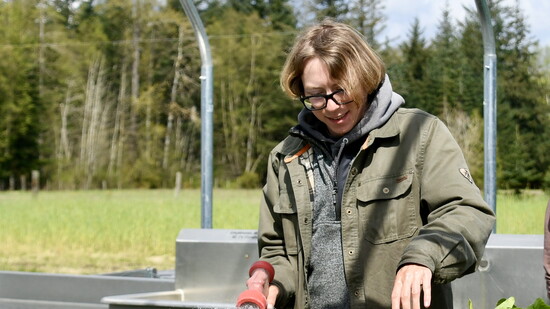
Last month, I drove north to Ferndale to visit Wright Brothers Farm—and spend time with someone many of you already know from our market: Craig Wright.
As the Mercer Island Farmers Market Manager, I spend Sundays talking with vendors, helping shoppers, and watching relationships unfold—but every once in a while, I get to step away from the market and go see where it all begins.
If you’ve stopped by Craig’s booth at the market, you’ve probably had this experience: you ask a question about a vegetable, and suddenly you’re in a full conversation about flavor, how to cook it, where it came from, and why it matters.
But what you don’t see on Sundays is everything behind it.
A Life That Started in the Fields
Craig didn’t “become” a farmer. He’s always been one.
He and his brothers started working on this land in elementary school—full days in the summer. Early years weeding, washing, and packing vegetables. By high school, Craig was helping to manage the farm stand.
This farm has been in his family for generations, dating back to the early 1900s. His grandfather was a dairy farmer and his uncles converted the dairy farm into one of the first organic vegetables farms in Washington. Today, Craig, his brothers, nephews, and extended family are still here—working the same soil.
He left for a while. Built other careers. Lived life.
And then, like a lot of people who grow up connected to land… he came back.
Not because it’s easy. Because it matters.
What It Really Looks Like Out There
The morning I visited, the farm felt alive in that quiet, steady way only farms do.
In the fields, the crew was picking and washing spring greens and brilliant red radishes. Craig attributes much of the farm’s success to its crew. “We are fortunate to have all of our crew back from last year. Our farm manager, Paul, has many years of experience. Nephews Matt and Zach have been involved since we started growing. Sofia joined us last year and is already a key member of our team. Every crew member cares deeply about growing great tasting, healthy food.”
Farming is not romantic work. This is hard, grinding, 24/7, 365-days-a-year work that never really stops. Right now, they’re doing the work that sets the entire season in motion—developing healthy soil, planning crops, watching weather patterns, hiring staff, solving problems before they happen, building out greenhouse systems, and mapping out exactly when each crop will move from seed to greenhouse to field to market to your table.
And when the season hits? It’s a nonstop rhythm: planting, harvesting, washing, packing, setting up booths, selling, delivering… and doing it all over again the next day.
What Makes Wright Brothers Farm Different
Wright Brothers Farm doesn’t try to be the biggest farm. They try to be the best at what they grow. Craig told me their number one priority is simple: flavor comes first.
That’s why they grow both long-time favorites (beets, carrots, corn, lettuce, and tomatoes) as well as things you won’t always find in big stores—including unique varieties of Asian vegetables such as amaranth, bok choy, choi sum, Komatsuna, and tatsoi.
The Work You Don’t See at the Booth
Wright Brothers Farm isn’t just growing one or two things really well. They’re growing 40–50 different crops—and working to have them available consistently throughout the season.
It’s not one job. It’s twenty - understanding soil science, strategic crop rotation, weather patterns, irrigation, electricity, marketing, sales, and how people cook.
“We have an amazing team. My brother Chris, Matt, and Paul handle all things mechanical, including building and maintaining our hoop houses, designing and building market displays, and a transplanter used behind our tractor. Zach and Sofia are our ‘flex’ specialists: they do the tough field work but also take their knowledge of the crops to farmers markets where they share that knowledge with our customers.”
Why He Keeps Coming Back to Mercer Island
Craig has lived on Mercer Island for over 30 years and has deep roots in this community— including a personal connection with Mercer Island Youth and Family Services, who supported his family through a difficult time.
Craig has been a Mercer Island Farmers Market vendor for four years—and plans to be here for many more. Because of you.
He talked about the market with genuine warmth in his voice, it’s a place he loves—the music, the energy, the families, the kids with mini shopping carts, and the weekly regulars.
More Than a Farm
Everyone has a role. Everyone contributes. His brothers, his nephews, and even his 86-year-old mom—who lives on the farm—are part of what keeps it going. “Without my mom, her brothers and parents, and grandparents, we wouldn’t be here.
It’s not just a farm.
It’s a place of belonging.
A deep history.
A bright future.
A family choosing, every single day, to keep this going.
So when you walk through the Mercer Island Farmers Market this Sunday, I want you to stop by Wright Brothers Farm.
Not just because the produce is fresh.
Not just because it tastes incredible.
But because now you know what’s behind it.
The early mornings.
The late nights.
The decades of history.
The family.
The intention.
You’ll notice new additions this season—a broader spectrum of onions, garlic, and even more tomatoes than before.
Go say hi to Craig and Zach, ask them what’s best this week, tell them you want to try something new, and let them guide you.
Because once you see the farm behind the booth…you start to understand something: missing a week means missing something special.
When food is grown like this—intentionally, seasonally, and at peak flavor—that’s not something you want to miss.
This is what our market is about—real farmers, real work, and food grown with purpose.
The produce at Wright Brothers Farm doesn’t wait around. It’s grown for flavor, harvested at its peak, and changes week to week—meaning if you miss it, you miss it. Here’s the story behind one of Mercer Island’s most beloved farmers.
Last month, Mercer Island Farmers Market Manager Ange Garrett visited Wright Brothers Farm in Ferndale to see firsthand what goes into the produce we shop for each Sunday. What she found was a family legacy, relentless work, and a deeper understanding of what it means to eat seasonally—and why missing even one week at the market means missing something special.