For the Urban Land Institute, real estate development in Fayetteville goes beyond mapping out building dimensions and creating floor plans. It’s about intentionally creating spaces for community, movement and wellness. It’s also about building the minds of people who will continue to create authentic connections through smart real estate development.
Inside the Anthony Timberlands Center in south Fayetteville, a group of University of Arkansas students from across disciplines worked to build a city with welcoming spaces and a vibrant culture.
Every detail, from transportation to amenities, was essential to thoughtful placemaking. Their work centered on people and on how to take their needs into account when redeveloping urban and suburban spaces.
These students redeveloped the area around a strip mall in Austin, Texas, ultimately submitting their master plan to the Urban Land Institute’s Hines Student Competition. It included affordable housing, new businesses, a central park area, and well-connected streets, amenities experts say Fayetteville also needs.
Ken McCown is the chair of the landscape architecture department at the Fay Jones School of Architecture at the University of Arkansas. He said the collaboration between the university and ULI has been in the works for a couple of years. Students from across campus took a seminar taught by McCown and other development experts on how to prepare for the Hines competition. These students also took important career lessons from experts across architecture, landscape architecture, and real estate development.
Jessica Hester is the CEO of Verdant Studio and the mission advancement chair at the Urban Land Institute. Hester participated in the Hines Competition when she was a student and now mentors students from the University of Arkansas. For her, guiding these students through this competition helps create the next generation of thought leaders to push Fayetteville forward. “We are trying to create the future leaders of ULI and future participants in civic engagement, and that’s what this course does,” Hester said. “Everyone who participates, whether they end up in landscape architecture, architecture, or real estate, is going to be a better citizen, supporting development happening in our region and beyond.”
McCown said the collaboration helps prepare students for the real world and creates better communities by bringing many perspectives to the table. “Their discipline is one of many that contribute to the built environment,” McCown said. “One metaphor I like to make is that it’s like students learning how to play guitar, play drums, but they’re not in a band yet. You need to be in a band to make music, and urban design is like making music, right? You have to have all of the instruments working together to make beautiful harmony in beautiful places.”
Hester said bringing these students together also brings a wealth of new perspectives on how to build a city that serves everyone. “There is not a project that gets built in real life that isn’t impacted by disciplines from all across the region, by people from all walks of life,” Hester said. “Everybody has an opinion on development and you need lots of people on your team to make that development come to fruition.”
Ken McCown is the chair of the landscape architecture department at the Fay Jones School of Architecture at the University of Arkansas. In his work and his teaching, he focuses on sustainable urban design. He said the collaboration between the university and ULI has been in the works for a couple of years. Ultimately, five students from across campus ended up taking a class taught by Hester and McCown on how to prepare for the Hines competition.
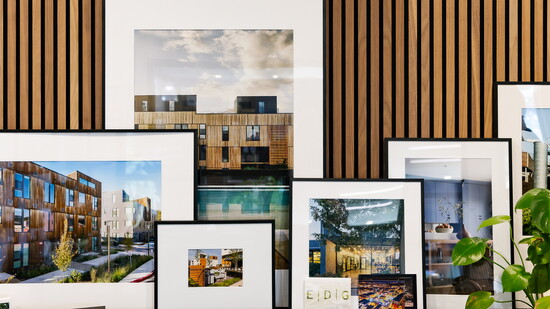
Years before these students stepped into the classroom, Jeremy Hudson had a vision for Fayetteville’s growth. “Smart growth is just being a good steward of the resources we have,” Hudson said. “It’s realizing that we certainly want to grow. We certainly need to grow, but we want to grow in a way that preserves not just natural resources in the sense of water and land, but also cultural resources.” His project, the Eco-Modern Flats apartments on Hill Ave., was a finalist for the Urban Land Institute’s Global Award of Excellence. From there, he connected with Urban Land Institute leaders, who shared his goal of creating healthier built communities, and he was able to create a satellite council and a place where local architecture and real estate experts could gather and share ideas.
ULI’s work on creating a better Fayetteville has had a growing impact. ULI’s leaders have played a major role in the planned redevelopment of the 71B corridor, which has already begun its first phase on College Avenue. The project promises to improve the health of people who live and work in the area by utilizing mixed-use development, combining affordable, sustainable housing with new businesses and healthy community spaces.This type of development expands transportation options beyond cars and empowers people to take wellness into their own hands by offering more opportunities for intentional movement. This, in turn, has led to building communities where people can connect and truly know each other.
Hudson said the work ULI does is important because it focuses on helping people and crafting communities. “You’re going to be happier, going to be healthier [too],” Hudson said. “If you live in a place that has trails or a place where you can walk to not just your immediate neighbors but your surrounding community, you’re not only going to live longer. You’ll hopefully live in Northwest Arkansas longer because these are the ties that keep people in a place.”