When homeowners in South Louisiana begin planning a pool, a pool house, or a complete outdoor transformation, the first call often goes to a builder, a pool contractor, or an architect. Each brings valuable expertise. But before the first shovel breaks ground, one question matters most:
Who is looking at the property as a whole?
Design First
That early stage, before excavation, concrete, and elevations are locked in, is where the long-term performance of a property is decided.
“Once slab heights are set and drainage patterns are established,” says David Abadie, owner of Magnolia Landscape Architecture, “the site begins to take shape whether you’ve planned it holistically or not. Those early decisions affect everything: patios, steps, retaining walls, circulation, planting, and how water moves across the property.”
A house can be beautifully designed. A pool can be expertly constructed. But if the broader site is not evaluated as a complete system, small oversights often compound over time. Drainage issues surface. Exterior steps feel awkward. Hardscape elevations conflict with surrounding grades. What could have been seamless begins to require correction.
The Whole Property in View
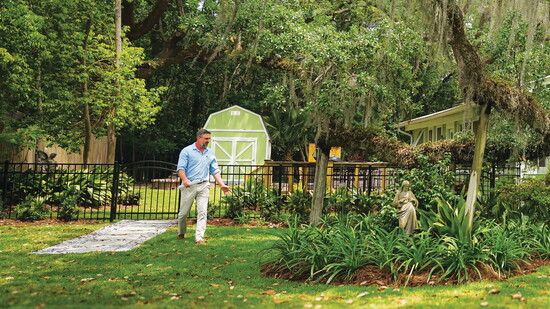
Abadie, a graduate of Louisiana State University with more than two decades of experience, approaches projects from the standpoint of total site strategy. His work throughout the Northshore, greater New Orleans region, and Gulf Coast frequently includes pools, garden structures, outdoor living spaces, and full-property master planning.
“As a landscape architect, my responsibility is to understand how all the parts relate,” he explains. “Grading, drainage, structures, paving, planting, circulation—these are not separate decisions. They influence one another.”
Before Problems Become Expensive
In many cases, Abadie is brought in before construction begins. When given that opportunity, he assists in determining slab heights, driveway elevations, and finished grades. These technical decisions dictate how the property will function for decades.
“If we can establish elevations correctly at the beginning,” he says, “we prevent problems later. Water moves where you intend it to move. Transitions feel natural. Adjacent properties are protected. The entire site works together.”
He is equally clear that he can solve problems after the fact. He has been called in to correct grading conflicts and drainage failures once construction is underway, or even after it is complete.
“Solving problems is possible,” he says. “But preventing them is better.”
From Vision to Construction
Design, however, is only part of the equation. Construction is where the vision is tested.
Builders manage construction. Contractors coordinate trades. Architects focus on structures. Each fulfills a specific role, yet on many residential projects, no single professional remains engaged exclusively from the homeowner’s perspective across the entire property.
That is the role Abadie assumes.
“My loyalty is to the client,” he explains, “and to their property, budget, and long-term outcome. Whether we’re working alongside a general contractor through construction administration or coordinating multiple trades through project management, I remain involved to ensure the work aligns with the design.”
An Advocate for the Homeowner
Serving as the owner’s representative on site, Abadie reviews grades, confirms dimensions, verifies material installations, and resolves unforeseen conditions before they expand into larger complications.
“It’s not adversarial,” he says. “Contractors are craftsmen. When everyone is working from precise documentation and communicating clearly, the process becomes more efficient and the results improve.”
And the results speak for themselves.
Clear construction documents reduce ambiguity. Competitive bidding promotes fair pricing. Early coordination minimizes costly change orders. Independent oversight ensures that what was designed is what is ultimately built.
Proportion, Scale, and Purpose
Abadie emphasizes that his work is not about expanding scope or adding unnecessary features. Instead, it’s about intention.
“Proportion and scale matter,” he says. “Spatial relationships matter. The pool, the pool house, the terraces, the plantings—each element should serve a purpose and relate correctly to the whole.”
Abadie studies how people move through a site, how elevation changes affect comfort, how structures define outdoor rooms, and how materials transition from one space to another. The objective is not simply aesthetic appeal, but balance and long-term performance.
“When a property feels right,” he says, “it’s usually because someone paid attention to how all the parts work together.”
That level of refinement does not happen accidentally. It results from experienced design applied thoughtfully from the beginning and carried through construction with consistency.
Curating Beauty with Purpose
For homeowners, the value of that process often becomes clearest at the end. Not just in the finished space, but in the absence of lingering problems. The grades function as intended, drainage performs correctly, materials are properly installed, and the project reflects the original vision.
Most importantly, the homeowner knows that someone was evaluating the entire property from start to finish.
“In projects of this scale,” Abadie says, “someone needs to be thinking strategically from day one and staying involved through completion. That continuity protects the investment.”
If you’re considering a pool, a pool house, or a full-property transformation, don’t think of landscape architecture as an accessory service to be added late in the process. Instead, think of it as a foundational discipline that shapes how the property will function and feel for years to come.
And when that foundation is established correctly and curated wisely, the result is not only beautiful but altogether sound.
“When a property feels right, it’s usually because someone paid attention to how all the parts work together.”
David Abadie, founder of Magnolia Landscape Architecture, takes a design-first approach to outdoor spaces that balance beauty, function, and lasting value. His work emphasizes thoughtful planning, detailed construction documents, and careful project oversight from concept to completion. Magnolia Landscape Architecture is located at 1521 Gardenia Drive, Metairie. You can contact David by phone at (504) 460-9780, by email at David@magnoliascapes.com, or by visiting magnolialandscapearchitect.com. You can also follow him on Facebook and Instagram @magnolia.landscape.architect to explore projects that integrate form, function, and lasting value.