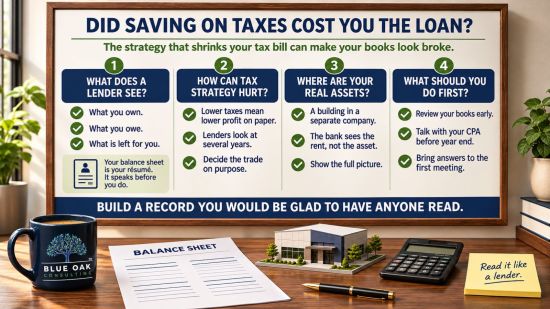
Lenders do not read a company the way its owner does. The owner sees a full schedule, crews he trusts, and a building he paid off years ago. The lender sees a few pages of numbers.
A reconstruction contractor working out of Lewisville learned this the hard way when he started talking with banks about a line of credit. The business was busy and paying its bills. On paper, it looked like it was underwater.
The gap between those two pictures came down to choices made years earlier for good reasons. Nobody had connected them to the day he would need to borrow.
What Does a Balance Sheet Tell a Lender?
A balance sheet tells a lender what the company owns, what it owes, and what is left over for the owner. That leftover piece is called equity. Think of the balance sheet as your résumé. The lender never meets your crews or walks your jobsites, so those pages have to speak for you.
In this case, long term debts were about $750,000, which was more than everything the company owned. Retained earnings, the running total of profits kept in the business over its life, sat at roughly negative $730,000. To the bank's reviewer, that reads like a company that has lost money for years and owes more than it is worth. The owner knew the business was healthy. The financial reporting said otherwise, and the financial reporting is what gets read.
How Can a Tax Strategy Hurt Your Ability to Borrow?
Aggressively shrinking taxable income lowers your tax bill, but it also lowers the profit a lender sees. Part of the negative equity here came from years of doing exactly that. Every expense pulled forward and every deduction maximized made sense in April. Buying a truck in December to claim the deduction, for example, cuts this year's tax bill. It also cuts this year's profit on paper. Stacked together over several years, they produced a balance sheet that told a lender the company had never made money.
Lenders also tend to look at several years at once, so the pattern matters more than any single return. Neither choice is wrong on its own. Paying less tax and qualifying for credit simply pull in opposite directions, and an owner should decide that trade on purpose rather than discover it in a loan meeting.
Where Do Your Real Assets Actually Sit?
They may not sit where the lender is looking. This owner had a paid off building worth about $400,000. It was held in a separate company he also owned, not on the operating company's books. The operating company paid that separate company about $6,800 a month in rent.
Holding real estate in a separate company is a common and often sensible arrangement. But the bank evaluating the operating company saw the rent expense and none of the asset. The owner's real wealth was invisible in the one document that mattered for this loan. Good advisors can help present the full picture, sometimes by showing the related companies together, but only if the owner knows to bring it up. Left unexplained, a building the owner fully controls can look to a lender like an asset the company has no claim to at all.
What Should an Owner Do Before Applying for Business Credit?
Review your balance sheet six to twelve months before you expect to need a loan, and read it the way a stranger would. If you are planning year end tax moves this month, ask your CPA how the approach of the last few years has shaped your equity, and whether some of it is still worth it given what you plan to borrow. Make a list of assets held outside the operating company and how they connect to it.
A fractional CFO can walk through the statements with you and prepare a clear explanation for the lender before the questions start. Even a single page showing how the related companies fit together can change the tone of the first meeting. Walking in with answers is how you stop reacting and start planning ahead.
A Final Thought
The numbers we keep tell a story about us, whether we mean them to or not. Honest, complete books are a quiet form of integrity, and they open doors that a narrow focus on any one number can close. Build a record you would be glad to have anyone read.
Chris Thomas is the founder of Blue Oak Consulting, a fractional CFO firm serving small businesses across North Texas. Visit www.blueoakconsulting.net to learn more.