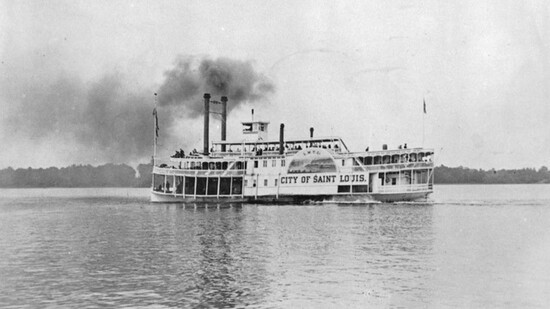
Compared to most metro communities, Lake Minnetonka boasts an unusually varied and high-end dining scene. On the surface, lakeside fine dining appears to be a modern trend. In reality, the lake has demanded the highest culinary standard for the better part of 150 years. A prime example could once be found sailing aboard the steamboat City of Saint Louis.
The City, as she was commonly known, was the second largest boat to grace the waters of Minnetonka. Built in 1881 for Minnesota Senator William Washburn, she measured 160 feet in length and 48 feet wide. For comparison, the largest boat on the lake today is Al & Alma's Bella Vista, which comes in at 83 feet—just over half the length of the City of Saint Louis.
Unlike others of her time, the City was built using Virginia white oak for her hull and mahogany throughout her cabin. Washburn spared little expense, hoping his newest ship would attract tourists for cruises across both Lower and Upper Lake. The total cost of constructing such a steamer was roughly $30,000 - $50,000. That’s about $950,000 - $1,500,000 today.
Upon her launch in June 1881, she instantly became the largest boat on the lake, boasting a capacity of 800 passengers. The City was the first "palace steamer" on Minnetonka and featured three decks, all outfitted with electric lighting. Her second deck was equipped with moving walls that could be opened during fair weather or closed against harsher conditions. Large panes of glass offered tourists the best possible views while enjoying the comfort of being indoors.
It was on this deck that the restaurant was located. Reporters from the Tourist & Sportsman visiting in 1881 wrote that she was "exquisitely finished in hard woods, with the necessary drapery, curtains, tables, etc., where meals are served. The table is always supplied with all the delicacies of the season, and at reasonable rates. The restaurant is under the charge of one of the best caterers of the Northwest, who is assisted by competent cooks and waiters." While no authors detailed the full menu aboard the City, we can make reasonable assumptions about what was served.
Passengers might have enjoyed fresh Minnetonka walleye with potatoes and vegetables. Fresh cranberries, raspberries, and strawberries grew abundantly in the surrounding area and likely made their way onto the tables. In a pre-refrigeration era, locally grown foods were a staple, and menus were somewhat dependent on the season. Preserves and desserts stretched beyond seasonal limits, with wild berry pies and fruit puddings being all the rage. A reporter from the Excelsior Weekly noted, "A fine restaurant is one of the attractions of this steamer, and dinners are served to order or at a fixed price.” While they enjoyed their meal and company, hired bands played the era’s most popular music. Waltzes, polkas, and parlor songs likely skipped along the waves surrounding the mammoth boat as she steamed across the lake.
Passengers expected more than a dinner cruise, and the crew of the City was happy to oblige. She delivered tourists from railroad stations in Excelsior and Wayzata to the grand hotels of the Upper Lake and Northern Bays. Some, such as Spring Park's Hotel Del Otero and Minnetonka Beach's Hotel Lafayette, were renowned for their elegance. Lafayette was so widely known that it even welcomed Presidents Ulysses S. Grant and Chester Arthur. During his visit, Grant wrote to his wife that the lake was "a beautiful sheet of water almost as large as Como, in Switzerland, filled with islands.”
The City of Saint Louis enjoyed a 17-year career before being dismantled in 1898. Lost with her was the most opulent steamer to have sailed Minnetonka—though one could argue that today's dinner cruisers offer comforts no 19th-century steamer could match.
No matter how you look at it, Lake Minnetonka has impressed people from all walks of life and all corners of the country. Our community's standard of excellence runs high in many regards, and the culinary tradition is no exception. So next time you're enjoying a pan-fried walleye at a lakeside restaurant, take a moment to appreciate that timeless centerpiece of the finest Minnetonka dining.
Nathan Hofer is a local author & historian who holds a deep passion for all things Lake Minnetonka. His platform, the Minnetonka Minute, connects people to their community’s past and present through engaging storytelling, responsible research, and a heavy focus on community betterment. See more at www.MinnetonkaMinute.org!