Ask a small business owner about their plan for the year, and most will describe a list of things they want to get done. More clients. A new hire. Better cash flow. Those are goals - and goals are good - but they are not a strategy. Strategy requires knowing where you stand before you decide where to go.
If you have ever asked yourself how to stop reacting to financial problems and start planning ahead, a SWOT analysis is one of the most practical places to start. It does not require a consultant or a retreat. It requires honesty, a few hours, and the right questions.
What Is a SWOT Analysis and Why Does It Matter for a Small Business?
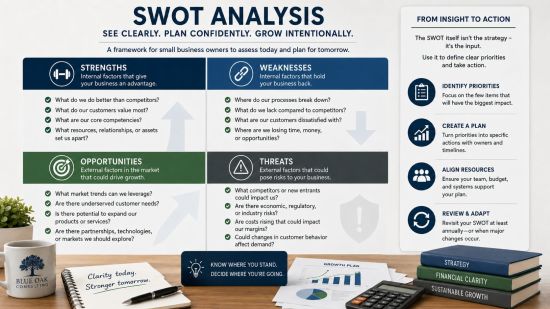
SWOT stands for Strengths, Weaknesses, Opportunities, and Threats. It is a structured way of looking at your business from two angles: what is happening inside it, and what is happening around it.
Strengths and weaknesses are internal. They describe what your business does well and where it falls short - your team, your processes, your financial health, your reputation. Opportunities and threats are external. They describe conditions in the market, your industry, or the economy that could either help or hurt your business.
The reason this matters is simple: most small business owners spend almost all of their time reacting to internal demands. A SWOT analysis pulls them out of that mode and forces a more complete view - one that includes what is changing around them, not just what is happening in front of them.
How Often Should a Small Business Do a SWOT Analysis?
Once a year is the practical answer for most businesses in the $500K to $25M range. Build it into your annual planning cycle, ideally at the time you are building your budget for the next fiscal year.
That said, certain events should trigger an off-cycle review: a key employee departure, a major new competitor entering your market, a significant shift in material or labor costs, or a serious conversation about growth or acquisition. If something material changes in your business or your market, your strategy should reflect it.
How Do You Know If Your Small Business Is Ready to Grow?
This is one of the most common questions small business owners bring to a planning conversation - and a SWOT analysis is often what surfaces the honest answer. Consider a plumbing and HVAC contractor in the DFW area generating around $3 million in annual revenue. A SWOT might look like this:
Strengths - Long-standing client relationships, a skilled field crew with low turnover, and a strong reputation for reliability in a specific service corridor.
Weaknesses - No formal job costing process, owner-dependent sales pipeline, and a back-office that runs on manual tracking rather than systems.
Opportunities - Residential construction activity in Denton and Collin counties is accelerating. Commercial maintenance contracts are underserved in the current coverage area. The owner has relationships that could support a second location.
Threats - Material costs have increased 15 percent over 18 months with no corresponding price adjustment. Two larger regional competitors are expanding into the same geography. A labor shortage is creating pressure on field capacity.
Once those four quadrants are filled in, the next question is: what do you do about it?
What Do You Do With the Results?
The SWOT itself is not the strategy - it is the input. What comes out of it should be a short list of specific priorities: where to double down, what to fix, which opportunities to pursue first, and which risks to get ahead of before they become problems.
For the contractor in the example above, the SWOT surfaces two immediate actions: fix the pricing to recover margin before the next busy season, and build a job costing process so future bids are based on real numbers. Both are on-the-business decisions that would never get made if the owner stayed buried in daily operations.
This is exactly what a fractional CFO does for a small business - translates findings into financial priorities and a plan tied to real numbers, so the owner is building toward something instead of just responding to whatever comes next.
A Final Thought
Good stewardship of a business means knowing where it stands before deciding where to take it. A SWOT analysis is not a corporate exercise. It is how a small business owner gets honest, gets clear, and builds a plan worth following.
You do not need a perfect strategy. You need an honest one.
Chris Thomas is the founder of Blue Oak Consulting, a fractional CFO firm serving small businesses across North Texas. Visit www.blueoakconsulting.net to learn more.