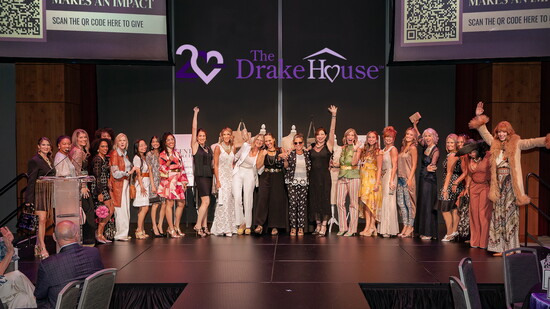
The Drake House's annual fashion show has always been more than the runway - it's a night where community comes together to help single moms and their children find stable ground.
Their two boutiques are also stocked with gently-loved treasures, designer handbags, shoes, and closet staples waiting for a second life. Bring your gently-used goodies for a donation, shop the racks while supporting moms and kids working toward a fresh start.
Nesha Mason, President of The Drake House had this to says:
"This is the largest fundraising total in The Drake House history, and it goes further than any one number can show. $207,144 raisied will fully fund 3-4 families through an entire six-month stay in our crisis housing program - housing, case management, life skills programming, and mental health support included. But what excites me most is how it impacts every family already in our care: more career coaching, more resources for our youth, more groceries and essentials through our on-campus market, more of the everyday support that turns a program into a real path forward. This total does more than increase our reach - it allows families to move further along their path to stability."
"Having an alumna share her story is something attendees look forward to every year. What made this year different is that Kirby didn't just tell her story from a microphone. She walked the runway and became part of the show itself, letting the audience see the shift in her confidence rather than hear about it. It was something to celebrate. Standing in that light means something enormous to a woman who once lived with the uncertainty of being a single mother with no place to live. That's the resilience I see in so many of our moms. They don't just move through this program, they carry each other through it. Kirby is part of a growing community of former residents staying connected through our alumni network, Professional Women's Career Network (PWCN). Recently, at our Pillar Awards, celebrating families' progress across all five pillars on the path to stability, Kirby spoke directly to current residents, giving them proof of what's possible on the other side of this program."
Sharing her story as keynote speaker Kirby Gavatt, founder of The Trich To Stop - a nonprofit supporting people living with Trichotillomania, the hair-pulling disorder - returned to inspire the next group of women to do the same.
For Gavatt, Drake House wasn't just temporary housing. "At the time, Drake House meant relief," she says. "It meant I had support, I didn't have to worry about where I was going to lay my head while I strategically came up with a game plan. That gave me room to breathe and think clearly about my next steps." Coming back this year as keynote speaker felt like closing a loop. "It's proof that I took advantage of the tools and assistance Drake House extended to me, not just while I was in the housing program, but even after I left."
Looking out at a room full of women navigating the same uncertainty she once faced, Gavatt's message was simple: there's no shame in needing help. "I wanted them to know they are worthy of help and assistance," she says. "Going through a challenging time and seeking out help isn't something to be ashamed of. It's commendable." She encouraged the crowd to keep leaning into the community support around them, "because that support can carry you further than you realize."
Gavatt's own path to founding The Trich To Stop started long before she had the language for what she was experiencing. Her hair-pulling began in second grade when trichotillomania was barely understood, and not talked about. "I had to give grace to the people who didn't understand it," she recalls. "I became my own best friend." Watching people with other disorders and disabilities receive care and compassion she wasn't getting made her determined to change that through social media, sharing her story and creating space for others to do the same. "Many were hiding from the world, carrying an extreme amount of shame that stunted them. I didn't like it, and I refused to let that continue to be our narrative." She also noticed a lack of representation within the community. "I didn't see many people who looked like me representing this condition. So I wanted to change the narrative, on many different fronts."
Building a nonprofit with no formal background, Gavatt says, wasn't so different from what Drake House residents are doing right now. "I used whatever resources were available to me, every little thing," she says. Her advice to residents starting over: use everything Drake House provides. She also points to something less obvious - reciprocity. "I offered something I had in abundance, or a service that didn't cost me too much time or energy... It wasn't about taking. It was about exchange." Her takeaway: "Building something from nothing starts with recognizing you already have more to work with than you think."
If there's one thing Gavatt wishes someone had told her, it's this: "What matters most is what you do with the season of challenge you're in. Turn that challenge into passion, and turn that passion into something productive." She reminded the audience that hardship, once survived, often becomes the very thing that equips you to help someone else. "Every challenging season is a learning experience. And once you've made it through, if the opportunity presents itself, you can turn around and help someone else with the wisdom and experience you gained."
For Drake House, she encourages the community to keep donating, volunteering, and spreading the word "so more women in need can find their way there like I did." For The Trich To Stop, she says awareness matters just as much as funding - follow on social media, visit www.thetrichtostop.org, or connect her with schools and organizations for speaking engagements. "Every dollar helps, but so does every share, every conversation, and every introduction."
As Gavatt puts it, Drake House and The Trich To Stop are doing work that changes lives in different but connected ways — "one gives people stability, and the other gives people understanding." And a community willing to show up for both, at every stage of someone's healing, is one truly investing in lasting change.