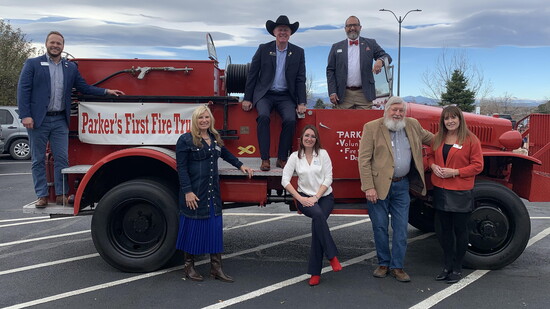
As Parker looks toward the future, local leaders are emphasizing the value of its roots. “Preserving local history should be important to everyone,” says Jan Truskolaski, President of Parker History, outlining the organization’s commitment to guiding the town as it navigates the future.
As Parker expands, staying true to its heritage with every new business and neighborhood fuels a sense of community, loyalty, and gratitude. It’s a town rich in history and diversity that drives forward, while keeping a sharp eye on where it all started.
Catherine Traffis, Vice President of Parker History, explains, “The Arapaho, Ute, and Cheyenne nations were all part of this area. At the bottom of Rueter-Hess Reservoir, when they were excavating that, they actually found settlements up to 9000 years old.”
She continues, “There’s been some major archaeological discoveries around this area showing how people lived in those times and how there were animal tracks that became Native American trails, and they’re the same road systems that we use today in many ways. Those road systems ended up being used by people coming out to Colorado in the time of the Gold Rush, in the late 1850s.”
Along with the chance at stumbling upon a gold mine, many homesteaders came west seeking relief from tuberculosis, which had no cure at the time.
“The O’Brien family were homesteaders out here,” Catherine says. “They actually took over a plot of land that was at approximately Stroh and Parker Road. They took over a business…We call it the Twin Houses. They’re not there anymore, unfortunately, and it was part of a tuberculosis sanatorium called the Ponce de Leon Chalybeate Springs.”
The medicinal spring that stood there led people to the area in search of drier air, hoping to find relief from the bacterial mucus in their lungs.
“Pioneers after the Civil War had many reasons for coming here,” Jan adds. “They came for gold. They came for air. They came to homestead.”
The Homestead Act of 1862, signed into law by Abraham Lincoln, drove many people out west in the hopes of owning the promised 160 acres, after settling and farming it for five years.
“So originally, a lot of the neighbors who would have been in early Parker were very far apart,” Catherine inputs.
Parker, originally named Pine Grove, had a stagecoach stop at 20 Mile House, which is considered one of the first things that built the town. It was owned by several families, but significantly by James Sample Parker, a Civil War veteran and bullwhacker.
“He decided to make this 20 Mile House, which is 20 miles from Denver, and there are several stagecoach stops along that trail,” Catherine says. “We have a small remnant on west Mainstreet of the 20 Mile House remaining today, and the 17 Mile House stage stop is completely intact.”
A beautiful nod to Colorado's history dating back to the 1860s, locals take advantage of the picturesque 17 Mile House on Parker Road for photo opportunities.
After the railroad was built in the late 1800s, the area was a bustling hotspot until the Flood of 1935, when the deteriorating rail beds and trestles were washed away. The railroad was never rebuilt, but cars took over, keeping the location flourishing despite the loss.
The town of Parker was legally incorporated in 1981. Jan explains, “There were about 600 families here.”
While there was no police or fire department or town council at that time, it was incorporated. Unfortunately, not much is known about how it all began. With the town turning 45 this year, there is more demand to understand how the town got its start after its incorporation.
“In five years, we’ll be opening the time capsule that sits in O’Brien Park in a monument to the 20 Mile House,” Catherine says with delight. “It is a lovely monument if you take a closer look; it is faced with petrified wood, which is technically known as Parker Wood. It’s a very specific kind of petrified wood.”
With so much wonderful history to explore and uncover, Shanna Schmidt, a local REALTOR and member of The Parker Insiders, is leading the charge on a short docuseries about Parker’s history.
“I’m trying to figure out what is most important to preserve, while also uncovering some of those special stories and details people may have never heard,” Shanna explains. In doing this, Shanna is seeking out residents who have been in the Parker area for 50 or 60 years, especially business owners, to incorporate their stories into the feature.
With Jan and Catherine helping to lead the revitalization of Parker's Heritage Center Museum located on the main floor of the Schoolhouse on Mainstreet, Shanna hopes to gift the docuseries to the museum after it airs.
“Our long-term goal is for The Parker Legacy Project to start with our history, then continue documenting what is happening today because today is tomorrow's history,” Shanna shares.
With the museum upgrade and the docuseries on the horizon, there’s a sense of gratitude for where Parker has been, where it’s going, and what sets it apart.
“There’s a central identity to preserve,” Catherine adds. “That’s the ball that Jan and I and our other board members and volunteers try not to drop…to maintain that sense of place for everyone; no generation can drop the ball.”
As each generation continues to preserve their piece of the town, it’s the gratitude for Parker’s founders and how they built with kindness and generosity that sets Parker apart.
Catherine finishes with, “Mr. Parker himself was a county commissioner, and you know, just very much on the ground floor. He and his brother, George, were very generous people. They gave land and money to build churches...you know, more prosperity for other people. It’s a real American dream story.”
“It’s important to acknowledge that there’s an indigenous history here."
“Parker was a town before it became a suburb, and I think that's important. There is an independent culture and identity here that makes it feel different from another addition to the greater metro area.”