If you’re looking for a summer getaway from the mean streets of Northern New Jersey, we have an idea for you that you might not have thought about. But maybe you should.
Rovinj is found in the region of Istria in Croatia. It is the heart-shaped peninsula in Croatia's far northwest — closer to Venice than to Dubrovnik, geographically and culturally. It's where menus arrive in two languages and the olive oil rivals Italy's. As a native Croatian - speaking the language, being a citizen and having lived there every summer growing up - I’ve experienced different parts of Croatia in many ways and I’m excited to share some hidden gems. No gatekeeping!
Touching Down: Pula, the Prelude
Rovinj sits just north of Pula, Istria’s largest city. Getting to Pula from any NY area airport is straightforward, with connecting flights running through major European cities like Zurich and Frankfurt.
Upon your arrival in Pula, you can either stay there for a couple of days and explore (what I consider) the “Rome of Croatia”, or do the quick 40-minute drive over to Rovinj the same day. The drive is stunning and worth doing in daylight as the road threads through olive groves and vineyards with the flash of the Adriatic between the trees. There's a regular local bus if you don't want to rent a car, and taxis run the route comfortably for around €50.
A couple of days in Pula is a happy precursor of what’s to come. Two nights is the sweet spot. Pula is a legitimate port city, built around a 1st-century Roman amphitheater (imagine the Colosseum in Rome) that locals walk past every day. This historic amphitheater is still an active spot, known for hosting amazing concerts in the summer.
Where Rovinj is composed and picture-perfect, Pula has a quieter sophistication — less curated, more authentic, layered, and alive — and that subtle contrast makes it the perfect prelude to Rovinj.
Arriving in Rovinj: A Slice of Heaven
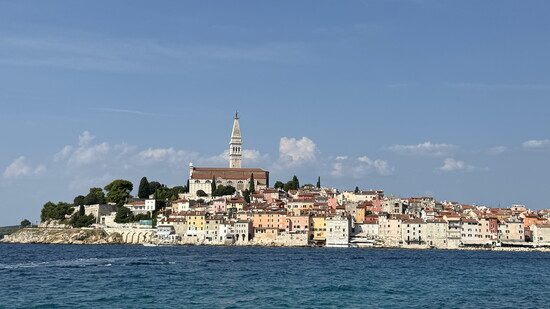
Perched on a small peninsula reaching into the Adriatic, Rovinj is a cascade of stone houses spilling down toward the water, all crowned by a bell tower borrowed straight from St. Mark's Square in Venice.
The lanes of the island-turned-peninsula are barely wide enough for two people to pass, houses lean into each other for support, and laundry is strung between windows like signal flags. No cars. No chain stores. Just stone, sea, and sun.
Rovinj isn't a place for agendas or strict itineraries — it's a place to wander leisurely and savor at your own pace. Grisia Street is the spine of the old town, where local artists hang their paintings directly on the walls of the houses, turning the whole lane into an open-air gallery. Wander down to the rocks below the town walls, where iron ladders are bolted straight into the stone and people of all ages dive off into the Adriatic. The water is so clear it doesn't look real. And once you swim in it, nothing else quite compares.
Just like in Pula, the street signs are bilingual — but here it feels like more than a nod to Italian history. It's an intentional preservation of Istrian culture with that blend of Italy and Croatia. Linger in any café and you'll hear Italian, Croatian, and a Venetian dialect that's been spoken here for centuries!
The dining is where Rovinj quietly shows off. Fine-dining restaurants and family-run konobas tucked into stone courtyards both lean on whatever came in fresh on the morning boats — scampi from the bay, sea bass, and octopus. For the most soulful experience, the konobas are the move. Often there is a nonna somewhere cooking in the back. Look for seafood risotto inked black with cuttlefish, fuži with local truffles, and pljukanci with shrimp — local staples that turn up on the best menus.
Three days in Rovinj is the minimum — enough to wander the old town, eat properly, swim off the rocks, and soak in a few unforgettable sunsets. A full week lets you stop counting and start living there for a while. By day four you'll have a favorite konoba. By day six you'll already be plotting your return.
The Stay: Grand Park Hotel
I'm usually suspicious of hotels that collect a lot of stars and a lot of press. They tend to be either soulless or too corporate to have any real character. The Grand Park Hotel Rovinj is somehow neither. It sits directly across the marina from the old town, tucked into a slope of Mediterranean pines. You almost have to look twice to find it. The location is the whole magic: every room looks straight at the old town skyline, and the daily sunsets from the balcony (or anywhere in the hotel) had me wondering if this is what heaven looks like.
The design is open and warm, all-natural wood and soft light, nothing forced, nothing performed — just genuine Croatian hospitality with a luxurious touch. The three pools are the real deal, each one overlooking that dreamy old-town skyline. Breakfast is worth getting up for every single day: local cheeses, silky Istrian prosciutto, fresh figs, eggs cooked exactly how you like them. The old town is a charming 15-minute stroll along the harbor, or you can borrow one of the hotel's bikes! The best perk of all? The hotel's luxury speedboat to St. Katarina Island for a beach day — the ride over, with its 360-degree views of Rovinj, is half the fun, and the beaches on the other end are pure bliss.
Istria is the rare destination that delivers more than it promises. Rovinj will take your breath away. It is a place so beautiful, you'll keep looking up from your kava just to confirm it's real.