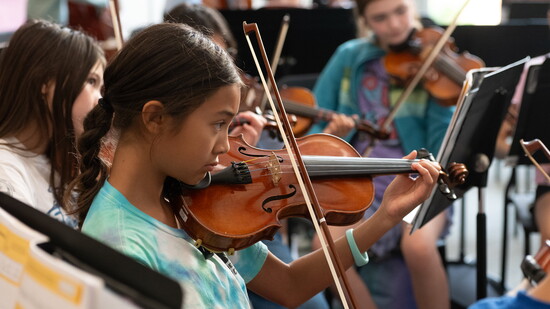
For Sarah Hart, music education has never been solely about performance. It is about cultivating attentiveness, empathy, discipline, vulnerability, and connection — qualities that shape students far beyond the orchestra room.
In her essay The Arts: Safeguarding Our Humanity, Hart reflects on a quiet moment following a rehearsal of Scarborough Fair with her sixth-grade orchestra students. After the final note faded, one student paused and softly asked, “Ms. Hart — that was really beautiful — wasn’t it?”
For Hart, moments like that reveal the deeper purpose of arts education. In a world increasingly driven by measurable outcomes, she believes the arts teach students something equally important: how to listen, feel, reflect, and care for one another.
That philosophy is clearly reflected in the voices of her students.
One student shared that orchestra helped them understand there is not always one “right” solution to a problem. By learning the viola, the student discovered different ways of thinking and approaching challenges — much like finding multiple paths through a math problem.
Others spoke about the profound sense of community created through music.
“Being a part of orchestra has taught me not only how to create beautiful music, but also how to be a part of something bigger than me,” one student reflected.
Another described the orchestra program as “almost like a huge extended family,” while others repeatedly used words such as welcoming, supportive, connected, and meaningful.
Many students connected music directly to emotional growth and human understanding.
“Through orchestra, I’ve learned to listen more to others and to truly understand how meaningful music is,” one student wrote.
Another student reflected, “You aren’t just playing your own part; you are entirely focused on contributing to something bigger than yourself.”
Several students emphasized that orchestra teaches resilience and vulnerability alongside technical skill. One student explained that performing music helps young musicians push past self-doubt and understand that mistakes are opportunities for growth supported by teammates and section members.
Others reflected on the broader life lessons gained through rehearsals and performances: accountability, focus, teamwork, leadership, perseverance, and confidence. “Music gives players a sense of enrichment and fulfillment seldom found anywhere else,” one student wrote. “When I play music, I feel complete.”
Together, the students’ reflections reveal something powerful about Hart’s approach to teaching. The program’s success is not rooted solely in technical excellence, but in creating an environment where students feel seen, connected, challenged, and inspired. The music becomes both the vehicle and the outcome — a way for students to develop musicianship, empathy, trust, self-expression, and belonging.
Hart believes these moments of attentiveness and beauty are essential in modern education because they help students remain deeply human in an increasingly hurried world. Judging from the students’ words, those lessons are resonating far beyond the classroom.
Recently, students from Islander Middle School received an invitation to perform at the prestigious American String Teachers Association National Orchestra Festival 2027, taking place February 24–27 in Chicago. The invitation recognizes not only the orchestra program’s musical excellence, but also the culture of connection, purpose, and shared humanity being cultivated inside the classroom every day.
Perhaps that is the true meaning behind the pause after the final note — the moment when students stop long enough to hear not only the music, but each other.