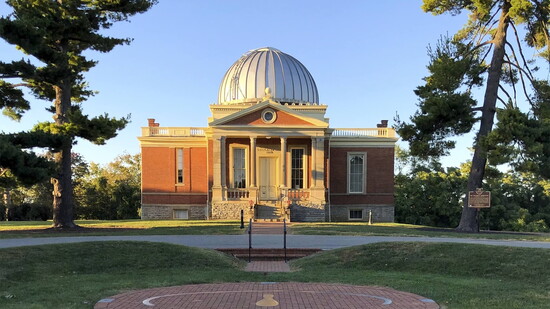
“Most people don't realize the pivotal role that our city played in the development of astronomical research in the United States,” Dr. Wes Ryle of the Cincinnati Observatory shares. “When our Merz & Mahler telescope was first used in 1845, it was one of the largest telescopes in the world and the first professional research observatory in the country. Even more impressive, the funds for the telescope and observatory were crowdsourced from the citizens of Cincinnati, fueled by an interest in astronomy generated by our founder Ormsby Macknight Mitchel through his engaging public lectures.”
Today, the very same telescope–manufactured in Munich, Germany–is in use for almost all of the organization’s programming.
Ryle, who was born and raised in Northern Kentucky, has always considered Cincinnati a hometown.
“Like many kids, I grew up with an interest in space and dinosaurs,” he says. “The love for space just never went away.”
By the time of the Civil War, Ryle explains, coal smoke from downtown factories made astronomical observations difficult—so much so, that the second director of the Observatory, Cleveland Abbe, focused instead on developing methods for weather forecasting, eventually leaving to help found what would become the National Weather Service.
In 1873 the telescope was moved to rural (at the time) Hyde Park/Mt. Lookout, with its main building designed by famous Cincinnati architect Samuel Hannaford.
“Over the subsequent decades, the observatory continued to function as a research facility and upgraded to a larger Alvan Clark & Sons refracting telescope in 1904, moving the historic Merz & Mahler to a newer, smaller building,” Ryle says. “The observatory also became the official timekeeper for the city of Cincinnati, utilizing the motion of the stars to provide the most precise measurement of time available. Today, the historic observatory's mission focuses on preservation of its unique buildings and instruments while also providing science outreach and education services to the community.”
Ryle notes a few events taking place later this year, which may be of interest to any amateur stargazers.
“An almost total lunar eclipse will be visible from our area beginning the evening of August 27 and running past midnight,” he says. “Viewers need only find the Moon in the sky with their naked eye to watch the eclipse unfold over the course of a few hours, with the Moon turning a ruddy red color midway through the eclipse.
“It's also a good year for multiple meteor showers,” Ryle adds, “with relatively little interference from the Moon to ruin our view. Prominent showers include the Perseids in mid-August, the Leonids in mid-November and the Geminids in mid-December.”
Ryle points out that the Cincinnati Observatory is funded through a combination of memberships and individual donations, grants and revenue from public programming.
“At the observatory,” he says, “we believe science should be accessible to everyone. Grant support helps fund educational field trips and outreach to thousands of students every year, focusing on underserved students.”
Over the years, the observatory has made a focused effort to diversify its programming to appeal to a wide variety of audiences, Ryle explains.
“We typically have three or four onsite programs per week and all will include viewing through our historic telescopes if the weather cooperates. Family Astronomy Night and Interstellar Adventures are good choices that involve fun crafts or activities for kids. Adults may be interested in our Adult Astronaut Academy, Observatory After Hours or Late Night Date Night programs,” he suggests. “We're also branching out into the community, including monthly programming at Madtree Brewing in Oakley featuring our inflatable planetarium on the last Thursdays of the month through October.”
Cincinnati Observatory | 3489 Observatory Pl., Cincinnati | 513.321.5186 | info@cincinnatiobservatory.org | CincinnatiObservatory.org
“The observatory became the official timekeeper for the city of Cincinnati, utilizing the motion of the stars to provide the most precise measurement of time available." -Dr. Wes Ryle, Cincinnati Observatory Astronomer