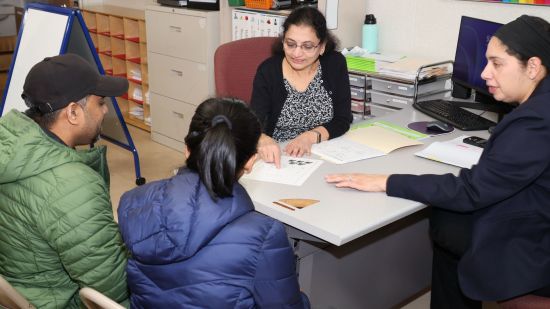
The most successful students rarely get there alone. Behind them, almost always, is a school that didn't just teach their child — it partnered with their family.
It's a distinction worth examining. When schools speak of "parental involvement," they typically mean attendance at back-to-school nights, appearances at fundraisers, a seat at the parent-teacher conference table twice a year. These things have their place. But education research is making something increasingly clear: involvement and engagement are not the same thing. And the gap between them is where student potential is either realized or quietly left on the table.
The Research Is Unambiguous
A landmark randomized controlled trial from Harvard University — the gold standard in education research — found that students whose families received consistent, meaningful communication from teachers demonstrated significantly higher homework completion, stronger classroom participation, and fewer behavioral challenges. Not marginally higher. Significantly.
Separate research from the Northwest Evaluation Association deepens the picture. True family engagement requires schools to treat parents not as an audience, but as equal partners in educational decisions. It demands an honest reckoning with the barriers many families face — work schedules, language differences, systemic constraints — that outdated school models have long failed to address. The families who are most engaged are not necessarily the most available. They are the ones whose schools made genuine partnership possible.
What True Partnership Actually Looks Like
It looks like a teacher who can tell you not just what grade your child received, but how she thinks — where her curiosity lives, where her confidence wavers, and what approach unlocks her best work. It looks like goal-setting that happens with families, not at them. It looks like information moving in both directions, with schools genuinely learning from parents rather than simply reporting to them.
This quality of partnership doesn't emerge from good intentions alone. It requires structure. It requires capacity. It requires teachers who are not stretched so thin that every family becomes a number on a roster.
The Cedar Hill Prep Difference
At Cedar Hill Preparatory School in Somerset, NJ, class sizes of 15 students make this quality of engagement not just aspirational — but standard. Teachers here don't simply know their students' names. They understand how each child learns, what drives them, what challenges them, and how to build a genuinely effective partnership with each family behind them.
"Dr. Nan, our Head of School, is incredibly accessible — something you rarely find in other schools. She gives students early exposure to high school and career pathways through programs like Debate, STEM, and Future City. Even after graduating and attending some of the top private high schools in and out of state, students return to ask her for guidance on college counseling. That speaks volumes about the relationships built here. CHP's warm and nurturing environment truly focuses on the whole child." — Anjalee Patel, Guidance Counselor & CHP Parent
The school's International Baccalaureate framework is designed around precisely this philosophy — that education is not something done to a child, but something built in collaboration between school and home. Small class sizes give teachers the time and the bandwidth to maintain the kind of frequent, substantive communication that research consistently links to better outcomes. Not just academically. In confidence, engagement, and a child's belief in their own potential.
The Questions Every Discerning Parent Should Ask
When evaluating a school, move past the brochure. Ask how teachers communicate about your child's learning — and whether the answer extends beyond quarterly report cards. Ask how class size enables genuine individual attention. Ask whether families participate in setting learning goals, or are simply informed of outcomes after the fact. Ask what the school does, structurally, to make two-way communication not just possible but habitual.
The answers will reveal whether a school truly treats families as partners — or simply performs that belief in its marketing materials.
The Bottom Line
The most forward-thinking schools understand something fundamental: a child's education does not begin and end at the classroom door. It is shaped, every day, by the quality of the relationship between school and home. Family engagement is not a feel-good initiative. It is a research-backed strategy that measurably changes outcomes — and it flourishes only where the right conditions exist.
Seek out those conditions. Ask the hard questions. Because the difference between a school that involves parents and one that genuinely partners with them isn't cosmetic — it is the difference between a child who is taught and a child who is truly supported.
Cedar Hill Preparatory School is an IB Candidate School for Preschool–8 families across Somerset County, NJ — including Bridgewater, Hillsborough, and Montgomery Township. We'd love to meet your family. Visit cedarhillprepschool.com or email admissions@cedarhillprep.com to inquire about the CHP experience.