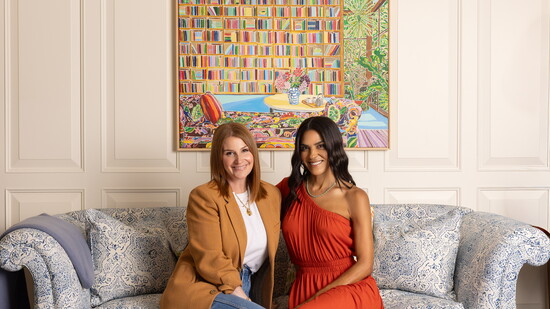
Before This Is About Humanity became a humanitarian organization with a powerful network of supporters, annual events and impact projects reaching families on both sides of the U.S.-Mexico border, it began with something much simpler: two mothers, a DM and a desire to help.
In 2018, as images of family separations dominated headlines, Zoe Winkler Reinis and Elsa Marie Collins found themselves asking the same question: "What can we do?" For Zoe, the answer began with a video she couldn't stop thinking about. "I saw my kids in those kids and myself in those moms," she says. "The images completely haunted me." At the same time, Elsa, who grew up in Tijuana crossing the border daily for school, was quietly trying to verify where donations from friends would should go to actually reach them. The two women had crossed paths around Brentwood for years, seeing one another at SoulCycle, local restaurants and through mutual friends. But they weren't close.
Then, Zoe saw one of Elsa's posts on Instagram and sent a direct message. “Whatever you're doing, I want to help,” she said. “I told her, ‘I'm just taking donations and putting them in my car,’” Elsa recalls with a laugh. Neither woman imagined what would happen next. What began as a small donation drive quickly filled a large U-Haul. Then came a volunteer bus trip. Then another. Eight years later, that grassroots effort has grown into This Is About Humanity, an organization that has mobilized thousands of volunteers, provided emergency relief to families on both sides of the border, served millions of meals and built a devoted community of supporters—all while remaining rooted in the same values that brought its founders together in the first place: compassion, dignity and a belief in showing up for others.
Zoe and Elsa arrived at the work from very different backgrounds. Zoe is LA-born and raised, the daughter of iconic actor Henry Winkler and his beloved wife, Stacey Winkler. Though she spent most of her childhood in Toluca Lake while her father filmed Happy Days, she has always had strong Brentwood ties and her parents moved to their current home Brentwood Park nearly 30 years ago. “I've been going to the Country Mart since I was born, basically,” she says. “People think Los Angeles doesn't have community, but Brentwood absolutely does.” Her mother grew up on Oceano Avenue, her husband, Rob Reinis—co-founder of Valle Reinis Builders—is also from Brentwood and today she is raising three sons here herself. Before founding a nonprofit, she spent years as a preschool teacher, including a decade at Circle of Children on Montana Avenue. “I've always been around families and kids,” she says. “I think that's part of why this resonated with me so deeply.”
Elsa's story began a world away. Raised in Tijuana, she crossed the border daily to attend school in San Diego before returning to Mexico for part of her education. “My mom wanted us to be bilingual, bicultural and biliterate,” she says. “At the time I didn't appreciate it. Now I realize what a gift it was.” While attending Stanford University, she met her future husband, former NBA player and coach Jarron Collins. The couple eventually settled in Los Angeles, first living in Brentwood before purchasing a home nearby in Westwood Hills, where they have raised their three children for more than two decades. “I used to think I could never live in Los Angeles,” Elsa says. “Now I don't know if I could live anywhere else.”
The Collins family also has deep LA roots. Jarron and his twin brother, Jason Collins, grew up in Granada Hills, and became basketball stars at Harvard-Westlake before both going on to successful NBA careers. Jason, who sadly passed away in May from glioblastoma, left a lasting legacy both on and off the court, using his platform to create a more inclusive future in professional sports. “Everywhere we go, people have a story about Jason,” Elsa says. “That's the kind of impact he had—not just in sports, but in people's lives.”
Though their paths were very different, both women shared a deep appreciation for family, community and service—values that would ultimately become the foundation of This Is About Humanity. At the start, Elsa and her sister, Yolanda Selene Walther-Meade—who lives in San Diego and serves as the nonprofit's third co-founder—began collecting supplies for families affected by separations at the border. When Zoe joined the effort, they expected to gather a handful of boxes. Instead, donations poured in, enough to fill a 25-foot U-Haul. A friend lent them the truck. Another connection secured a bus. What followed was the first of dozens of trips to the border and the beginning of an organization that would grow far beyond anything they had imagined.
“We thought we were just dropping off donations,” Elsa says. “Then we realized people wanted to keep learning and stay involved.” The first trip took volunteers to San Diego, where they met with families, advocates and community leaders. On the ride home, participants immediately began asking when the next trip would be. Over the next several years, This Is About Humanity organized approximately 50 educational and service trips to San Diego and Tijuana. The experiences allowed participants to hear directly from families and gain a deeper understanding of the challenges they faced. The bus rides—departing Los Angeles before dawn and often filled to capacity—became a community unto themselves. “It almost felt like camp,” Zoe says. “Everyone would introduce themselves and share why they were there. Strangers became friends.”
The organization's name emerged during those early days as well. Shortly before one of the first trips, Elsa attended a demonstration in El Paso and made a sign that read: "This Is About Humanity." Their friend, activist Mandana Dayani, suggested they use this as the name for their growing movement. "It was about who we are as people," Elsa says. That philosophy remains central to the organization today. "We're here to say, let's treat human beings like human beings," Zoe says.
Over the years, the organization has evolved far beyond those first bus trips. One of its largest initiatives today is a community kitchen in Tijuana. When World Central Kitchen prepared to close an existing operation, This Is About Humanity partnered with Fundación Tijuana Sin Hambre to keep it running. “We feed 3,100 people a day,” Zoe says. “More than a million people a year.” The organization has also responded to crises closer to home. Following the Los Angeles wildfires, This Is About Humanity raised more than half a million dollars for people who often fall outside traditional aid programs, including day laborers, restaurant workers, nannies and service workers. More recently, it has organized grocery distributions for families facing hardship and uncertainty. “We just keep showing up,” Elsa says.
For both founders, however, the impact is measured less by statistics than by relationships. Zoe is now the legal sponsor of a family she first met through the organization years ago, including a young girl named Zoe. “Their rent has been completely paid for three years,” she says. “They're family to me now.” For Elsa, one of those stories belongs to a young man who arrived in the United States as an unaccompanied teenager, eventually graduated from UC Berkeley and now works helping other immigrant families navigate the same challenges he once faced. “He's a great example of the kind of person we want in this country,” Elsa says. “Someone you would want as a neighbor.”
That spirit of community is on full display during This Is About Humanity's annual fundraising event, which is now in its 8th year and takes place at a residence in Brentwood on August 29th. “It's the antithesis of what you think of when you think of a gala,” Elsa says. The event began as a small dinner attended by roughly 30 guests. Today, hundreds of supporters gather for what feels more like an elevated backyard food festival than a formal fundraiser. This year's event will feature Michelin-starred Mexican chef Javier Plascencia, along with chef Ray Garcia, who participated in those earliest dinners, as well as many more. Guests can expect exceptional food, meaningful storytelling and a celebration of the volunteers, donors and community members who have helped sustain the mission.
Past honorees have included Nate Berkus and Jeremiah Brent, Lauren Sánchez and Phil and Lily Rosenthal. Supporters over the years have included everyone from Kim Kardashian and Jeff Bezos to countless local families who quietly contribute their time and resources. For the founders, however, the event is never about celebrity. “We have the most incredible volunteers and community, and we wouldn't be able to do what we do without them,” Zoe says. That lesson is already being passed to the next generation. Zoe's son raised more than $50,000 for the organization through a bar mitzvah philanthropy project. He also hopes to become a chef, and cooks alongside Plascencia at the gala. Elsa's children have grown up volunteering at events and helping wherever needed.
Eight years after that first Instagram message, the mission remains remarkably simple: show up, help where you can and never lose sight of the people at the center of the story. Or, as Zoe puts it, “We are just a group of moms supporting families.”
This is About Humanity Anniversary Gala
August 29th
Private Residence, Brentwood
thisisabouthumanity.com