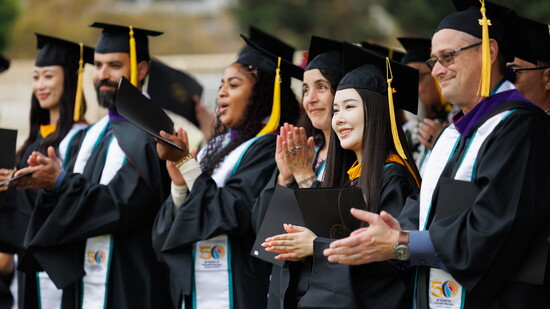
There is a university in Palo Alto where gratitude is worth three credits.
The course sits in Sofia University's doctoral catalog: Positive Psychology, Gratitude, Compassion, and Forgiveness. Students trace how gratitude and compassion function across a course of therapy, then apply the same material to their own lives. It carries the same three credits as the program's research methods courses.
Sofia was founded in 1975 by Robert Frager, working with James Fadiman. The idea took shape in a small office at UC Santa Cruz. The first campus was the bottom floor of a house, with a living room where classes met, a kitchen, a bathroom, and a hot tub. They called it the California Institute of Transpersonal Psychology. The premise fit inside one sentence: learning should engage more than the intellect.
The school has moved and been renamed since. It was in Menlo Park by the mid-1980s, became the Institute of Transpersonal Psychology in 1986, then Sofia University in 2012. It has been accredited by the Western Association of Schools and Colleges since 1998. A second campus opened in Costa Mesa in 2019.
Ask what the school means by "mind, body, spirit, heart," and the answer comes back concrete. Learning, Sofia says, should be more than acquiring information or preparing for a career. It should connect to who a student is and what they want to contribute to the world. The ordinary academic measures still apply on top of all of it. "Those things are important at Sofia as well," the university says. "But we add another dimension."
That dimension changes shape by discipline. A psychology student sits with self-awareness alongside theories of human development. A business student weighs how a leadership decision lands on people and culture, not just the bottom line. A computer science student weighs a technology's ethics alongside its engineering. The purpose is unhedged: Sofia wants graduates who are "more conscious, compassionate, and purposeful contributors to the world." Unlike a placement rate, that is not a claim anyone can audit.
The catalog is wider than the psychology it started with — an MBA and doctorate in business, a master's in computer science, certificates in artificial intelligence, machine learning, and cybersecurity, plus dream studies and transpersonal ecopsychology. Still, the university is careful about what the expansion means. "We are not trying to make every discipline psychology," it says. "We are bringing a whole-person perspective to each discipline."
Students run from about twenty-three to past sixty. Many are working professionals after a credential or a change of field; many are international. Sofia's pitch: a large institution can leave a person feeling like one among thousands, and a school this size lets classes stay small enough for faculty to learn their names.
Dr. Carol Humphreys’ path to Sofia was shaped by years of leadership in higher education. She became president in July 2023, after two years as provost, and spent seven years before that in senior administration at Saybrook University. Before higher education, she worked as a psychologist in a forensic hospital and as a social worker with trauma survivors. She holds a doctorate in clinical psychology from Miami University and dual bachelor's degrees from Cal State Dominguez Hills. She started at Cypress Community College, a single mother raising two children while working days and studying nights.
The campus itself is part of the pitch. It sits a short drive from the companies building the artificial intelligence its own certificates now teach. Sofia frames that location as an advantage: the same industries reshaping how people work need people who can weigh the ethics and human impact of what they're building. Silicon Valley has no shortage of people capable of building the technology. What Sofia offers is education that encourages students to consider not only what can be created, but why it matters and whom it serves.
To learn more about Sofia University and its programs, visit www.sofia.edu.
“We are not trying to make every discipline psychology. We are bringing a whole-person perspective to each discipline.”