You've decided it's time to get your finances under control. Good. That decision alone puts you ahead of most people.
Now you're asking the question everyone asks next: Do I need a financial coach or a financial advisor?
The answer matters — because hiring the wrong one is like calling a personal trainer when you need a doctor. Both work with your health. Neither is a substitute for the other.
Here's the honest breakdown.
What Is a Financial Advisor?
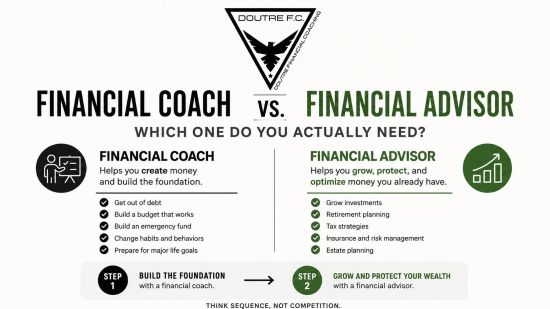
A financial advisor is a licensed professional who manages, grows, and protects money you already have. They handle investments, retirement accounts, insurance products, estate planning, and tax strategies.
Most financial advisors work on a commission or fee-based model — they earn money when you invest money with them or buy products through them.
The key word: they work with money you already have.
If you walk into a financial advisor's office with $70,000 in debt, a negative monthly cash flow, and no savings — most of them can't actually help you. Not because they're bad at their job. Because that's not their job.
What Financial Advisors Are Best For:
Growing a retirement portfolio (401k, IRA, index funds)
Estate planning and wealth transfer
Insurance and risk management
Tax-advantaged investment strategies
Managing assets of $100,000 or more
What Is a Financial Coach?
A financial coach works with you where you are right now — debt, bad habits, zero savings, financial stress, and all.
A coach's job is behavior change. Most financial problems aren't knowledge problems. People know they shouldn't spend $600 a month eating out. They do it anyway. A coach identifies why that's happening and builds a system to stop it.
Financial coaches help you:
Build and stick to a working budget
Create a debt payoff plan
Understand your cash flow
Break the emotional patterns driving poor money decisions
Build the foundation needed before investing makes sense
As a Certified Ramsey Coach, my work is built on a proven, step-by-step system — but adapted to where each individual client actually is. No cookie-cutter plans.
What Financial Coaches Are Best For:
Getting out of debt
Learning to budget for the first time
Building an emergency fund
Changing financial habits and behaviors
Preparing financially to buy a home
Managing major life events (divorce, career change, inheritance)
The Core Difference: Behavior vs. Portfolio
Here's the simplest way to think about it:
A financial advisor optimizes the money you have. A financial coach helps you create money to have.
If you're spending more than you make, carrying consumer debt, or living paycheck to paycheck, no investment strategy in the world will fix that. You need to close the cash flow gap first.
Once your debt is paid down, your budget is working, and you've built 3–6 months of savings, that's when a financial advisor becomes the right next move.
Think of it as a sequence, not a competition.
Who Needs a Financial Coach First?
You likely need a financial coach before a financial advisor if:
You carry more than $10,000 in consumer debt (credit cards, personal loans, student loans)
You don't have a written monthly budget
You're living paycheck to paycheck regardless of your income
You've tried budgeting before, and it never sticks
You're going through a major life change: divorce, job loss, home purchase, career transition
Your monthly expenses regularly exceed your monthly income
You feel anxious, overwhelmed, or avoidant about your finances
According to the Federal Reserve, nearly 40% of Americans couldn't cover a $400 emergency expense without borrowing. That's not an investment problem. That's a cash flow and behavior problem — which is exactly what coaching addresses.
Who Needs a Financial Advisor First?
You're ready for a financial advisor if:
You have little to no consumer debt
You have 3–6 months of expenses saved
You have disposable income you want to grow
You're approaching retirement and need portfolio management
You have significant assets (property, business equity, inheritance) to protect
If that's you, great. A fee-only fiduciary advisor is typically the best starting point.
If it's not, start with coaching.
What About the Income Question?
This comes up constantly: "Is financial coaching worth it if I don't make a lot of money?"
Yes, arguably more so.
When income is tight, every dollar has to work harder. Wasted spending, high-interest debt, and no financial plan hit lower-income earners disproportionately hard. Coaching helps you find the money you already have and redirect it strategically.
At Doutre Financial Coaching, I work with clients across a wide income range: from households earning $20,000 a year to those earning $100,000. The strategies differ. The need for a clear plan doesn't.
A Note on My Specific Approach
Most financial coaches stop at budgeting and debt. I don't.
I'm both a Certified Ramsey Coach and a Licensed Realtor in Utah. That means if your financial goals include buying a home, which they often do , I can coach you on the financial side and the real estate side without you bouncing between professionals who don't talk to each other.
I also integrate professional development coaching. Your income is a variable in your financial equation. If there's room to grow it through a career move, a promotion, or a salary negotiation — that's part of the plan too. Most coaches don't touch that. I do.
Frequently Asked Questions
Can I work with both a financial coach and a financial advisor at the same time? Yes, and sometimes it makes sense. But for most people under $100K in income with existing debt, coaching comes first. Once the foundation is built, transitioning to an advisor is part of the coaching exit plan.
Is a financial coach the same as a financial therapist? No. Financial therapists focus on the psychological and emotional roots of money behavior. Coaches focus on practical systems and accountability. There's overlap, but the work is different. Coaching can include behavioral tools, but it's action-oriented, not therapy.
Do financial coaches give investment advice? Not licensed ones — and you should be wary of any coach who does without proper licensing. A coach builds your foundation. An advisor grows it. Both have their lane.
How much does a financial coach cost? At Doutre Financial Coaching, a single session is $120, with package and membership options available. For clients earning under $30,000, income-based pricing is offered. Compare that to carrying $70,000 in debt at 22% interest — the math on coaching is easy.
How long does financial coaching take? Most clients see meaningful results in the first 90 days — typically around $300/month in recovered cash flow from the first budget overhaul alone. Full debt payoff and financial foundation goals typically take 6–12 months.
The Bottom Line
If you have debt, inconsistent spending habits, or no working budget — you need a financial coach, not an advisor.
If you've already built that foundation and have money ready to grow, a financial advisor is your next move.
Most people reading this are in the first category. That's not a judgment — it's just where most people are. And it's exactly where coaching makes the biggest difference.
Ready to find out which step you're on? Start with a free 30-minute consultation.
Book your free consult: calendly.com/doutrefinancialcoaching Website: doutrefinancialcoaching.com
Josh Doutre is a Certified Ramsey Coach and Licensed Realtor based in Ogden, Utah, serving clients in-person across Weber County and virtually nationwide. Doutre Financial Coaching helps individuals and families break free from financial stress, build working budgets, and create a clear path to financial independence.