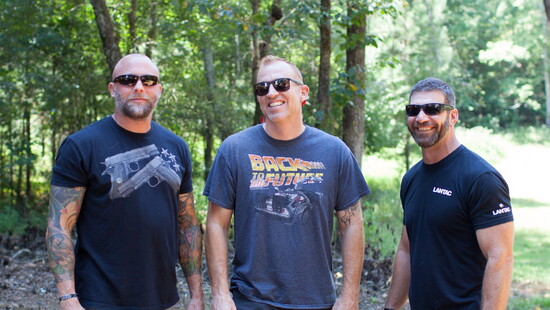
For years, Corey Collins fought battles most people around him could not see.
The United States Marine Corps combat veteran served as an Infantry Rifleman with 3rd Battalion 7th Marines and deployed to Iraq. But after returning home, the war inside his own mind became harder to escape than anything he experienced overseas. Mental health struggles, substance abuse, isolation, and hopelessness slowly took control of his life.
“My life had unraveled to a point I never thought I’d reach,” Collins shared. “I felt lost and overwhelmed.”
At his lowest point, Collins says he felt completely disconnected from reality and from himself.
“There was a constant weight on my chest, like I was drowning in my own thoughts with no way to come up for air,” he said.
The situation became so severe that he found himself facing legal trouble tied to actions he could not even remember.
“I was battling extreme mental health struggles that spiraled into serious legal trouble, including being arrested on two charges that I still don’t even remember committing,” Collins explained.
For many veterans, asking for help can feel impossible. Pride, fear, shame, and the pressure to stay strong often keep people suffering silently. Collins admits he was not ready to seek support the first time he encountered the Brothers Keeper Veteran Foundation (BKVF).
His introduction to the organization happened unexpectedly during a meeting at the gym with founder Christopher Cathers.
“He shared what the foundation stood for and how it supports veterans who are carrying burdens like mine,” Collins said. “At the time, I wasn’t ready to accept that help, and I walked away without getting connected.”
Months later, everything changed.
While Collins could not bring himself to ask for help personally, his wife Sarah made the decision for him.
“That single act of love and courage became the turning point that saved my life.”
Founded in 2020, Brothers Keeper Veteran Foundation was created to address Post-Traumatic Stress Injury and provide support for veterans and active duty military personnel navigating mental health challenges. The foundation was built by Christopher Cathers, whose own experiences in Special Forces, the CIA, and personal battles with Post-Traumatic Stress and cancer inspired him to create a place where veterans could find understanding without judgment.
Following Cathers’ passing in February 2026, Special Forces veteran Rob Vaughan stepped into leadership to continue the mission.
“From the realization of being medically retired from active duty, I had a very strong need to give back,” Vaughan shared.
Today, the organization focuses on meeting veterans wherever they are emotionally, mentally, and physically.
“BKVF is a veteran non-profit that meets the veterans where they are,” Vaughan explained. “Whether that is a survive, stabilize or thrive need.”
The foundation provides assistance with housing, claims support, sober living programs, therapy resources, service dogs, and virtual support groups. It also works directly with veterans struggling with their mental health.
Vaughan believes the public often underestimates the depth of the crisis facing veterans.
For Collins, the organization became more than a support service. It became a lifeline.
“When I first met Chris and he shared parts of his own personal struggles, it immediately broke down the walls I had built,” Collins said. “There was a level of honesty and vulnerability in the way he spoke that you can’t fake.”
That honesty helped Collins begin opening up about struggles he had buried for years.
“On top of that, the fact that many of them are veterans created an unspoken bond,” he said. “There’s a mutual understanding that doesn’t always need to be explained.”
Through Brothers Keeper Veteran Foundation, Collins received weekly therapy, attended Warriors Heart for intensive mental health and substance abuse treatment, and connected with specialized traumatic brain injury recovery care through the Shepherd Center in Atlanta.
“For the first time in a long time, I’ve developed a stable and healthy mental baseline,” Collins said. “I’m no longer living in constant chaos or survival mode.”
Today, he says he is thriving in school, rebuilding relationships, and becoming more present for his family.
“I am now the husband my wife deserves and the stepfather my stepdaughter needs,” he shared.
While conversations surrounding veteran mental health have become more common in recent years, Vaughan says stigma still prevents many people from seeking care.
“PTSD is looked upon as a damaged individual with the stigma of a disorder,” Vaughan explained. “The brain has been damaged and can be repaired, but treatment must be sought out.”
He also stresses that healing is not one-size-fits-all.
“The treatment that works for me doesn't necessarily mean that it will work for you.”
For Collins, one of the most important messages he hopes other veterans hear is that asking for help is not weakness.
“Take the step,” he said. “Living in that darkness, in that constant state of ‘the suck,’ is far more exhausting and damaging than facing the discomfort of change.”
He hopes veterans who feel trapped understand they are not alone.
“There are people who understand, who have been in that same place, and who genuinely want to see you come out the other side.”
For Collins, that first step ultimately gave him something he thought he had lost forever: hope.
To learn more about the organization, visit BKVF.org.
“Taking the first step was the hardest part, but it changed everything. BKVF gave me support, structure, and people who truly understood what I was carrying. Today, I’m healthier mentally, rebuilding my life, and showing up for my family in ways I never thought possible.
-Marine veteran Corey Collins