You’re lost in the woods.
You shiver as the temperature in Idaho’s backcountry drops further. You huddle closer to a tree, grateful for even a little respite from the biting wind.
You hope someone will find you.
Then, out of the darkness, a glowing streak. You blink hard, trying to make it out.
A sharp bark, and there’s a black-and-white dog lying next to you.
You reach out a hand for the pup to sniff as you read the bright orange, illuminated vest: SEARCH AND RESCUE.
Help has arrived.
This is one of countless scenarios that volunteer Idaho Mountain Search and Rescue Unit (IMSARU) K9 teams encounter as they work throughout the Treasure Valley and beyond.
The Right Pooch for the Job
Like all working dogs, IMSARU dogs specialize.
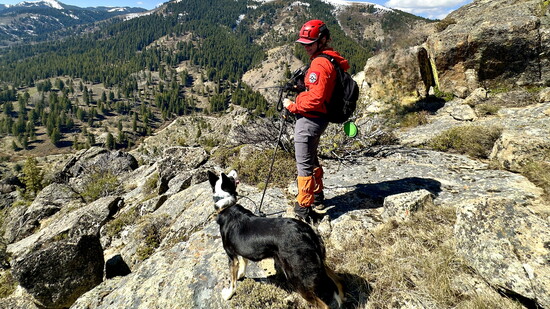
For 3-year-old border collie Mayday, that means locating living subjects. Her teammate, Mika, a 4-year-old border collie, specializes in human remains detection.
“A lot of people have a misconception with the dogs, thinking that they would do both inherently, or one or the other,” said Kelsey Chereskin. “But you actually have to train them on which they're finding specifically.”
Chereskin, IMSARU’s public relations director, also serves as one of the organization’s K9 team leads with Mika and Mayday. Mika came from a Montana breeder with a long line of working dogs. Mayday was a rescue who simply needed a job that could channel her endless energy.
Both dogs are certified through national organizations. Mika also serves as a Human Remains Detection (HRD) dog, a specialization that allows her to assist law enforcement with criminal investigations and recovery efforts.
Keeping the Nose to the Grindstone
Training is essential to keep the dogs ready for a call. Chereskin said Mika and Mayday each average about 60 miles a week as they train in scent work, agility, endurance, and exposure to different people, helping prepare them to encounter everyone from lost toddlers to hunters caught in severe weather.
Working toward certification can take years, depending on a dog's aptitude, but a good nose is essential.
Once a dog is trained to recognize a specific scent, handlers gradually increase the difficulty of the search scenarios. The work is almost entirely scent-based.
“They can get that scent from pretty far away and follow it to that person,” Chereskin said.
IMSARU conducts approximately 34 to 40 searches each year, with human remains callouts accounting for six to 10 of those missions.
“While both dogs train the same amount, our goal as a unit is to utilize Mayday more frequently than Mika,” Chereskin said. “And that’s a good thing. Although, Mika may try to tell you otherwise!”
The Search
When a search is ordered, IMSARU is called in. Responding teams load up the appropriate vehicles for the terrain and head out.
“More frequently than not, IMSARU deploys outside of Ada County,” Chereskin said. “We do get calls for missing children, individuals with disabilities, and Silver Alerts for missing elderly people.”
Once on scene, the operations lead assigns terrain to each team. On a K9 team, flankers—volunteers who train alongside handlers but do not have dogs of their own—provide support to both the dog and handler.
Searches can vary dramatically depending on the circumstances. Some involve a lost hiker who wandered off trail and simply needs help getting back to safety. Others involve children who have become separated from their families, hunters overdue from a trip into remote terrain, or elderly individuals who may be confused, injured, or unable to communicate their location.
Weather, terrain, and the amount of information available all influence how teams approach a search. A clear trail and a recent sighting can help narrow the area quickly. In other situations, searchers may be working with limited information and large expanses of rugged country.
“Every search is different,” Chereskin said. “You never really know what you're going to get when you arrive.”
For handlers, one of the most important tasks is learning to trust the dog. While maps, radios, GPS devices, and search plans all play critical roles, the dog's nose remains the primary tool.
“Sometimes they'll pick up on something before you have any indication that someone is nearby,” Chereskin said.
That partnership between handler and dog is built through years of training. Handlers learn to recognize subtle changes in behavior that signal a dog has detected scent, even before the animal begins actively trailing toward a subject.
When a find is made, the goal is simple: locate the missing person as quickly and safely as possible and bring resources to where they are needed most.
Geared up in her fluorescent orange vest, Mayday also wears a GPS tracking collar so Chereskin can locate her if she gets too far ahead. Then it's off downwind to give the dogs the best chance of picking up a scent.
“Once we get out there and we're searching, as soon as she catches on to someone's scent, she'll start trailing them in,” Chereskin said. “As soon as she can get within proximity and actually locate them, that's when she'll provide us with her trained final response, which in her case is to sit down and bark at the person. Then she's trained to stay with that person until we get there.”
If the search area is cleared without success, teams move on to the next assignment.
“We take breaks, of course,” Chereskin said. “I look at how Mayday’s doing and how she's feeling. If she's getting tired, I try to give her short water breaks and rest breaks every 30 minutes or so before restarting and getting going again.”
Operational periods typically last around 12 hours, with the dogs spending three to four hours actively searching during that time.
Work and Play
Payday comes for working dogs, too.
“As much as a lot of people assume the dogs do it because they're altruistic, they usually do not, though they do love their job,” Chereskin said. “We find the toy that they like more than any other toy.”
Handlers sometimes conduct what they call a “toy inventory,” spreading out dozens of toys and allowing the dog to choose a favorite. That prized toy becomes the reward that motivates the dog to work.
“And that's what makes these dogs work,” Chereskin said. “Their favorite toys.”
When not on the job or training, the dogs enjoy downtime just like anyone else.
“Mayday's favorite hobby is swimming,” Chereskin said. “You will find her in any water that she can find at all times if it's accessible.”
Mika’s favorite pastime surprises most people.
“I refer to it as bubble ballet,” Chereskin said. “She likes to twirl and leap and jump, and she just goes crazy for the bubbles. Sometimes I actually use that as her reward at the end of searching.”
With search dogs typically retiring around age 10, Mika and Mayday still have many more searches, toys, treats, and bubble payoffs ahead.
To support IMSARU’s mission and dogs like Mayday and Mika, visit imsaru.org.