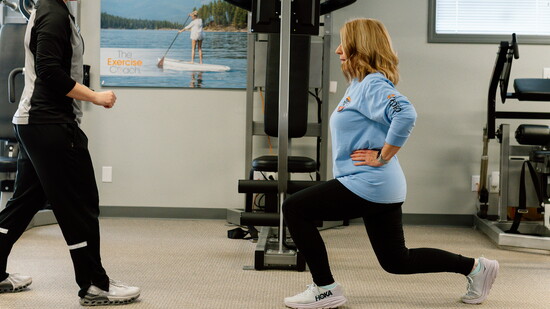
Most of us don't think about balance until we lose it. A stumble on the stairs. A moment of hesitation stepping off a curb. The quiet, creeping worry that a grocery run might go sideways — literally.
But Sabrina Denny, owner and coach at The Exercise Coach in Liberty, thinks about balance every day. It's not just a fitness metric for her. It's the foundation of independence.
"Our mission — everything we strive to do — is to transform the way people age," Sabrina says. Strength training has always been central to The Exercise Coach's approach, but over time, she kept hearing the same thing from clients — “I really want to improve my balance.” Her solution was adding an entire balance program.
The Balance Transformation Program at The Exercise Coach is a comprehensive, multi-system program built around the Exerbotic Balance Tracker — a connected technology platform that places users on an unstable surface and guides them through balance and cognitive challenges simultaneously.
The machine targets three distinct systems: the vestibular system (the inner ear that senses head movement and orientation), the visual system (how the body processes visual input to maintain stability), and the proprioceptive system (spatial awareness). Through targeted exercises on a single platform, the program trains each of these systems — and the connections between them.
"We know from the research that balance and cognition are very interdependent," Sabrina says. "So there are also dual-task cognition drills that we’ll also do — working on memory, reaction time, corrective agility."
Sessions on the tracker are woven into a broader program that also includes strength training, cardio, nutrition guidance, and for some clients, coach-assisted stretching. The idea is that muscles need to be strong enough to sustain balance, and the brain and body need to be working in sync.
"We've got to get the brain and the muscles working together," she says.
Sabrina describes three distinct groups who have found their way to the Balance Transformation Program. The first is adults in their 50s, 60s, and 70s who have started to notice some decline in their stability — not a fall risk yet, but enough of a shift to prompt concern. They're looking to get ahead of it, to take action while they still can.
"Typically, what we'll hear initially is, 'I want to make sure I can take care of myself, I want to make sure I can stay at home as I age,'" Sabrina says. "The thing that, a lot of times, is the catalyst for someone not being able to live on their own is when they start falling.”
The Balance Transformation Program seeks to get ahead of that.
The second group is more athletically motivated: recreational athletes — skiers, water skiers, soccer players — who want the agility and quick-adjustment ability to perform better. Sabrina knows this from personal experience. After getting the Balance Tracker last summer, she went water skiing with her sister in August — something she’d only done once before — and found herself staying upright.
"I personally couldn't believe how much it impacted my ability to stay upright on the water skis," she says. "It's not just for people who have the age-related decline of balance. It can really just help with everyday agility and movements."
The third demographic is people with cognitive concerns — those with a family history of dementia or Alzheimer's, or clients managing Parkinson's disease.
“There’s a lot of good research out showing the benefits of training balance to improve cognition,” Sabrina says. This research includes the release of brain-derived neurotrophic factor (BDNF) during training — what Sabrina describes as "essentially Miracle-Gro for the brain" — which helps protect against cognitive decline.
With the addition of the Balance Transformation Program in her studio, Sabrina has seen clients benefit from the training firsthand. One of Sabrina’s clients, Shirley, is 88 years old and lives at home with her husband, who is a leg amputee, which means she is the sole caregiver for both of them. Her children brought her to The Exercise Coach out of concern — she was struggling with strength and stability, and the family worried she was going to fall trying to get in and out of her car to run errands.
Three months into the Balance Transformation Program and the change has been striking. Shirley now feels confident going out, making trips to the store on her own, and navigating stairs she had previously avoided.
"She used to avoid going into her basement just because she was scared of falling on the stairs," Sabrina says. "But now she's able to go up and down them with no problem and not feel like she’s going to have that instability or where she’s going to fall. It’s really allowed her specifically to stay in the home with her husband and keep doing the things they want to do on a daily basis.”
But Shirley’s transformation has been more than just tackling stairs.
"It's how we've seen her confidence grow," Sabrina says. "She just has this confidence about her now that lights up a room anytime she walks in. She's gone from feeling like, 'Is my destiny just to not be able to do things anymore?' to now she's out and about, running errands, going on walks with her kids and grandkids. She just has that joy back in her life."
The Balance Transformation Program at The Exercise Coach in Liberty begins with a full assessment, including movement evaluation, balance and cognitive baselines, and strength testing, followed by a customized plan. Two complimentary intro sessions are available for new clients. To try it for yourself, you can find The Exercise Coach online at exercisecoach.com/liberty, via phone at (816) 792-5800 or at 6 Westowne Drive, Suite #602 in Liberty.
Always a Soccer Player
Sabrina Denny started playing soccer at age 10. She played goalkeeper through high school, until a series of concussions prompted her to change positions, primarily playing center midfielder through her college years at William Jewell. After graduation, she stayed in the game through adult leagues and travel tournaments, and spent a decade with Youth Rise, a nonprofit using soccer as a mentorship tool for disadvantaged youth in Kansas City's Northeast neighborhood. There, Sabrina worked with kids from more than 30 nationalities and, at times, seven languages were being spoken on the field. "What's cool is soccer is kind of that unifying language," she says.
As the World Cup comes to Kansas City this summer, she'll be cheering loud for Team USA.
"Our mission — everything we strive to do — is to transform the way people age,"