A BRIEF HISTORY OF TRANSFERWARE
The tradition of setting a Thanksgiving table with fine English transferware depicting the holiday bird or other pastoral scenes is almost as old as Abraham Lincoln’s proclamation of an official Thanksgiving Day — established in 1863.
Before the invention of transferware, every decorated plate in Europe was hand-painted, making patterned tableware an exclusive luxury for royalty and the ultra-wealthy. Transferware — named after the process of transferring intricate art onto ceramics via engraved copper plates and tissue paper — transitioned pottery decoration from a painstaking artisan craft to representing the dawn of industrialized consumer goods, considered the ceramics equivalent of the printing press. Mass-production began in 1750s Britain as a high-tech solution for potters to compete with the Chinese porcelain trade. The resulting heavy mimicking of Chinese porcelain gave rise to Spode’s iconic “Blue Willow” pattern — a romanticized European interpretation of an Eastern landscape, still one of the most manufactured ceramic patterns in human history.
Transferware began featuring true pastoral scenery, country estates and rural landscapes around 1810. By the 1820s, British factories were exporting Historical Staffordshire to the United States, featuring patriotic imagery, estates and landscapes like George Washington’s Mount Vernon, Jefferson’s Monticello, the Hudson River Valley and more (eventually, American hubs like Ohio and Trenton mastered the production, too).
By the 1850s, transferware had become a staple of the American home — and around 1870, the proud Tom Turkey motif landed front and center of designs by Spode, Mason’s and Enoch Wood & Sons, in reaction to the newly declared American holiday, and expanding into the rich sepia browns, crimson reds and forest greens to uplift the autumn aesthetic of the Thanksgiving table.
By the turn of the century, what began as mass-production shifted back to artistry, as wealthy American households sought more exclusive tablescapes, artisans began layering hand-painted polychrome details over the printed base with each feather and harvest border touched by hand.
And by the 1940s, multi-colored collections like Johnson Brothers’ “His Majesty” cemented transferware’s transformation into treasured heirlooms taking pride of place on the Thanksgiving table.
GET THE LOOK
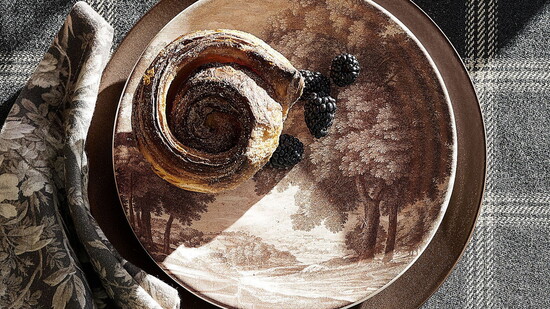
In the aesthetic tradition of these transfer-printed pieces, Juliska's Country Estate Collection recalls the charm of idyllic country life in a decal hand-painted by designer Deborah Sears and applied to hardy stoneware. Shown here: Reminiscent of traditional toile, The Harvest Tray does double-duty as a charger for place settings; Dinner Plate in stunning Delft Blue; and each of the assorted Harvest Party Plates (set of 4 in Sepia) depicts a different scene during autumn. Juliska.com.
Handcrafted from stoneware with a white glazed-decal finish, Pottery Barn’s Etched Garden Stoneware Collection, including these Salad Plates, are inspired by vintage botanical illustrations and hand-carved block prints. Pottery Barn, Rochester; potterybarn.com.
The peachy tone of Anthropologie’s Mimi Thorisson Italian Hours Wine Glasses — crafted of mouth-blown soda glass with a vintage-inspired pedestal stem — add a kiss of the harvest season to the holiday table. Anthropologie.com.
Intricate, textural embroidery lines Kim Seybert’s linen Jardin Napkin (in White & Blush). Kimseybert.com.
The perfect blue accent to deep burgundies and browns, this Glass Taper Candle Holder in Navy will lighten the table in the most elegant way. Area Sur La Table stores; surlatable.com.
Sculptural Fluted Church Taper Candles by Greentree Home, available in the most delicious collection of colors. Greentreehomecandle.com.