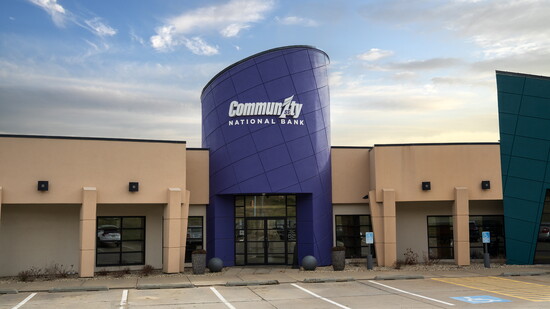
A visit here almost always begins with the same simple moment. The door opens, someone waves, another person smiles, and several greetings come your way before you even reach the front desk. The space feels warm, open, and easy to navigate. Conversations move freely across the room, and the faint smell of popcorn fills the air. Within seconds, it becomes clear this is not meant to feel like a distant financial institution, but a place built around people. For a quarter-century now, this atmosphere has defined Community First National Bank in Manhattan.
Founder and President Rob Stitt always wanted the bank to feel approachable. Customers should be able to walk in, see the people who work there, and know they are welcome there. In many ways, it reflects both the personality of the man who built it, and the spirit of the town itself, because Rob Stitt is Manhattan through and through.
A native of the Little Apple, Stitt grew up here and graduated from Manhattan High School in 1982 before enrolling at Kansas State University. At K-State, he studied management and pre-law, but after an internship with the county attorney’s office, he changed that direction. Banking, however, was something that had already begun to capture his interest.
While attending college, Stitt worked several diverse jobs that helped shape his outlook on people and service. He spent four years at Sirloin Stockade, where he also met his future wife, Kathy. He later worked at Mini Mart, the convenience store that once stood where Casey’s on Highway 24 is today. There, he met another future banker, Kevin Wagner, who would later become an original investor/founder, and a catalyst in launching the bank.
Stitt’s banking career began while he was still in school when he started working at Citizens Bank in the mid-1980s. After graduating from Kansas State in 1988, he joined Union National Bank under Bill Stolzer. He began as a credit analyst reviewing financial statements before moving into a loan officer role. When Union National eventually became Commerce Bank, Stitt stayed on and continued building his experience.
Around 2000 he was approached by a banker named Kent McKinney, who suggested Stitt take over a bank in Topeka. Stitt had another idea: since Manhattan had not seen a new bank charter in roughly thirty years, perhaps the community was ready for one.
So began the kind of undertaking few people ever see from the inside. Starting a bank requires a deep knowledge of banking, regulatory approval, capital, investors, and patience. The process required submitting three separate applications at the same time: one was to the Office of the Comptroller of the Currency, because Community First would be a national bank; one to the FDIC, because all deposits would be insured; and then, of course, an application to the Federal Reserve.
The charter application itself became a blueprint for the future. It included the business plan, the people involved, resumes, financial statements, and the experience behind the proposed bank. Before the process was complete, Stitt and his team had gathered roughly one million dollars in commitments just to confirm there was real local interest. Then, came the actual capital raise. In January 2000, Stitt left his job, took a leap of faith, and began the journey full time.
Community First launched with about forty shareholders. Investments ranged from $5,000 to $300,000, raising roughly $3.5 million to get the bank off the ground. Today, starting a bank would likely require $10 million or more, one reason so few traditional community banks are created anymore.
Even then, there’s no guarantee of quick success. Community First lost money for its first eighteen months, as many young banks do. But the timing, structure, and local need all aligned as Community First National Bank officially opened on February 1, 2001.
On opening day, the bank was not yet in its current space. While renovations were being completed, operations ran from the basement of the neighboring building with just six employees, no drive-through, and not even an ATM. Customers had to come inside to conduct their business. The move to the current location at 215 Seth Child Road came later that spring, in April 2001.
Before it became a bank, the building was the final home of Raoul’s Taco Real, one of Manhattan’s most beloved Mexican restaurants since 1964. When the restaurant closed, Community First stepped into the space and leaned into the history with a bit of humor. The first sign placed on the building read “Nacho Ordinary Bank.” It was playful, memorable, and unmistakably local, exactly the tone a hometown bank should strike.
As Community First grew, so did the footprint. What began as a single space gradually expanded into more. The bank eventually purchased and joined neighboring portions of the property, creating what is now roughly twenty thousand square feet in total.
A few years after opening, Community First expanded again, this time to the east side of Manhattan. The bank had outperformed its original projections, and Stitt recognized the need to better serve customers across the city. In 2003 the bank purchased property on the east side at 210 Tuttle Creek Boulevard that had previously housed a Sonic restaurant and later an Eastside Bait shop. The building was demolished and replaced with a new Community First branch, extending the bank’s reach while reinforcing its commitment to serving the entire Manhattan community.
The bank also grew alongside Stitt’s own family.
Rob and Kathy married in 1988, and she began her career in education in Junction City, before coming back to Manhattan and joining USD 383. She taught at Marlett and Amanda Arnold Elementary, later serving as the principal who reopened Bluemont Elementary. Today, she is currently the principal at Amanda Arnold.
The couple raised three children in Manhattan - Abby, AJ, and Alex - who have since started families of their own, adding four grandchildren. Abby works at the bank as teller supervisor and BSA officer, while her husband Paul, and her brother AJ, both serve as mortgage lenders. Rob’s younger brother Randy joined the bank in its early years, and has spent more than two decades as a loan officer.
That sense of family extends to the broader culture of the bank. Stitt has long believed personality matters just as much as technical skill when hiring employees. Banking knowledge can be taught, but genuine customer service cannot.
That philosophy has guided Community First through several historic moments. The bank opened only months before the attacks of September 11, 2001. It weathered the financial crisis of 2008, and later played a key role in helping local businesses during the pandemic by processing many Paycheck Protection Program (PPP) loans.
Through each challenge, Community First remained focused on the same mission it began with. Stitt believes a community bank should do more than process transactions. It should help people make responsible financial decisions and support the growth of the community around it.
A quarter century after opening, Community First still feels like Manhattan: welcoming, hardworking, and community proud. In a world increasingly shaped by apps and algorithms, here, everything remains personal. Just as important, its future will remain local. Stitt has made it clear the bank isn’t for sale, and the commitment is there to keep serving this community for the next 25 years and beyond.
Because they’re not just another bank in Manhattan, but one that truly puts the Community First.
“We hire more for personality than skill set. You can teach banking, but you cannot teach personality to someone.” - Rob Stitt
“Part of our job is to be financial counselors, not just to make money. A community bank should help people make responsible decisions for their future and families.” - Rob Stitt