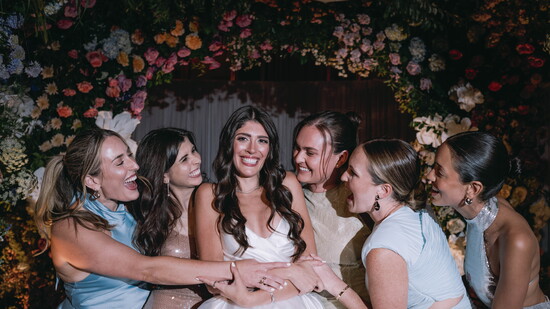
There are certain moments in life that people always wish they could revisit—the sound of laughter during a wedding toast, the pride in a parent’s eyes during a bar mitzvah, the feeling of being surrounded by the people who matter most. For Zvi Goffer, that universal longing—to hold onto fleeting moments—became the driving force behind ReloomVR, a groundbreaking immersive technology that allows families to do something once thought impossible: truly return to their most meaningful memories.
Long before ReloomVR transformed milestone celebrations, Goffer, who lives in New York, was simply a father trying to show his sons something meaningful from his own life. When his boys were young, he attempted to introduce them to the college he attended, Binghamton University, hoping to spark curiosity about their futures. But when he opened the school’s virtual tour online, he was surprised. The experience felt flat and uninspiring, and his sons quickly lost interest. In that moment, he realized there had to be a better way. “You shouldn’t have to apply to a school blind if you can’t visit,” Goffer recalls. “You should be able to put on a headset and feel as though you’re actually there.”
Though he had no engineering background—coming from finance—Goffer grew up in a family of mechanics, where building and fixing things was simply part of life. Driven by instinct and curiosity, he began developing the technology himself. At its core, the system is both sophisticated and beautifully simple: a discreet, remote-controlled tripod equipped with multiple cameras moves throughout an event, capturing every angle and emotion. The footage is then seamlessly stitched together into an immersive virtual reality experience, viewed through a custom headset. What began as an idea quickly became a company focused on immersive virtual college campus experiences, allowing students anywhere in the world to explore universities as if they were physically present. Timing accelerated everything. Launching just before the pandemic, when travel halted and in-person tours became impossible, demand for immersive virtual experiences surged. Colleges adopted it quickly, and athletic departments soon saw even greater potential—using VR to recruit athletes by transporting them directly into stadiums, locker rooms and game-day environments.
The growth was rapid. “Everything just took off,” Goffer says. He began working with powerhouse athletic programs including Duke, Connecticut, Alabama, Auburn, Texas, Mississippi and Maryland, helping schools recruit top talent in football and basketball. In one notable case, a top basketball recruit committed after experiencing a university entirely through VR, and the following year the team reached the Final Four. The technology was reshaping how athletes connected with programs—and how universities told their stories. Goffer even met with the Dallas Cowboys to explore bringing immersive fan and facility experiences to the professional level. What began as a simple idea had become a national innovation.
But everything changed during a deeply personal moment—one that shifted his focus from institutions to people. After losing his own mother a little over a year ago, a close friend asked Goffer to record something simple yet deeply meaningful: a Sunday spent watching football with his father, who was ill and nearing the end of his life. Barbecuing, laughing, throwing a ball with grandchildren—ordinary moments that suddenly felt irreplaceable. Weeks after his father passed away, the friend called, overwhelmed with emotion. “I just put on the headset and for twenty minutes I forgot that my father was gone,” he told Goffer. “You gave me the ability to relive a moment with someone who’s no longer with me.” That realization changed everything, and what began as a favor became a mission.
From there, Goffer saw the potential to preserve life’s most meaningful celebrations. “We started with weddings and bar mitzvahs because those are the moments people want to remember forever,” he explains. Soon after, a prominent rabbi invited him to capture his daughter’s 1,200-person wedding. When the rabbi later experienced it in virtual reality, his hands trembled and tears streamed down his face. “He told me, ‘I feel like I went back in time and watched myself walk my daughter down the aisle again,’” Goffer says. “That’s when I knew this was something different.”
As word spread, one of New York’s most respected event planners, Norma Cohen, experienced the technology for herself. “She put on the headset and suddenly she was back at a wedding she had attended months earlier as a guest,” Goffer recalls. “It hit her emotionally.” Cohen quickly began booking the company for her clients. “As an event designer with over 35 years of experience creating unforgettable moments, I know the true value of capturing emotion and storytelling,” Cohen says. “Working with ReloomVR has completely transformed how I preserve and share my clients’ most cherished experiences. I'm sorry I didn't know the team prior to now. What I would have personally done to have all my events in VR!” In another memorable experience, ReloomVR captured the bat mitzvah of influencer Lizzy Savetsky’s daughter, who later posted a video on Instagram showing her family reliving the event in awe. “This is epic!!!!” she exclaimed. “Everyone should do this for their big life events.”
ReloomVR expanded from New York to Miami, and now Los Angeles, quickly working with top talent including the city’s ultimate event planner, Mindy Weiss. “I recommend this for everyone," says Irene Boujo of Weiss’ team. "It feels like you are right back in the moment.” One particularly meaningful project documented the bat mitzvah of a Palisades family rebuilding after the devastating fires. “When I delivered the headset, the mother told me that they had lost decades of physical memories—photos, heirlooms, everything,” Goffer recalls. “She said she felt relief knowing she would never lose this. That stayed with me.”
Today, the experience is comprehensive and deeply personal. “We capture everything,” Goffer explains. “Getting ready, the first look, ceremony, speeches, dancing—even personal messages from parents and guests.” Each moment is organized into chapters so families can return to any part of the day. “You want to watch the ceremony again; you click and you’re back there,” he says. “It’s like moment-specific time travel.”
After the event, clients receive a custom headset containing both highlights and the full immersive experience, preserved forever. Additional headsets can be created for family, guests or loved ones who were unable to make it in person. In one milestone birthday celebration, the host even sent VR headsets as invitations, each containing a personal message. After the party, the full experience was loaded onto every headset so guests could relive the celebration. The technology is also being used to capture early childhood milestones, from first birthdays to little league games.
For Goffer, the meaning of the work is clear. “The sports business was great, but this is different,” he says. “The reactions are real. People cry. It means something.” At its core, ReloomVR is not about technology—it is about preserving what matters most. Because someday a celebration becomes a memory—but with ReloomVR, you don’t just remember it. You step back inside it, again and again.
ReloomVR
@reloomVR
reloomvr.com
“Working with ReloomVR has completely transformed how I preserve and share my clients’ most cherished experiences.” -event planner Norma Cohen
“We capture everything. Getting ready, the first look, ceremony, speeches, dancing—even personal messages from parents and guests. It’s like moment-specific time travel.”