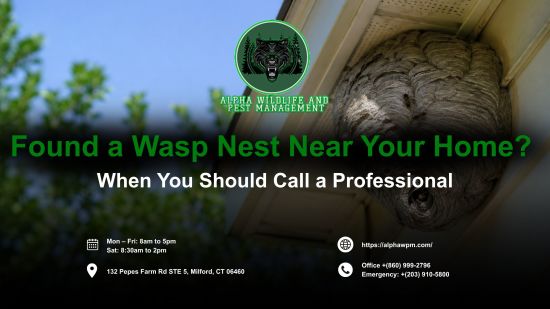
Found a Wasp Nest Near Your Home? When Should You Call a Professional?
It is ill advised to play the hero if you find a wasp nest around your home.
If you notice a small paper nest tucked under the roof eaves, wasps flying in and out of a hole near your deck, or suddenly realize that the buzzing around your porch is not just a coincidence, your first thought might be, “I can probably take care of that myself.”
Maybe. But there is a pretty good reason professional wasp nest removal exists.
Wasps can become highly defensive when they feel their nest is threatened. What looks like a small nest from a distance may contain a growing colony and disturbing it can turn a simple pest problem into a swarm of angry insects.
For homeowners in Milford, CT and throughout Connecticut, knowing when to call a professional for wasp removal can help prevent painful stings, unnecessary risks, and much bigger problems later in the season.
Why Wasp Nests Shouldn't Be Ignored
Wasps in and of themselves are not a problem. They play an important role in the ecosystem and can help control other insect populations.
They become a problem when they build a nest too close to where people live, work, and spend time.
A nest near a front door, patio, children's play area, deck, pool, or outdoor kitchen creates more opportunities for people and wasps to cross paths. As a colony grows, activity around the nest can increase.
This is why wasp control in Connecticut is often about more than simply getting rid of the insects you happen to see flying around.
The real question is: Where are they coming from?
If you repeatedly see wasps entering and leaving the same area, there is a good chance there is an active nest nearby. The nest may be visible, or it may be hidden inside a wall, attic, soffit, or another part of the structure.
And that is where things can get tricky.
Where Do Wasps Build Nests Around Connecticut Homes?
Wasps are surprisingly creative when it comes to finding a place to settle down. They look for areas that offer protection from rain, wind, predators, and regular disturbance.
Common wasp nest locations include:
Under roof eaves and overhangs
Around decks and porches
Inside sheds and garages
Under siding
Inside wall voids
Around windows and doors
Beneath stairs and railings
In attic spaces
Around rooflines and soffits
In trees, shrubs, and landscaping
Underground around lawns and gardens
Some nests are easy to spot. Others are hidden so well that homeowners may not realize they have a problem until wasps start appearing inside the house.
If you notice wasps consistently flying into a small opening, do not assume they are simply passing through. That opening could be the entrance to an established nest.
5 Signs You May Have an Active Wasp Nest
Not sure whether the wasps around your property are actually nesting there? Watch for these signs.
1. Wasps Keep Returning to the Same Location
Seeing one wasp in the yard is not necessarily a reason to panic.
Seeing several wasps repeatedly flying to and from the same location is different.
Consistent traffic around one area may indicate an active colony. Pay particular attention to rooflines, soffits, decks, sheds, trees, and openings around the exterior of your home.
2. You Can See a Nest
Some nests are obvious. Others are surprisingly easy to miss.
Paper wasp nests may appear underneath eaves, porch ceilings, railings, or other sheltered areas. Other species may build nests underground or inside wall cavities.
If you can see a nest, resist the temptation to poke it, spray it, or knock it down.
A visible nest does not tell you how large the colony is or how aggressively the insects may respond to being disturbed.
3. Wasps Are Entering Your Home
Finding a wasp inside your house can be especially concerning when it happens repeatedly.
If wasps are appearing around windows, ceilings, light fixtures, walls, or attic spaces, there may be an opening allowing them inside. In some situations, an active nest may actually be located within the structure.
This is where professional pest inspection becomes especially useful. Treating the individual wasps you see indoors does not necessarily solve the source of the problem.
4. Wasp Activity Is Increasing
Maybe you noticed two wasps last week and now you are seeing them every day.
That increase matters.
Wasp colonies can grow throughout the warmer months. The sooner an active nest is identified the easier it may be to address before activity becomes more intense.
5. The Nest Is Near a High-Traffic Area
Location matters.
A nest at the far end of a large property may pose less of an immediate concern than one directly above the front door.
If a nest is near a:
Front entrance
Back door
Deck
Patio
Pool
Playground
Outdoor dining area
Garage
Pet area
it is worth having it evaluated.
Why DIY Wasp Nest Removal Can Go Wrong
We understand the appeal of DIY pest control.
There are sprays at the hardware store. There are online tutorials. And there is always that one person who says, “Just knock it down at night.”
The problem is that wasps do not necessarily cooperate with the plan.
Disturbing an active nest can trigger defensive behavior. Unlike honey bees, many wasp species can sting repeatedly. A disturbed colony may become significantly more aggressive in response to what it perceives as a threat.
There is also the issue of access.
Trying to reach a nest on a second-story roofline with a ladder creates a fall risk. Reaching into a wall opening can put you directly in the path of insects you cannot see. Spraying an unknown product into a wall cavity can also create problems if the source of the activity has not been identified.
In other words, DIY wasp removal is not always as simple as grabbing a can of spray.
If the nest is hidden, elevated, inside a structure, or located near an area your family uses regularly, professional treatment is the safer choice.
Wasps, Hornets, and Bees Are Not the Same
Another reason professional identification matters is that homeowners often use the terms wasp, hornet, and bee interchangeably.
They are not interchangeable.
Different stinging insects have different nesting habits, behaviors, and treatment considerations. A professional technician can help determine what type of insect is actually causing the problem and where the colony is located.
This matters because effective stinging insect control starts with understanding what you are dealing with.
You do not want to treat the wrong area, use an ineffective approach, or accidentally disturb a nest that should have been handled differently.
How to Make Your Home Less Attractive to Wasps
Professional wasp control services can address active nests, but homeowners can also take steps to reduce conditions that attract wasps.
Start with the basics:
Keep Garbage Sealed
Garbage cans can be an easy food source, particularly during warmer weather. Keep lids tightly closed and clean up spills around the containers.
Clean Up Outdoor Food
Sweet drinks, fruit, meat, and other food can attract foraging wasps. During outdoor meals, keep food covered when possible and clean up promptly.
Pick Up Fallen Fruit
If you have fruit trees, regularly remove fallen or overripe fruit from the ground.
Seal Exterior Openings
Check around windows, doors, siding, vents, soffits, and utility openings. Sealing gaps can help prevent insects from finding their way into wall voids and other protected areas.
Inspect Outdoor Structures
Take a quick look around decks, porches, sheds, garages, and rooflines throughout the warmer months. Catching unusual activity early can make a big difference.
When Is the Best Time for Wasp Treatment?
Timing matters when it comes to wasp nest removal.
Early detection is always preferable. A nest that is identified while it is still small may be easier to address than a mature colony that has been growing for weeks or months.
That does not mean you should attempt to remove a nest yourself just because it looks small.
Instead, think of early detection as an opportunity to bring in a professional before the situation becomes more difficult.
This is particularly important during late summer when wasp colonies can be highly active.
What Happens During a Professional Wasp Inspection?
A professional inspection is about more than finding the most obvious nest.
A technician can evaluate areas around the property to determine:
Where wasps are entering and exiting
Whether an active nest is present
Whether the nest is inside or outside the structure
What type of stinging insect is involved
Whether additional nests may be present
What conditions may be attracting the insects
Whether there are openings that should be sealed
This allows the treatment to focus on the source rather than simply the symptoms.
That distinction is important.
Killing a few wasps flying around your patio may make things look better for an afternoon. Finding and properly addressing the colony is what helps solve the actual problem.
What If the Nest Is Inside a Wall?
This is one situation where homeowners should be especially cautious.
If wasps are entering a wall opening or you are hearing buzzing inside the wall, do not seal the opening immediately without determining what is happening inside.
You may accidentally trap insects inside the structure or force them to find another way out, potentially bringing them into your living space.
Instead, have the area professionally inspected.
Wasp control for homes sometimes requires understanding what is happening behind the surface, not just what is visible from the outside.
Protect Your Connecticut Home From Wasp Problems
Wasps are a normal part of summer in Connecticut, but an active nest next to your home is a different story.
If you see repeated wasp activity, find a nest, or notice insects entering your home, do not wait until the problem becomes a safety concern.
The goal of professional wasp control in Milford CT is simple: identify the source, treat the problem appropriately, and help prevent future activity.
At Alpha Wildlife & Pest Management, we provide wasp removal, yellow jacket control, stinging insect control, and pest control services in Milford, CT and surrounding Connecticut communities.
Our team can inspect your property, identify where the activity is coming from, and recommend the appropriate solution.
Found a Wasp Nest? Here's the Simple Rule.
Don't disturb it. Don't spray blindly. Don't climb a ladder to try to knock it down.
If you have found a wasp nest around your home, especially near an entrance, deck, patio, attic, wall, or other high-traffic area, let a professional take a look.
A small nest today can become a much bigger headache tomorrow.
Seeing wasps around your home? Contact Alpha Wildlife & Pest Management at (860) 999-2796 to schedule an inspection.
You should be able to enjoy your backyard this summer without the worry of stinging insects.