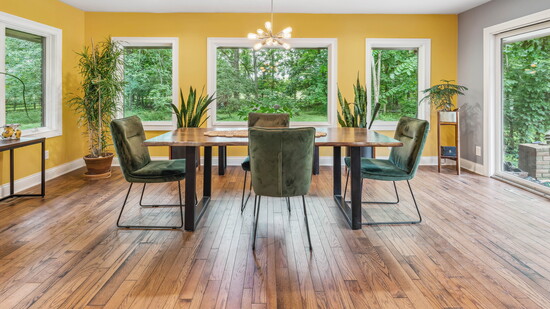
Tucked away in one of Northwest Columbus's original subdivisions, this 1960s brick ranch sits on a beautiful, open property—complete with gardens, wildlife, and long backyard views. But inside, you wouldn’t have known it.
A prominent fireplace, added during a previous remodel, dominated the dining area. Flanked by two small windows and wrapped in a glossy finish that felt disconnected from the home’s mid-century roots, it blocked sightlines and consumed valuable wall space.
The homeowners saw it differently.
Rather than preserve a feature that didn’t belong, they chose to remove it entirely—replacing it with a large window that now frames their landscape. Deer and coyotes pass through the yard. The light shifts throughout the day. The dining space, once constrained, now feels expansive and intentional.
The project team at J.S. Brown & Co., led by designers Clare Love and Shannon Weigand, understood immediately that this renovation was about more than aesthetics. “They felt like the house was very cut up,” Clare explains. “They wanted better visual flow.”
That philosophy extended beyond the fireplace. A solid wall between the kitchen and family room was removed, restoring connection from front to back while maintaining subtle separation through a newly designed buffet zone. The hallway that once looked directly into the kitchen was closed off, creating a more thoughtful transition between private and public spaces.
Space was borrowed from an oversized powder room to make it right-sized, allowing the team to carve out a generous walk-in pantry behind it. What had once been wasted square footage now supports everyday living.
During demolition, original alternating-width hardwood floors were discovered beneath the powder room. Rather than replace everything, the team sourced matching planks and blended old with new—honoring the home’s era while refining its function.
The house didn’t lose character. It regained its integrity.
If the new dining window reorients the home emotionally, the kitchen grounds it functionally.
Both homeowners love to cook, so the layout was designed around shared use. The island features two sinks, creating separate prep zones that allow them to work simultaneously without friction. Storage was prioritized over excess display, with deep drawers and integrated inserts supporting daily routines.
Appliances—including the refrigerator, freezer, and dishwasher—are concealed behind wood panels, reducing visual noise. Composite granite sinks coordinate with dark countertops, reinforcing a natural, understated palette.
“They were very focused not only on aesthetics, but on functionality,” Clare says. “They wanted to make sure the kitchen worked for how they cook and live every single day.”
Even the cabinetry grain direction reflects intentionality. Horizontal grain runs along the base cabinets, while tall and upper panels run vertically—originally a response to material constraints, but ultimately a design decision that adds subtle architectural rhythm.
The newly created buffet area acts as a bridge between kitchen and family room—part serving station, part storage hub, complete with a discreet broom closet while the island contains concealed outlets for laptop use. It allows the spaces to feel connected without becoming chaotic.
This remodel offers an important lesson for homeowners considering change: preserving a home’s character doesn’t mean preserving every feature. Sometimes the most respectful decision is the bold one. The best addition can be through subtraction.
In this case, removing a fireplace didn’t erase history. It revealed the view that had been there all along.