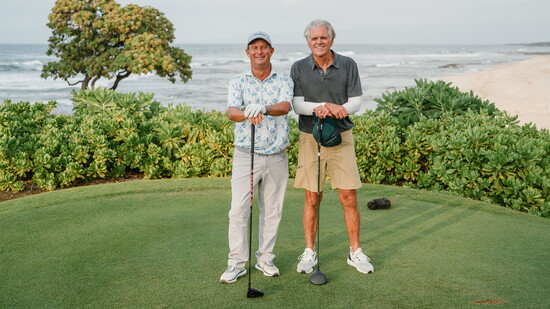
The trade winds were taking a rare afternoon off when I walked onto the Hualālai Golf Course with two men who know it like family.
Brendan Moynahan, the current Director of Golf, has stewarded this place since 2005. Sam Ainslie, the original Director of Golf, was here when “world-class” was merely an aspiration.
The welcoming, pristine, championship hosting resort course that you see today didn’t happen by accident.
Before the Four Seasons, before the iconic ocean holes, Hualālai was a failed project. "They crunched 14 holes of golf,” Sam remembers, “and then they stopped. It was a real black eye.” Two skeletal stories of a hotel had been built, but construction had ceased.
The problem was timing. In the early 1990s, the second-home market wasn’t what it is now. Interest rates were high. Resort real estate wasn’t the engine it later became. “There was no market,” Sam said of that era.
And yet, the project couldn’t simply be abandoned. Contractual commitments forced a restart. Sam was part of a team hired to rethink and rescue the resort. It was this pressure that, in hindsight, helped forge the standard Hualālai became known for. Sam says it simply: “We do our best work when it’s against all odds.”
In the 90s era, golf architecture often equated difficulty with greatness. But difficulty has consequences: lost balls, slow play, frustration. Sam puts it bluntly: “Too hard means a five-hour round of golf.”
Course designer Jack Nicklaus was already a legend, known for tough designs. Sam and his team fought for a different vision. Resort golf needed to be playable and enjoyable for the everyday guest without losing its championship identity. The goal was to play and enjoy golf. Sam laughs: “If you break 80 for the first time, you think the course is great.”
Sam recalls flying to Florida to collaborate with Jack, being picked up at the airport and whisked away to a Dolphins game with the Nicklaus family, then working together to redirect intimidation into invitation. There was an intentional redesign to include two phenomenal oceanfront holes, 17 and 18, which became the now iconic finale.
Hualālai didn’t only change expectations with design, it was to set a new bar with service, conditioning and maintenance. The strategy was to differentiate through excellence, bringing private-club standards to a resort environment.
In Hawaiʻi, beauty is everywhere, and sometimes it can mask sloppy operations. Hualālai was to be a place that felt warm and local, yet run with elite precision. “What you want is friendly, good service,” Sam says. “We’ve all had friendly, bad service… And we’ve also had unfriendly, good service… Friendly, good, sounds real… obvious.” When paired with the quiet, relentless discipline of course conditioning, fairways beautifully manicured, greens that roll true day after day, you create a reputation golfers will travel for.
When the course was completed in 1996, Sam paired with Jack to play the inaugural round. “This is the nineties, so Jack had a headset on, and there were speakers in the carts for the gallery,” Sam remembers with fondness. That opening round was the beginning of a legacy of greatness.
Hualālai’s tournament story is iconic: a PGA Tour event that has been here for decades, and is now under contract through 2030. Legends return. The winners' board is a who's who of the greats, reminding you this isn’t just a resort course.
But what makes Hualālai uniquely lovable is what happens when the ropes come down.
Current Director of Golf Brendan Moynahan has carried the legacy forward over the last two decades. His vision culminated in a bold, expensive renovation and a move to seashore paspalum, a grass that performs better in brackish or salty water. It wasn’t simply a cosmetic upgrade. It was a stewardship ensuring the course could remain elite, consistent and healthy in Kona’s punishing conditions.
Today, the result is unmistakable: a course that looks immaculate and plays reliably. A surface worthy of champions, but forgiving enough for resort joy.
His most recent project is the Golf Hale: a teaching and practice facility with multiple bays, TrackMan technology and a simulator experience robust enough to be genuinely fun. But the detail that matters most for Kona is simple: locals can come for lessons in Hawaiʻi’s premier golf instruction facility. On any given afternoon, you might find the local high school team out on the putting green practicing.
Brendan talks about a member-driven idea called the Happy Hundreds. “The rules are, there really are no rules,” he explains. “You can replay a shot… We just want to enjoy ourselves.” It became a doorway for newer players who might be intimidated by traditional formats.
Sam still sounds amazed by the contrast. Great champions call Hualālai one of their favorite courses, and yet it can be a home for beginners, too. “Those two things don’t happen… That’s so wild,” he says.
It is wild. And it’s the direct fruit of that early decision: a Nicklaus design shaped by a director of golf who insisted the resort guest mattered just as much as the elite player.
When you walk the course, enjoy the pristine greens. When you listen long enough, you realize Hualālai is not just a golf masterpiece, it’s a testimony to perseverance. A place built through setbacks. A place shaped by vision and conviction. A place where excellence has been carefully cultivated. A private club standard delivered with “friendly, good service.” It’s a course where champions play and where beginners can learn, laugh and fall in love with the game.
When you have the chance to enjoy Hualālai, you might just fall in love, too.