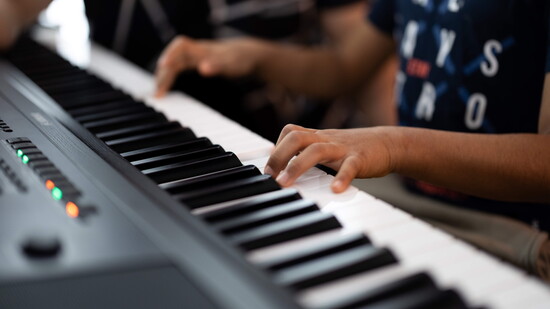
On any given afternoon at Payam Music, a student might be playing a pop song, a movie theme, or a melody they helped write themselves. Students seem excited, engaged, and ready to learn - a little unexpected for a piano school. They are learning technique, reading notes, music theory, rhythm, and discipline, but the first goal is simple: be excited to sit at the piano.
That idea grew out of founder Payam Khastkhodaei’s own experience.
Payam was three when his mother first sat him at the piano and six when he began formal classical lessons. He learned the traditional way, with sheet music, structure, repetition, and the slow climb through levels. It was the kind of piano education many families still recognize: serious and often sluggish. Over time, the system meant to build his musicianship began to drain his connection to the instrument.
Like many students, Payam eventually quit lessons. However, he did not quit piano.
What kept him playing was composition. At eleven, he wrote a piece for his newborn sister and won his first competition with it. The lesson stayed with him. Music meant more when he could shape it, personalize it, and make it his own.
Years later, while studying at the University of Washington, Payam began experimenting with the alphanumeric notation system that would become the foundation of the Payam Method. Around 2009, he started teaching a small group of students out of his parents’ basement in Bothell. Families responded quickly. The lessons were structured and challenging, yet they felt more joyful than the rigid model many parents remembered from their own childhood. In 2017, Payam opened his first school in Bothell.
The Payam Method begins with a belief that traditional piano education often makes the hardest part come first. Payam compares music to language: children learn to speak before they read and write. In the same way, the Payam Method begins with ABCs and 123s instead of traditional sheet music, giving beginners a way to understand the keyboard, spot patterns, and play songs they know from the first lesson.
Sheet music remains a major part of the program. Students meet it within the first few levels, with Payam notation mapped alongside it. By the mid-intermediate stage, they are reading traditional sheet music fully. At that point, they already have rhythm, confidence, pattern recognition, and musical fluency - and this changes the feel of a lesson entirely. Students are not decoding one note after another in isolation. They learn to recognize right-hand patterns, left-hand progressions, and the larger structure of a song. Lessons are personalized around each student’s pace and taste, whether that means pop, classical, film music, original composition, or piano-band experiences that help students build confidence and community. Practice still matters. Weekly lessons work best when students play consistently between
sessions. Payam Music tries to make that practice feel worth doing. Students often call it “fun-work” because they are working on music they actually want to play.
Composition is one of the school’s signature features. Students learn to write songs as well as perform music by other composers. For advanced students, that creative path can lead to mentorship opportunities connected to composer Hans Zimmer’s studio and his Oscar-winning collective, Bleeding Fingers Music.
The results are hard to ignore, especially in Washington. Payam Music students began competing in the PTA Reflections program in 2018. They earned state recognition, then won their first national medal about two years later. In the 2024 to 2025 season, students earned 15 district placements, won all five first-place spots in Washington, and took four of the 14 national medals, including the No. 1 national winner in 2025.
The school also points to faster long-term progress. Payam Music says students can reach diploma level, described as the “black belt” of piano, in about four years compared with roughly 12 years nationally. It also reports that far more students continue beyond their first year than with traditional lessons.
Some of the strongest proof of the method’s local impact is now standing at the front of the classroom. Several Payam Music teachers are former students who grew up through the program and returned to teach it. Benyamin Boujari, Director of the Bellevue and new Redmond schools, was one of Payam’s first students. Local students becoming local teachers has become part of the school’s identity.
Expansion began with Bellevue in 2024, followed by the first California school in Santa Monica in 2025. Payam Music has since grown into Southern California, the San Francisco Bay Area, Bethesda, Maryland, near Washington, D.C., and Great Neck on Long Island in New York.
National growth is led by CEO Hadi Partovi, co-founder of Code.org, who became involved after his own son took lessons. Payam Music is also backed by musicians and business leaders such as Hans Zimmer and Mark Cuban.
Even as the school expands, Payam remains rooted in Washington. As Chief Academic Officer, he leads curriculum development, oversees teacher training, and protects the student experience across every location. Each teacher is rigorously trained in the Payam Method, and each school is designed to carry the same spirit as the first classrooms in the Pacific Northwest: positive, supportive, rigorous, and fun.
For a school that began in a Bothell basement, the growth is remarkable. The heart of the work still feels local. A child sits at the piano. A teacher helps them find a song they love. Before the lesson is over, music feels possible.