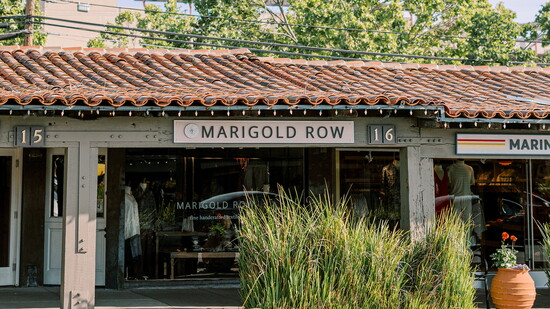
At Marigold Row, a shop on the Town & Country side of El Camino, Anita Mehta is unfolding a piece of cloth that someone in a village outside Kolkata stitched together by hand.
She runs a finger along a seam where two older fabrics have been joined. The technique is called Kantha, the Indian habit of refusing to throw a good cloth away. A grandmother's sari starts to wear through. Two layers are laid against each other, stitched together by hand, and the mending becomes the design.
Anita has been sourcing this work for twenty years, mostly wholesale, selling scarves into museum gift shops and other retailers around the country. The Harvard Art Museum shop is one of them. The retail shop on El Camino is three years old.
She grew up in New Delhi watching her mother shop for saris. Her mother knew India's weaving villages by craft: Jamdani in one town, Ikat in another, an embroidery technique somewhere else. Whenever she traveled, she came back with a sari from the region.
"It was like growing up in a school of how to understand and appreciate quality products."
Anita came to the United States as a student, expecting to return. She met her husband and stayed. She travels back to India every year.
In her first years here, she would read the made-in-India tags in department stores. The fabric was ordinary. The cuts were uninspired. She wondered why apparel made from finer Indian textiles was not what made it here.
The wholesale began in 2008: hand-loomed cotton, silk, and linen scarves, from the same towns her mother used to come home from. The retail shop is the more recent story. She opened it to put the regional work in front of people. In a wholesale catalog the threads look flat. On the rod by the window, they show what they are.
The work of the shop is bridging two visual cultures. Indian textiles run on vibrant color, intricate weaves, and detailed embroidery. Palo Alto runs on quieter palettes and minimal silhouettes. Finding the middle is the daily work: keeping the regional technique, softening the color, letting the silhouette stay Western.
Natural fabric is the rule of the store. Cotton, silk, linen, wool. Polyester does not come in. Anita is firm on this: synthetic doesn't breathe against the skin, and it ends up in landfills rather than closets.
She pulls another piece off a rod. The dyeing was done by hand: each section tied off, dunked into color, untied to show the white the dye never reached. Tie-dye that is actually tied. The dress with the silver threads is on a different rod, the silver coated onto silk filament and woven into the linen warp. It is the store's most popular piece.
The Google reviews are five stars. Customers say they came in for a present and left with something they couldn't find anywhere else, and the shop runs on that idea.
A photograph of her mother and father sits in the shop. Her mother was the inspiration, the teacher, the guide.
Marigold Row sources from all over India. The fabrics are woven on a handloom, hand tie-dyed, or hand embroidered. None of it is shipped in by accident. Someone in a remote village or a bustling metropolis did the work, and a woman in Palo Alto, oceans away, decided it was worth carrying across.
"It was like growing up in a school of how to understand and appreciate quality products."