Some journeys begin with a destination in mind. Others begin with a heartbeat—or the terrifying absence of one.
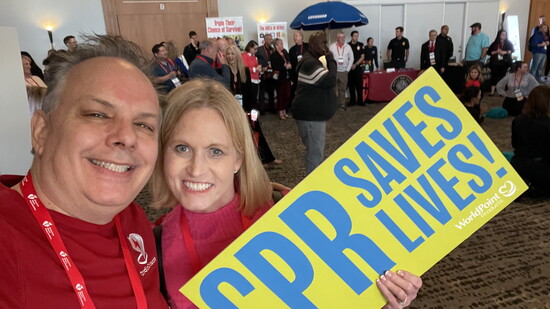
In 2018, Julie Coon was volunteering for the drill team at Plano Senior High School when her heart suddenly stopped. Without warning, she collapsed from sudden cardiac arrest (SCA). What saved her life wasn't luck alone. It was the swift, heroic actions of bystanders who called 911, started CPR, and retrieved a nearby automated external defibrillator (AED) within two minutes. That device shocked her heart back to life. For Julie's family, that day changed everything. Not just because she survived, but because of what her survival revealed about a critical, life-or-death gap hiding in plain sight across America.
"I am here today because someone knew where the AED was and didn't hesitate to use it," said Julie. "But for too many families, the story ends differently because an AED was hidden in a back office or unknown to the 911 dispatcher. We are fighting to change that."
The Mission That Became Cardiac Crusade
Julie and her husband Greg, rooted in Plano, founded Cardiac Crusade, the national 501(c)(3) nonprofit with a mission as urgent as it is clear: make every AED visible, accessible, and actionable. The problem they discovered was startling. Thousands of life-saving AED devices sit "hidden in plain sight" inside schools, gyms, and businesses, their locations unknown to 911 dispatchers and the public when emergencies strike.
Nationally, few out-of-hospital cardiac arrest victims survive. But in communities where AEDs are mapped and accessible, survival rates can soar. That gap between those two numbers represents thousands of lives that could be saved every year.
Anyone Can Map AEDs
The solution Cardiac Crusade is charting is powerful. Phase 1 mobilizes an army of volunteers to physically locate, verify, and map AED devices into a national database that EMS dispatchers can access at no cost. When someone calls 911 and says, "Someone collapsed and isn’t breathing," a dispatcher can immediately respond. For example: "There is an AED 50 feet away at the gym, behind the reception desk." Phase 2 aims to get those locations natively searchable on Google and Apple Maps, making life-saving information as easy to find as a nearby restaurant. Greg and Julie are already in active conversations with those global mapping companies to make that vision a reality.
Successes So Far
The map they're drawing is already saving lives. Cardiac Crusade volunteers have verified over 12,000 AEDs nationwide, a number that statistically saves 18 lives every single year. Partnering with Google, 7.5 million emails were sent to U.S. businesses, resulting in 4,000+ new AED registrations. Campaigns in Buffalo, New York, and Massachusetts have already mapped more than 2,700 AEDs.
Cardiac Crusade is also collaborating with communities across the country to achieve HEARTSafe designations—a recognized standard ensuring communities are truly prepared when cardiac emergencies strike.
The journey that began on a school campus in Plano has now traveled far. But it's far from over, with countless thousands of AEDs that still need to be mapped.
To donate, watch Julie's TED Talk, or to help map AEDs and save lives in your community, visit cardiaccrusade.org.