Haley Perez grew up in the Nambe Pueblo in Northern New Mexico, surrounded by enchanting desert landscapes. A few miles outside her Pueblo, in the foothills of the Sangre de Cristos, lies a desert oasis with beautiful waterfalls framed by lush greenery, truly an anomaly in the arid climate.
As a kid, she often visited the waterfalls, exploring dirt paths, hiking to the falls, admiring the phenomenal views, and camping under the stars with her family. Admiration and respect for nature were instilled in Perez from a young age. She said, “I’ve always been taught to take care of the land around me. And that fostered my love for the environment.”
Looking back on cherished memories of this beautiful place, Perez believes the falls sparked her love and curiosity for water. This became a major influence throughout her studies and eventually led her to pursue a career in the environmental sector.
Perez attended Fort Lewis College and earned two bachelor’s degrees in environmental studies and public health. These two areas of study blended magnificently, piquing her interest in how humans interact with the environment and create systems to best serve and maintain public health.
In the summer of 2022, Perez traveled abroad for the first time to conduct research in Tanzania. Her research focused on how water quality affects communities and their quality of life. This experience combined her fields of study, opening her eyes to new possibilities and boosting her confidence.
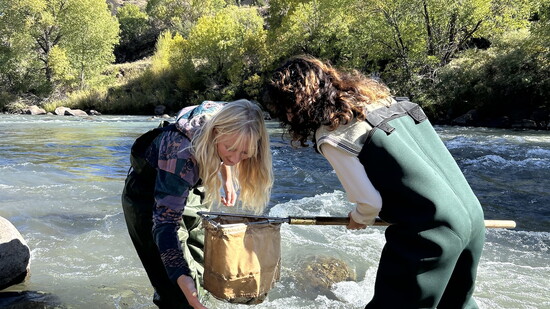
Shortly after returning to Durango, Perez began another research project, collecting water samples in the Weminuche Wilderness. For several weeks, a small research team backpacked through the Weminuche in search of E. coli in the water. Perez reflected, saying, “It was so cool to be able to have that adventurous side. But also, we were conducting research, monitoring a natural resource, and protecting the public." Her findings on human bacteroides were used to monitor human fecal contamination in the backcountry.
After graduating, Perez served as an AmeriCorps member and began working at The Mountain Studies Institute (MSI) as an Outdoor Education Technician. She speaks fondly of this experience, noting that she gained many skills and learned specific tools to best accommodate different learning styles and attention spans.
Perez now serves as the Community Science Program Coordinator for MSI. She loves her job, noting, “it's the perfect amount of science and the perfect amount of people.” In this role, she organizes educational programs for all ages and volunteer opportunities through citizen science initiatives. As an outdoor educator, Perez also teaches environmental sciences, including forest health, wildlife ecology, water quality, snow science, and more. She said, “The environmental education realm here in Durango is so rich, it's amazing! I've never seen such a place that has so many outlets for that.”
MSI has a saying: “The outdoors are our classroom.” A great example of this is their Rising River Stewards. Offered to students in grades 6-12, this after-school program explores environmental topics through hands-on learning. Students visit the Animas River and learn about its ecology through water-quality and forest-health activities, understanding how healthy ecosystems are complex and deeply interconnected. They also work on a research project of their choosing to present at MSI’s Annual Spring Youth Summit.
“For me, growing up, going outside was such a big influence and probably why I decided to go into this career in the first place,” said Perez. Through their programs and outreach, the Community Science Team at MSI hopes to foster students' connection to nature and inspire the next generation of scientists and stewards.