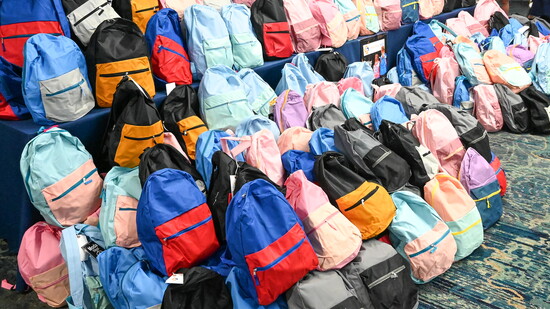
Comfort Cases are backpacks filled with comfort and personal care items for youth entering the foster care system. Rob Scheer knows what it means to carry everything he owns in a trash bag. Today, the Maryland father and founder of Comfort Cases is determined that other foster children won't have to.
A childhood marked by abuse, foster care, and homelessness became the foundation for a ministry of compassion, dignity, and practical service. The story is not simply about giving children backpacks. It's about showing them they matter.
Childhood in a Trash Bag
When Rob entered foster care at age 12, he carried his belongings in a trash bag. When he turned 18 and became homeless, that bag represented everything he owned.
In his TEDx talk, Rob explained: "That trash bag tried to define me. It tried to make me feel that I was worth less than trash. It tried to make me see that I was not worthy of anything."
From Mortgage Banking to Comfort Cases
Rob described himself as a banker by trade, having worked in the mortgage industry since he was 20. By 2012, he was a senior vice president at a mortgage company, while his husband, Reece, had given up his career to become a very busy stay-at-home dad, raising their four children. Rob acknowledged that this is the hardest job in the world.
The mortgage company had established a tradition of organizing large Christmas toy drives for disadvantaged children in the Washington, DC, area. However, Rob began questioning whether these annual toy drives were creating the lasting impact he wanted.
During the 2012 Christmas season, Rob began reflecting on what their children were learning from these activities. He believed they had been generous with toys but had missed an opportunity to teach their children empathy.
Rob then remembered something from his childhood: the trash bag he had been given for his belongings when he entered foster care.
Even more troubling, the children Rob and Reece had welcomed into their own home through foster care had arrived with trash bags, too. They realized that decades later, children were still being treated in a way that made them feel disposable. Rob told Reece they needed to eliminate those trash bags, beginning in the Washington, DC, area.
From an Idea to a Nonprofit
Rob gathered members of his company's senior staff, people from their church, and some local political contacts. He told them about his childhood in foster care, something he had rarely discussed publicly.
Together, they began identifying the essentials a child should receive when entering foster care: new pajamas, personal toiletries, a toothbrush, age-appropriate books, activities, and comforting belongings.
The first packing party took place in December 2012. Comfort Cases was formally launched in 2013 in Montgomery County, Maryland. Rob's experience as a business executive gave him organizational and leadership skills, but his inspiration came from his childhood and his desire to teach his own children compassion.
Rob said, "We didn't start Comfort Cases with a master plan, but we ran it like a business from day one." He explained that they established procedures, standardized backpack contents, developed supplier relationships, and organized volunteer packing events. A trash bag says, "You're disposable." A Comfort Case says, "You matter."
Over the years, Rob and his husband Reece adopted four foster children, Amaya, Tristan, Grayson, and Makai. Amaya smiled when she received her brand-new nightgown. Tristan suggested including stuffed animals in every Comfort Case. Grayson said to include blankets so foster children would know someone loved them. The whole family contributed in one way or another to Comfort Cases.
And Then There Were Five
In September 2019, Rob was speaking at a Montgomery County, Maryland, High School when 18-year-old Alex approached to have his book signed. Alex explained that he had been in foster care since age five, lived in 11 homes, attended six schools, and feared becoming homeless when he aged out of the system.
Rob invited Alex to spend a Saturday with his family. They went out for dinner, and Alex got to know the children. Afterward, Rob's children insisted that their fathers do something more. They said, "We have to bring him home."
Rob and Reece petitioned the court, welcomed Alex into their home, and made him part of their family. Alex later asked to be formally adopted because he wanted the same last name as his brothers, sister, and parents.
Nationwide, Going International
Comfort Cases reports distributing more than 320,000 backpacks and duffel bags since its founding in 2013, reaching all 50 states, Washington DC, Puerto Rico, and the United Kingdom. Rob summarized it like this: "We all want to be loved. We want to know we matter. We're not disposable."
For more information or to volunteer, contact Comfort Cases National Center, 9300 Gaither Road, Gaithersburg, MD 20877, call (301) 605-7813, or visit https://www.comfortcases.org
TEDx Tysons talk: https://www.youtube.com/watch?v=xb0GKVJWhL8
A trash bag says, "You're disposable." A Comfort Case says, "You matter."