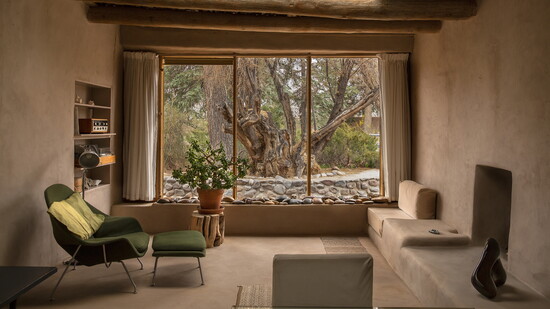
Sitting on lands long stewarded by Pueblo peoples, whose traditions still shape this place, Georgia O’Keeffe’s Abiquiú home and studio make a quiet first impression. Adobe walls soften sound and regulate temperature. Courtyards turn inward, and windows frame the landscape. “When visitors first walk in, they say it looks like an O’Keeffe painting come to life,” says Giustina Renzoni, director of historic properties at the Georgia O’Keeffe Museum. “They’re blown away by the size and don’t realize how large it is.”
Finding Abiquiú
O’Keeffe came to Northern New Mexico in the late 1920s, drawn by its vastness and solitude—what she called “the Faraway.” While in the Taos area, she searched for new landscapes to paint. “She would take her Model A Ford out looking for a good place to set up,” Renzoni explains. Friends soon encouraged her to visit Abiquiú and Ghost Ranch. When O’Keeffe first saw the Abiquiú property in 1935, it was vacant and in disrepair. Yet one detail captivated her. “That wall with a door in it was something I had to have,” she is said to have recalled. “The house itself held close to two centuries of history before O’Keeffe made it her own,” Renzoni says. The Adobe Hacienda’s earliest rooms date to the 1740s, first used as a shepherd’s hut before becoming a residential compound.
When O’Keeffe finally bought the property a decade later, it required major reconstruction. Local community members were hired to restore it using traditional building methods. Original features were preserved where possible, and more than 22,000 adobe bricks were handmade from nearby earth to expand the house into a pueblo-style hacienda. O’Keeffe also introduced subtle contemporary additions. “She made some pretty modern changes,” Renzoni notes, “including large landscape windows and skylight features you wouldn’t typically see in a traditional Northern New Mexico adobe home.”
Framing Space and Solitude
Despite its size, Abiquiú feels incredibly intimate. Thick walls, enclosed courtyards, and limited exterior openings create privacy and quiet. There are neighbors on only one side, and the property turns inward. “For O’Keeffe, home was really having a place of her own,” Renzoni says, “where she could create an environment that helped facilitate her creative process.” Her bedroom and studio sat inside a separate building, far from the road. Each morning, O’Keeffe passed through her studio on the way to the kitchen for breakfast, ensuring her first moments were with light and landscape. “She used architecture the way she used composition,” Renzoni says. “Framing exactly what she wanted to see, and nothing more.” The garden at Abiquiú also drew O’Keeffe. The property has held water rights since the 1700s, which remain active today through the acequia system. Each summer, hundreds of pounds of fruits and vegetables are grown and shared or donated among staff, local high school students, and area non-profits.
Abiquiú was O’Keeffe’s primary home from 1949 until her move to Santa Fe in 1984, and the setting inspired roughly 60 works. She often returned to the cottonwood trees outside her window and the patio door in the courtyard, where the house itself became part of the composition. “It’s not just about the landscape here,” Renzoni notes. “It has a lot to do with the architecture as well.”
Visiting Today
Tours are limited to eight guests per group and curated with great care. When they end in late fall, the home shifts to preservation mode. Adobe walls and earthen floors are repaired by hand each winter using traditional methods. Resuming in March this year, the museum offers a new Closet Visit, using fashion to explore O’Keeffe’s life and work. “Many people have come to recognize Georgia O’Keeffe as a style icon,” Renzoni says. The experience includes a walk through the home and concludes with a dive into her wardrobe, featuring some of the most iconic pieces from the museum’s collection while exploring her place in fashion history.
An Evening Tour also returns this summer, ending with a garden reception. Renzoni notes that tour dates can sell out months in advance, but encourages visitors to explore the Welcome Center and visit Ghost Ranch for hiking and horseback riding in the same landscapes O’Keeffe painted. “People leave Abiquiú understanding this wasn’t just where O’Keeffe lived,” Renzoni says. “It was how she lived.”