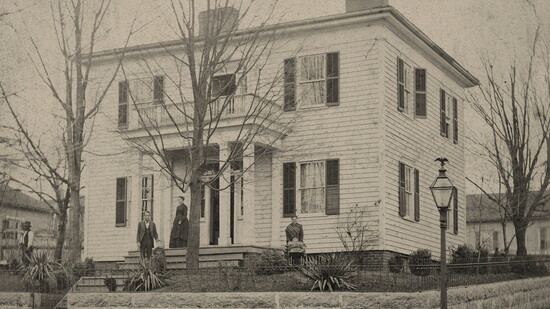
With wintertime just around the corner, it’s much too easy to take for granted the casual flick of a light switch. One hundred and fifty years ago in Knoxville, it was rather different. During dark and often dreary nights, particularly during the post-Civil War years, local residents were just getting used to a new marvel: the gas lamp. These new flickering lights, put up on the busiest of street corners, began to shine a little light onto a gloomy city.
Over the next few weeks, you may see a gas lamp or two while watching any number of the film adaptations of Charles Dickens’ A Christmas Carol (1843). Whatever your favorite version is, one thing never changes, and that is, having finally closed his counting house late on Christmas Eve, Scrooge heads home along a darkened street to his house and sees Jacob Marley’s face appear in the doorknocker. The street and Scrooge’s stoop would have been likely lit by gas lamps. Later, when the Ghost of Christmas Present takes him on a wander through the streets of London, a lamplighter appears. Dickens writes, “The very lamplighter, who ran on before, dotting the dusky street with specks of light, and who was dressed to spend the evening somewhere, laughed out loudly as the Spirit passed, though little kenned the lamplighter that he had any company but Christmas.”
It would take more than a decade after Dickens’ novel came out before Knoxville got its first gas company. Exclusive rights to illuminate the city were awarded to entrepreneurs William Churchwell and Willam Swan in 1854, and they soon got the Knoxville Gas Light Company up and running. By 1860, the city, with a population of about 5,300, boasted 40 streetlamps and 128 private meters.
Then the serious business of the Civil War got in the way of progress, and the rugged city, occupied by Confederate and then Union troops for two years apiece, was plunged into relative darkness.
After the war, the city’s Gas Committee would prescribe the hours for lighting and extinguishing streetlamps and employ official lamplighters. Using a nationally published almanac for guidance, schedules were based on the prediction of moonlight: the rising and setting of the moon. Presumably, gas lamps weren’t lit at all on bright and cloudless nights.
For every lamp the lamplighters lit, they climbed a ladder to light the wick, and early in the morning, long before dawn, they returned on their patrols to extinguish them.
Following lunar activity ended in 1870 when the Gas Committee instructed the lamplighter to follow the committee’s schedule, “whether the moon shall shine or not.” By then, the gas works, located down by the river, used coal to produce gas that was then distributed by pipes throughout the city.
As Staub’s Opera House on Gay Street was undergoing construction in 1872, gas lamps were installed throughout the building, and by the main entrance, to help welcome new patrons coming to see the opening play, William Tell.
But if the town was delighted with its new grand entertainment venue, it was particularly proud of its street lighting all around. The following year the Daily Press & Herald reported, “The lamps and post [at Staub’s] are decidedly ornamental, while the light they diffuse is equal to that from the gas lamps in other parts of the city. We think Knoxville can now claim to be the best lighted city in the southern states.”
Others shared in the new wonder: around the same time, gas lamps were placed in front of the African American churches just east of downtown.
By the early 1880s, the official lamplighter was one Thomas Lockett, who proved to be creative on his rounds. After falling off his ladder one time, he rode a horse around and stood on the horse’s back to light his lamps. His trusty aid enabled him to complete his round and be back home in front of the fire for a few hours before returning to snuff them out around three in the morning.
Not being able to satisfy everyone, the lamplighter was questioned by one newspaper reader who asked, “Why in thunder don’t you keep the lamps lighted, these rainy nights, when there’s no moon and the streets are as dark as 40 black cats in the bottom of a well?”
Lockett was likely simply following the committee’s orders. Another time, he was accused of ignoring some residents’ gas lamps, and also for being too slow on his rounds. Lockett claimed that he was under instruction by the committee to “take his time.” Within a few years, a team of eight lamplighters would be employed.
Soon, however, the era of the downtown lamplighter was about to pass. The first electric lights were installed in 1885 and proved to be way more practical and satisfactory, even though gaslight service continued in some parts of town until the 1930s.
How wonderful it is today to walk around downtown at night and not have to worry about the moon’s schedule or waiting for the lights to be manually lit in sequence. Most fortunate we are.
This article is an extract of “Ghost Walking the Gas-Lit Streets of Knoxville,” first published on InsideofKnoxville.com. For more stories in this series, search for “Ghost Walking” on that website.
About KHP: The educational nonprofit Knoxville History Project tells the city’s true stories, focusing on those that have not been previously told and those that connect the city to the world. Donations to support the work of KHP are always welcome and appreciated. Learn more at KnoxvilleHistoryProject.org.