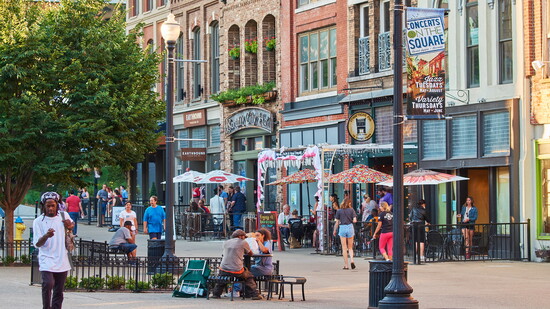
There are ghost walks and then there is ghost walking, which is how I often think about history while walking around downtown Knoxville.
Working for the Knoxville History Project since 2017, I’ve become familiar with the city’s history and many of its downtown spaces. I’m not an expert on Knoxville history, but I work for a man who is: Jack Neely, executive director of KHP, has been researching and writing about the city’s past for more than four decades now. Together, we’ve been writing articles for this magazine since 2020.
A few years ago, as I was walking with Jack through Market Square, my thoughts drifted back to the old Market House that dominated the square with its long, turreted, building. The structure still left enough room on either side for vendors to come in, first with their horses and wagons, later with their cars and trucks.
I casually asked Jack back then if he saw the ghosts of buildings wherever he went? Of course, he’d been seeing them for years.
Having recently re-read Jack’s book, A History of Market Square: The Most Democratic Place on Earth (2009), the old Market House had been looming large in my mind.
Everywhere one goes, layers of history are stacked on top of each other. As a space specifically designed to attract people and businesses, Market Square may be stacked deeper than most. In my mind there are ghosts of buildings and people everywhere. Like the shuffling on an old train station timetable, I often imagine many different eras at once, all blending in with each other.
Back when the northern edge of downtown lay along Clinch Avenue, there was an open field marked by blackberry bushes, and perhaps a few trees and whatever vegetation wasn’t gnawed on by a stray goat.
In my mind, I can see young entrepreneurs William Swan and Joseph Mabry scheming to buy this land, donating the middle section to the city, with the hope that the buildings that they’d own surrounding it would steadily increase in value once a public market hall was built (it was in late 1853). Profits may have been slow to realize in their own lifetimes, but they were certainly forward-thinking businessmen.
Photographer Thomas H. Smiley came to town in the 1850s and climbed the steps in the old courthouse on Main Street to capture what he could see looking to the north. In his photograph, Knoxville looks a little like Colonial Williamsburg without the tourists. Within two years, the town, like everywhere else, would be plunged into Civil War. You can see the first market house in the middle of the photo, more like a solitary barn than a bustling market.
As the town began to shrug off the misery associated with the passing of that conflict, the public market eventually took off and the square would get its first impressive building, courtesy of a recuperating soldier who decided to stay here after making a few dollars selling hoecakes to fellow combatants–Peter Kern’s bakery, built in 1875, still stands on the southwest corner where the Oliver Hotel and Tupelo Honey are today.
Kern’s would become locally famous as an impressive retail emporium filled with German-inspired candies. Kern, who was born in the U.S. to German parents, would add a soon-to-be-popular ice cream parlor and, before it was sold in bottles, an elaborate marble soda fountain—years before electrical refrigeration became a dependable thing.
Of course, there were also saloons, dry goods stores, barber shops, and likely horse manure galore. Almost everything that can happen in a city has happened in Market Square. Farmers drove their horses and wagons to sell their produce and their wares; others came simply to buy. Still others came to loiter and scrounge for what they couldn’t afford.
When City Hall was built in 1868 on the north end, officials installed a jail—or a “calaboose” as they called it—in the back where the chattier prisoners would engage passersby through the bars in the windows. The fire station was there too, particularly noticeable when the fire bell rang in the tower, followed by the trundle of firemen’s boots and the snorting of horses as those early fire teams spang to life.
In 1897, a larger Market Hall was erected, and it stood for a little more than 60 years. An urban myth has it that the Market House Hall burned down. Demolition was already a likely prospect when there was a fire in 1959, started by a careless teenager, but it wasn’t enough damage to cause the permanent closure of the structure. But a few months later, the City took the structure down anyway. The Market Square Mall era, with its concrete toadstools, was about to get underway. But that’s another story.
In the meantime, Market Square remains busy today, bustling with life as it always has; business owners trying to make a living, hopefully by satisfying contented customers moving throughout the square along with everyone who has ever been there before them. It’s a colorful place. I hope it always remains so.
This article is an extract of “Ghost Walking Market Square,” first published on InsideOfKnoxville.com. For more stories in this series, search for “Ghost Walking” on that website.
About KHP: The educational nonprofit Knoxville History Project tells the city’s true stories, focusing on those not previously told and those that connect the city to the world. Donations to support the work of KHP are always welcome and appreciated. Learn more at KnoxvilleHistoryProject.org