Charles Dickens’ classic tale, “A Christmas Carol,” where Ebenezer Scrooge encounters the Ghosts of Christmas Past, Present, and Future, was published on December 19, 1843, and by Christmas Eve, it had sold out. The first printing was six thousand copies. That same year would also see the invention of the commercial Christmas card, when Britain’s Henry Cole commissioned a thousand cards from the artist John Callcott Horsley, launching a tradition that has spread worldwide.
A quarter of a century before, in 1818, the very first performance of “Stille Nacht” (Silent Night) took place on Christmas Eve in a small church in Austria, on guitar, as the story goes because the church’s organ had failed. Joseph Mohr wrote the words and Franz Xaver Gruber the melody. Keep that carol in mind. It turns up again in 1914.
Much later, in 1941, a mere seventeen days after the attack on Pearl Harbor, Winston Churchill would be found spending Christmas at the White House, where he and President Franklin D. Roosevelt addressed America via radio on Christmas Eve. They spoke from the South Portico as the National Community Christmas Tree was lit. “Let the children have their night of fun and laughter,” Churchill told listeners. The following day, America would first hear Bing Crosby sing “White Christmas” over those radios on Christmas Day; it later became the bestselling single of all time, by most counts. For a good many of us, it simply is what December sounds like.
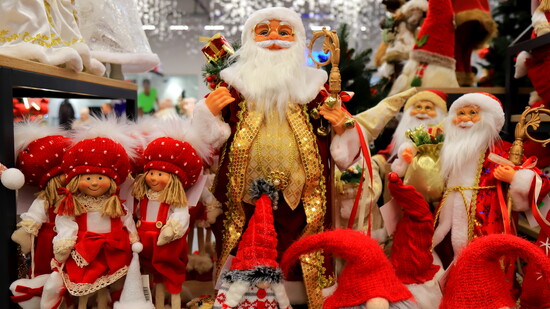
And another cherished Christmas tradition, the poem initially published as “Account of a Visit from St. Nicholas,” but better known by its first line, “’Twas the Night Before Christmas,” was published anonymously in a Troy, New York, newspaper on December 23, 1823. It is traditionally credited to Clement Clarke Moore, though some scholars argue for Henry Livingston Jr. Its description has long influenced the image that comes to mind when we think of Saint Nick.
One of the more recent Christmas traditions, the NORAD Santa tracker, reputedly owes its origins to a misprint in a Sears newspaper advertisement. In 1955, a misprinted number in the ad resulted in a child calling the Continental Air Defense Command in Colorado Springs, Colorado. When Colonel Harry Shoup answered the phone, the child asked, “Are you Santa Claus?” So as not to disappoint the child he decided to tell the child he was Santa Claus and provide updates on his flight around the world. Thanks today to volunteers at Peterson Space Force Base, who answer thousands of phone calls and emails while maintaining a digital tracker online, it continues to this day. Many significant events in world history occurred on Christmas Eve or Christmas Day.
Charlemagne, already King of the Franks, was crowned by Pope Leo III in Rome as Emperor of the Romans on Christmas Day in AD 800. More than two and a half centuries later William the Conqueror, fresh off his victory at the Battle of Hastings, would be crowned King of England in Westminster Abbey, on Christmas Day in 1066. The crowd’s cheers inside were taken for an attack by Norman guards, who set fire to nearby houses. And in 1914, during World War I, German and British soldiers along a portion of the Western Front stopped fighting, exchanged greetings, and shared a rare moment of humanity during an otherwise brutal conflict, on Christmas Eve. Small trees and candles lined the German trenches, and carols crossed the lines, among them “Silent Night.” By Christmas morning, men who had been shooting at each other walked out into no man’s land together. They traded food and tobacco, and they buried their dead.
It’s worth noting that the earliest Christians didn’t celebrate the birth of Christ; his resurrection at Easter was and remains their most significant holiday. But a Roman calendar around the mid-300s AD, drawing on records as far back as the reign of Constantine (the first Christian Emperor of Rome), shows that December 25th was recognized as Christ’s birthday. Some believe scholars derived this date from Biblical texts, but others think the date was chosen because the Saturnalia, a Roman pagan holiday the poet Catullus called “the best of days,” or Sol Invictus, happened to fall around that time. While in its time this might have made the new religion more palatable to pagan converts, much later this belief would lead the Puritans of Massachusetts to ban the celebration of Christmas from 1659 to 1681, partly because of its “pagan roots.”
The history of the Americas has its own share of Christmas tidings, if you will, starting in 1492 when Christopher Columbus spent Christmas Eve off the coast of Haiti. His lead ship, the Santa Maria, ran aground that night and was abandoned there. In 1776, George Washington and his Continental Army crossed the Delaware River on Christmas Night, surprising the Hessian garrison in Trenton in a battle that helped turn the tide in the fight for independence. During the US Civil War, General William Tecumseh Sherman would famously present the captured city of Savannah, Georgia, to President Lincoln as a Christmas gift. And on Christmas Eve in 1968 Apollo 8 astronauts Frank Borman, Jim Lovell and William Anders would orbit the moon, becoming the first to see its far side, and reciting from the Book of Genesis to a listening world. On Christmas Day, the engine that would bring them home fired behind the moon. Lovell then radioed Earth: “Please be informed, there is a Santa Claus.”
“Men who had been shooting at each other walked out into no man’s land together.”