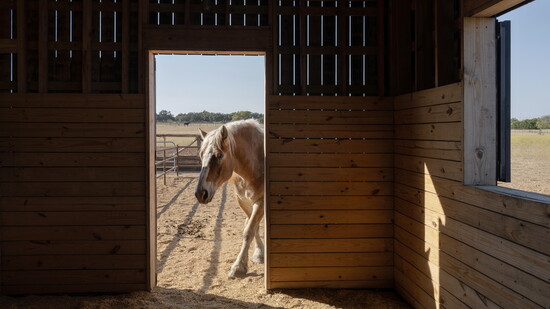
In the hills just outside Dripping Springs, a small herd of aging horses moves slowly through the pasture. Some navigate by sound, some by memory; a few can no longer see at all. But here, among the live oaks and limestone, blindness isn’t a burden. It’s simply part of life at Haven x Campise Farms, a nonprofit sanctuary offering end-of-life and special needs care to horses that would otherwise have nowhere to go.
“Many of our horses come from Texas kill pens, their last stop before crossing the border in Mexico,” says Kelli de la Torre, founder of the sanctuary. “This is the fate for thousands of horses in the U.S. every year. We exist to change that ending, one animal at a time.”
De la Torre grew up surrounded by land and livestock. Her family has been farming and ranching in Central Texas for more than a century, ever since her ancestors immigrated from Sicily. “As a third-generation lover of agriculture, I’m deeply grateful for the seeds of stewardship that were planted in me from childhood,” she says.
That heritage, mixed with a lifelong passion for animals and design, eventually gave rise to Haven x Campise Farms. The sanctuary now cares for a dozen horses—many blind, aging, or medically fragile—as well as a small collection of goats, dogs, and barn cats.
Haven’s approach is simple but radical: care without condition. “Every horse who arrives here is met with compassion and a promise: to rest, to heal, and to be loved for exactly who they are,” de la Torre says.
The idea for Haven grew out of personal tragedy. In 2014, de la Torre lost her husband to terminal cancer, and the grief left her searching for meaning and peace. “I found healing in nature, in quiet routines, and in caring for something outside myself,” she says. “That’s really what Haven is. A place that allows others, human or animal, just to breathe again.”
The sanctuary began when she intervened to rescue four blind horses from Bowie, Texas. “They were my first teachers,” she recalls. “They showed me what resilience looks like.”
Today, those horses and others like them live out their final chapters surrounded by the sounds of birds, the touch of gentle hands, and the slow rhythm of life on the land.
Unlike many rescues, Haven is not focused on adoption. It’s more hospice than stable. It’s a place where animals too often deemed “unadoptable” can exist in comfort. The horses’ days are filled with simple rituals: grooming, grazing, vet checks, and plenty of quiet companionship.
The sanctuary’s barn, designed and built by an all-women team, reflects the same thoughtful ethos. It includes sensory-accessible features for blind horses, such as a gravel-lined path that leads to an aerated fountain they can locate by sound and texture. “We wanted to create an environment where the horses could navigate safely and feel secure,” de la Torre explains.
One of Haven’s most meaningful initiatives is The Sterling Fund, named after a severely emaciated gelding rescued from the Bowie auction. Sterling arrived too weak to recover, but he spent his final days surrounded by care and comfort.
Through the fund, Haven provides medical treatment, palliative care and, when necessary, humane euthanasia, which de la Torre calls “a final act of love.”
Since moving to Dripping Springs, Haven x Campise Farms has found a strong community among locals. “We’ve met the most wonderful people who love our horses as we do and truly see the heart of our mission,” de la Torre says. “Dripping Springs definitely feels like our most aligned home.”
The sanctuary regularly hosts Open Barn Days, giving families, students, and neighbors a chance to meet the animals and learn about end-of-life care. “It’s a powerful experience,” de la Torre says. “People leave with a new sense of empathy and respect for aging and imperfection.”
Volunteers also play a big role in daily operations—feeding, grooming, cleaning stalls, or simply spending time with the animals. “Every pair of hands matters,” she says.
Haven continues to grow. Plans are underway for The Loft x Haven, a guest experience opening in 2026 that will allow visitors to stay on the property, participate in daily chores, and learn about holistic animal care and land stewardship.
“We want people to see what compassion looks like in practice,” she says. “It’s not glamorous work, but it’s meaningful.”
Haven is sustained entirely by donations and sponsorships. Supporters can sponsor a horse for $30 a month through the Sponsor a Soul program, which helps cover feed, vet care, and daily supplies. Donors receive updates and photos, watching as the horses age and heal in peace.
“Everything we do here—every bale of hay, every vet visit—is made possible by generosity,” de la Torre says. “We’re a small operation, but the love behind it is big.”
HavenxCampiseFarms.org | @havenxcampisefarms
Giving Back to the Land
Haven isn’t only about animals. It’s also about the soil beneath their hooves. The sanctuary integrates regenerative and biodynamic farming practices, allowing horses to rotate through pastures and naturally fertilize the land. “Our horses are partners in land restoration,” says de la Torre. “They heal the earth while the earth helps heal them.”
“This place isn’t about saving every horse. It’s about rewriting the ending for one soul at a time.” - Kelli de la Torre