Like any city, Knoxville has no shortage of unique and historic houses that were unfortunately lost to fire, demolition or neglect. There weren't many structures in the world quite like the Vendome or Westcliff mansion, while Logan Temple was an excellent example of a late 19th-century church, designed by one of Knoxville’s most prominent architects. Only recently, a fairly nondescript downtown parking garage stimulated robust conversations about historic preservation throughout the city.
These images from the Calvin M. McClung Historical Collection, and one film still from the Tennessee Archive of Moving Image and Sound, offer glimpses of classic Knoxville structures now gone but not likely to be forgotten any time soon.
“Westcliff” mansion
Knoxville industrialist and inventor Weston Fulton built his mansion, which he called "Westcliff," in 1928 at 5709 Lyons View Pike. Architect Charles Barber designed the ornate, multifaceted complex, which referenced many periods of Spanish and Italian architecture. So fantastic was the mansion's design, it was used as a castle in local filmmaker Mildred Keister Dennis' 1940 live-action "Snow White" film, from which this 16mm frame is taken. A few photographs of the mansion circulate, but most are in black and white. This is a rare color view of the mansion.
Very few glimpses of the mansion’s interior are known to exist, but another film in color at the Tennessee Archive of Moving Image and Sound gives a sense of what the house looked like inside just three years before it would be demolished.
Fulton died in 1946, and the mansion slowly fell into disrepair. In 1967, the house was demolished to develop Westcliff condominiums. The original gatehouse and the pool are the only parts of the original mansion that survive.
Logan Temple A.M.E. Zion Church
Knoxville's A.M.E. Zion Church was founded in 1865, and the cornerstone for Logan Temple was laid Sunday, November 22, 1885, at the corner of Marble Alley and Reservoir. The latter street would soon become Commerce Avenue, and a small strip of it remains today. Architect Joseph F. Baumann designed the structure, and L.C. Waters remodeled and expanded the church in 1911, including the addition of brick veneer.
In this damaged glass plate image, ladders are visible leaning against the side of the building, and some of the stained glass windows are only partially installed. A note on the back of the photo, “Logan Temple for Galyon,” suggests local construction company Johnson and Galyon was contracted for the remodeling, and documented their work in progress. A photograph of the church with completed restoration can be viewed at the McClung Digital Collection.
Frederick Douglass was known to visit the church at least once, likely in 1892, around the time he gave his lecture “Self-Made Men” at Staub’s Opera House. The church suffered a devastating fire in 1954, was condemned in 1958, and finally razed in August 1964. Today the site is occupied by Marble Alley Lofts at the corner of Commerce and Charles Place.
The Vendome Apartment House
The Vendome building stood at 417 W Clinch St., what today is a surface parking lot on the corner of Walnut and Clinch. W.J. Berg opened the six-story hotel on January 25, 1890, advertised as having many modern amenities, including hydraulic elevators, hot and cold water throughout the building, and boasting "Knoxville's only fire escape!" Rooms were $2.00, $2.50 or $3.00. The Vendome's hotel rooms eventually became long-term apartments.
What is particularly interesting about the Vendome is that no photographs capturing it in its full glory are known to survive. As it was hemmed in by other buildings on a narrow, crowded street, it was likely difficult to take a good photograph of the building in its entirety. Parts of the building, including its spire, make appearances in other images of downtown Knoxville at the time, but until a photograph is discovered, this architectural rendering published in the American Journal of Commerce is the best idea we have of what the Vendome might have looked like.
The building was demolished in 1942. Like Westcliff, which stood for less than four decades, it seems a rather short lifespan for such an extravagant structure.
Caption of image: The Vendome Apartment House. Leon Beaver, Architect. (Historic Illustration: Beaver & Hoffmeister, Architects, Knoxville. 1887). From the American Journal of Commerce. Vol. XVII, No. 28. December 1903.
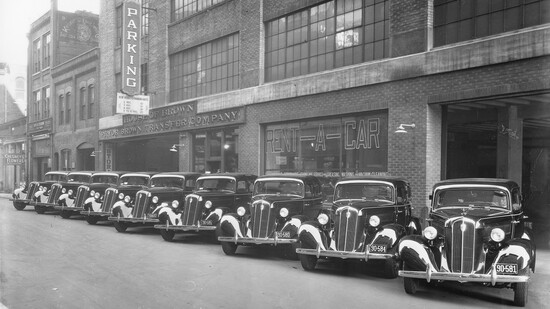
Pryor Brown Building
It might seem odd that people would be nostalgic for a parking garage, but Pryor Brown held a special place in Knoxville’s memory.
Drawing upon his experience as a horse-riding mail carrier, Pryor Brown originally built a livery stable at the corner of Church and Prince (later renamed Walnut) in the 1880s. As automobile ownership and usage grew, Brown built an 18,000-square-foot 400-car-capacity parking garage on this site in the late 1920s. The bottom floor hosted retail establishments and Brown’s parking, car rental and cab offices, while the top three floors were used for valet parking.
Two “gold bricks” were supposedly embedded in the structure and served as a local point of interest for decades. The building gradually fell into disrepair over the years, but was actually in use as a garage into 2013, with several businesses still operating on the ground floor. Plans to convert the building into a mixed-use retail and apartment complex never materialized, and the building was demolished in 2025 amidst a good deal of concern and controversy.
In its final years, the Pryor Brown building became an eyesore to some and a battered but charming relic to others. Downtown dwellers and workers would often sneak a peek into the dilapidated building through broken windows as they walked past, or catch a whiff of the strong musty smell produced by years of rain pouring into the roofless building.
The Knoxville History Project is an educational nonprofit dedicated to sharing Knoxville’s true stories. Eric Dawson is manager of the Calvin M. McClung Historical Collection, part of the Special Collections and History Department at the Knox County Public Library. Learn more at KnoxcountyLibrary.org/calvin-m-cclung-collection and KnoxvilleHistoryProject.org.