A few years ago, on a work trip to Japan, I started thinking about early retirement. My son had just entered his senior year of high school and my daughter was starting eighth grade. Traveling alone through Osaka and Naoshima gave me time to think about what might come next.
My children would grow up. My career would end. I wondered who I would be when motherhood and work were no longer my center of gravity.
In Osaka, I rented a bike and spent my free time riding along the river, wandering through flea markets and imagining wild possibilities. I felt so alive. I wanted to keep exploring Japan—to visit regions known for their ceramics and baskets, discover markets in unfamiliar places and learn more about what I found.
I wanted a reason to keep coming back. An idea began to take shape. What if I started a small business bringing antiques and found objects back to the U.S.?
A year later, I had bought an apartment in Osaka and was building a business named after one of my favorite words: Lapel.
My curiosity about Japan started when my dad brought me home a Mt. Fuji T-shirt after a business trip in the 70s. The shape of Fuji-san was my favorite thing to draw in kindergarten. Decades later, what I love about spending time there is that there is no default mode for me. Even simple things require my full attention—ordering a coffee, asking the price at a flea market, finding my way somewhere new. The friends I've made in Osaka came to know me outside of work and motherhood.
Today I split my time between Mercer Island and Osaka, exploring markets, visiting antique shops and seeking out craftspeople. Along the way, I've built relationships with antique dealers and makers. Lapel began with a pop-up in Brooklyn, where I discovered that the things I couldn't resist often had the same effect on other people.
I retired from a career in corporate marketing in May. Now I'm building Lapel, guest lecturing at a university in Kyoto and writing Alive and Well, a collection of illustrated essays on Substack.
Originally I thought the idea for Lapel came to me in Osaka, but its seed had been planted a decade earlier, in a gallery on the north end of Mercer Island.
I met Ginny and Jim Clarke shortly after moving to the island in 2016. I bought my first piece of art for our new home from Clarke & Clarke Arts + Artifacts, and soon it became much more than a place to shop. It felt like home.
Clarke + Clarke is filled with art, ceramics, textiles and artifacts from all over the world. During demanding stretches at work, I would stop in to unwind and, without leaving the island, travel a little. I'd pick something up and ask where it came from, who made it, how old it was and how on earth Ginny and Jim had found it. The answer always came with a story—the history of the object and the adventure of finding it.
Over time, we drank wine and talked about careers, parenting, life and the world. Their own lives were part of those conversations. Ginny spent 30 years working in textiles and fashion. Jim had been a corporate executive at Xerox and a professor of anthropology. Together, they opened businesses in Hawaii, and galleries in Scottsdale, Santa Fe, and Seattle.
I was in the thick of my own corporate career when they told me these stories. I didn't know then how much their willingness to change direction, and to keep changing, would inform my own choices. Ginny and Jim have always felt like family to me. Looking back, I realize they’ve also been mentors.
When I began spending more time in Osaka, I found myself asking many of the same questions I'd asked the Clarkes. I wanted to know who made something, what it was used for, what a pattern meant or why a repair had been made. I imagined the life each object had lived before I found it. The more I learned, the more I realized how much I didn't know.
When Lapel began taking shape, of course I brought it to them. Our conversations shifted to what I was finding, what things were worth and what customers might love. They taught me about running a retail business and shared what they'd learned from decades of working with art and antiques, while giving me room to develop my own eye.
In the September issue of Mercer Island City Lifestyle, Ginny said, “As I grow older, I never want people to say ‘what a sweet old lady.’ I hope they’ll say, ‘what on earth is she up to now?’” I want people to wonder the same thing about me.
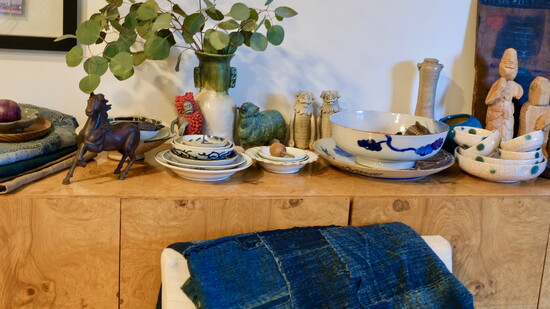
Lapel recently launched a pop-up at Clarke + Clarke with a collection of dishes, ceramics, fabrics and curious little statues. I’m also partnering with an antique dealer in Osaka to bring boro to local customers. Boro are Japanese textiles that were patched and repaired as they wore out, sometimes over generations. Born from necessity, they reflect a time when cloth was valuable enough to be repaired and reused rather than discarded. Each repair added another layer, leaving the history of the cloth visible. Given Ginny's own history with textiles, bringing them to her gallery feels especially fitting.
Having Lapel at Clarke + Clarke feels like coming home.
When I first imagined Lapel while riding a bike around Osaka, I thought it was a new idea. It turns out I'd been learning how to build it for years.
I retired from a career in corporate marketing in May of this year. Now I'm building Lapel, guest lecturing at a university in Kyoto and writing Alive and Well, a collection of illustrated essays on Substack.
Originally I thought the idea for Lapel came to me in Osaka, but its seed had been planted a decade earlier, in a gallery on the north end of Mercer Island.
Lapel recently launched a pop-up at Clarke & Clarke Art + Artifacts, with a collection of dishes, ceramics, fabrics and curious little statues.