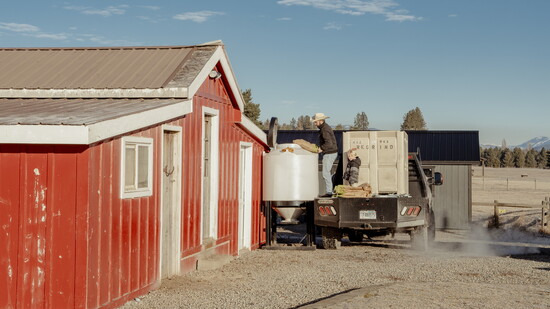
Amanda Saenz didn't grow up homesteading. Sure, she grew up in Spokane, connected to animals and nature, but it was nothing like what her life would become. Her husband was born and raised in Montana. His parents had a small farm and the whole family did 4-H. When the two married, they bought five acres in Columbia Falls with a few horses and a vegetable garden. Pretty normal, Amanda says.
Then, in March 2020, everything stopped.
Amanda's journey through a full-term pregnancy ended in devastating silence with the loss of her son. All while she was grieving, the world shut down around her. "My personal life stopped and also the world stopped," she tells me. "I was home for months and really depressed."
One day, something shifted. "I just felt like God was telling me to go be outside."
So she did. She started planting tomatoes for her kids. Sunflowers, because they reminded her of her son and made her happy. Her parents, trying to help, offered to buy her a greenhouse as a sympathy gift. "I was resolved to go out in the garden and find something that wasn't ugly," Amanda recalls.
Her kids were doing remote learning at the time. They spent hours outside together. It snowballed from there.
Gardening led Amanda to herbalism—figuring out what to do if you have a bad cut and the world is crazy and you need to handle it on your own. She walked their property with an app on her phone, learning about the plants growing wild there and what they could be used for. "I became obsessed with how to use our land and our property to supplement our living."
By the end of 2020, she'd taken herbalism classes and started making homemade products. At first, she had to order herbs online. For example, lavender from China for Epsom salts. Last spring, Amanda planted her own. Then calendula. "Probably my favorite to grow here in Montana," she says. It kept going from there.
Today, Saenz Family Farms sells eggs (their biggest product which they source from almost 400 birds), dried herbs, sourdough bread and baked goods, fire cider, coffee, tea, tinctures, honey, bath salts, dog treats, and so much more.
"I make really humble, simple products," Amanda explains. "And the reason it's worked is because people simply care."
She started selling at the farmers' market in Columbia Falls in May 2024. She was nervous, but the people loved her products. A friend taught her to make sourdough, so she incorporated that. "Now I'm so humbled that little old me is doing all of this because people care! I source my own seeds, grow things locally and organically, and it's becoming a substantial source of income for the farm."
In a couple years, the family will likely be completely self-sufficient. They're constantly investing back into the land from implements, tools, and a new shed. Amanda's goal is to become a local source for bulk ingredients that people usually have to order online. "There are so many people in the Flathead Valley who care about ingredients and want natural things."
They're also expanding their chicken operation. Amanda wants to raise purebred chickens to sell, especially rare breeds you can't find locally. Lavender Brahmas, for instance. And if she can make it happen this spring, she'll separate her roosters and hens, incubate, hatch, and sell the chicks.
Amanda also runs the Lakeside Farmers' Market, which she started two years ago on a friend’s property. It operated eight weeks in 2024, seventeen weeks in 2025. Now it's the only standing farmers' market that's ever existed in Lakeside. Every Saturday, hundreds of local craftspeople, makers, and growers show up—people with regular full-time jobs and side hobbies, doing what Amanda's doing.
"What's really cool is the community of people I've gotten from homesteading," she says. "Thousands of people come through each weekend, from all over the world."
People often ask Amanda how she does it all with seven kids (ages 15, 12, 9, 7, 4, and 2—and one who would've been 6). Her husband has a regular full-time job. He drops the kids off at school, she picks them up. They collaborate. Winter is easier to manage. Summer is busier—the kids are home, the garden is blooming, the farmers' market is in full swing.
"We just prioritize this way of life, and this is how we spend our time with our kids," Amanda says. "We don't go on vacation much; our families are close to us. You have to make a plan and set reasonable goals."
Her kids are hearty. They're not afraid of bugs or dirt or dead animals. They collect eggs, clean nesting boxes, wash and carton them. They help pull weeds, prune, and harvest fruit trees (there are over 20 on the property). Amanda's 12-year-old daughter knows how to identify and harvest calendula and how to store the herbs properly.
"They are learning both sides—how to run a business but also the very real world of growing and cultivating things," Amanda explains. "They know where their meat and vegetables come from."
This spring, starting in March, Amanda and her kids are growing tomato plant starts together. They'll plant a few thousand from their own plants, take them to market, and sell them. Whatever they earn will be their pocket money. "It's fun," Amanda says. "They don't always think so… but in the end I think they will realize it was a meaningful way to grow up."
For Amanda, there's no higher value than raising smart, competent, reliable people. "For them to know what it looks like to sacrifice is important."
When they lost her son, their life priorities drastically changed. They realized how much time they really have. "We were in the rat race," she says. Now she can make her kids breakfast, do chores, send them to school, do her computer work, then tackle farm chores together. "Our whole life is the business that we run out of the homestead."
Her advice to others curious about homesteading? "It's not that intimidating, I promise."
Start small. Learn to make mozzarella. Make your own yogurt. Amanda and her husband started with cereal when they looked at the ingredients on the back one day and decided ‘No.’
"You don't have to do it all right away. Start with just a few products."
And you can't do it all alone. "That's why you have to have a community," Amanda says. She doesn't make sauerkraut, for example, she buys from her friend Vanessa's local business, Farmented. "Let others who create things you love do that and focus on what interests you the most."
It all ties back to that moment in 2020, standing in her garden, deciding to go outside, and taking one step after faithful step. It was the intentionality and determination to grow something and to build a life rooted in the land beneath her feet and the people around her table.
Home, it turns out, is something you can grow.
I became obsessed with how to use our land and our property to supplement our living.
What's really cool is the community of people I've gotten from homesteading. Thousands of people come through each weekend, from all over the world.