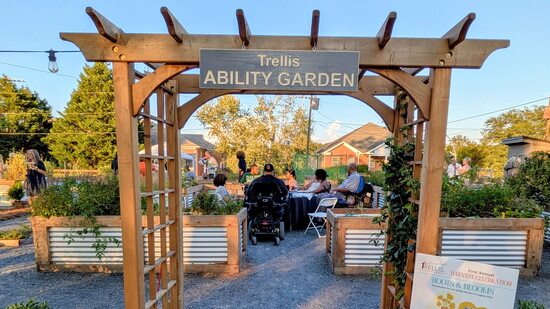
In Decatur’s largest greenspace, something remarkable is taking root. At Trellis Horticultural Therapy Alliance’s Ability Garden at Legacy Park, veterans coping with PTSD, stroke survivors, and gardeners using wheelchairs work side by side. Therapy happens not in clinical offices, but in the soil, under open sky, hands busy in raised beds, among friends.
The story of Trellis began with a vision and deepened through lived experience. Co-founders Rachel Cochran and Wendy Battaglia met at a horticultural therapy training program, united by a dream of bringing therapeutic gardening to Atlanta. Two years later, a life-altering event gave that vision sharper focus. When Rachel’s daughter survived a serious car accident resulting in life-altering injuries, Rachel gained an intimate understanding of the hardship and isolation people with disabilities face every day.
The experience revealed something both simple and startling: most spaces, especially outdoor ones, are not built with accessibility in mind. Many outdoor spaces have uneven paths, steep ramps, and fragmented layouts that quietly and continuously limit participation. When Rachel and Wendy reconnected, their mission solidified: create a fully accessible garden where people with physical challenges could engage with nature without first navigating obstacles.
For its first two years, Trellis operated as a mobile program, bringing soil, seeds, and supplies to assisted living facilities and special education classes. In 2019, a partnership with Callanwolde Fine Arts Center offered valuable space, including a greenhouse, but the setting presented challenges. Garden space was limited, and classrooms were spread across the campus. Workable, yet far from ideal for individuals using wheelchairs or walkers.
When Decatur Legacy Park offered space, everything changed.
The transformation has been profound. Where some participants once felt “tucked away” at the Callanwolde garden, many now describe feeling part of a vibrant, visible community. The garden’s design reflects intentional accessibility: raised beds at wheelchair height, smooth pathways for mobility devices, shaded outdoor classrooms, and a cottage that provides a comfortable indoor space year-round. These details, easy for many to overlook, determine whether participation feels exhausting or empowering. For individuals whose transportation challenges make every outing complex, the ability to access multiple resources in a single visit is nothing short of revolutionary.
Yet Trellis is not solely about accessible design. The organization’s deeper work centers on social and emotional wellness.
As Program Director Shelly Roberts explains, horticultural therapy involves achieving therapeutic goals through gardening. Instead of repetitive clinical exercises, participants engage in meaningful, productive activity. The same hand motion used to drop marbles into a cup during occupational therapy becomes the act of planting seeds. Strength and coordination develop almost incidentally, woven into tasks that feel purposeful and alive.
For stroke recovery groups, picking up and placing seeds builds fine motor skills, but with a far more satisfying outcome. The work is joyful and tangible, yielding tomatoes and herbs instead of simply completed repetitions. For veterans coping with PTSD, gardening offers a calming, structured environment and a safe, supportive social space.
The impact of Trellis becomes most visible in its stories.
One memory lingers from a middle school program serving neurodivergent students. A nonverbal girl, initially hesitant and withdrawn, found unexpected joy in planting. One plant became many, and curiosity became confidence. By the time she left, she was skipping toward the bus, visibly transformed by the simple act of being trusted with meaningful work.
Another story comes from a veteran who reflected on the difference a year can make. The previous birthday had passed in isolation and despair. The next birthday was spent seated on the ground with fellow group members, sharing cake, laughter, and belonging. Trellis had restored hope and meaning in life for this veteran.
Equally significant is what Trellis offers the broader community.
Disability often exists at the margins of public life; not through intention, but through the accumulation of small exclusions. Trellis disrupts this separation. At plant sales, festivals, and workshops, gardeners living with disabilities share space with neighborhood families, and volunteers learn alongside participants.
The organization’s emerging ethos — Connect, Learn, Thrive — reflects this widening vision. Trellis serves individuals living with physical challenges while inviting the wider Decatur community into shared space. Gardening classes, volunteer opportunities, and seasonal events transform the Ability Garden into a communal asset rather than a specialized enclave. The annual spring festival and plant sale on April 18th not only helps sustain Trellis’s programs but also embodies its mission, bringing together individuals of all abilities in a shared, welcoming space.
Trellis Horticultural Therapy Alliance’s programs are offered free of charge, acknowledging the financial realities many clients face. Funding depends on donors and grants, an increasingly uncertain landscape. Sustainability, like gardening itself, requires ongoing cultivation.
Trellis Horticultural Therapy Alliance is rooted in the simple, radical belief that people flourish when given access to nature, to community, to purposeful activity, and to one another. As Shelly Roberts notes, volunteers and staff often find themselves receiving as much as they give. In a world frequently defined by division and difficulty, Trellis offers something profoundly restorative: an accessible space where community grows.
To learn more about Trellis Horticultural Therapy, volunteer opportunities, upcoming classes, or ways to support its work, visit the organization’s website, trellishta.org, or stop by the Ability Garden at Legacy Park in Decatur.
“Trellis is rooted in the simple, radical belief that people flourish when given access to nature, to community, to purposeful activity, and to one another.”