Louis Comfort Tiffany was born into a world already prepared for him. His father, Charles Lewis Tiffany, had founded Tiffany & Co. and built it into one of America's great luxury houses. Wealth, social standing and a place within the family business awaited the younger Tiffany.
Instead, he chose to become an artist.
Tiffany studied painting, traveled extensively and became fascinated by color, nature and light. His interests expanded into interiors, mosaics, metalwork, ceramics, jewelry and, most consequentially, glass. Rather than simply inherit his father's legacy, he spent decades creating one of his own.
After Charles Lewis Tiffany died in 1902, Louis became Tiffany & Co.'s first Art Director. By then, however, he had already emerged as one of the defining figures of American Art Nouveau. Today, his name often evokes the famous Tiffany lamps, but some of his most ambitious work was created for sacred spaces.
Tiffany Studios produced monumental stained-glass windows and ecclesiastical interiors for churches, chapels, mausoleums and synagogues across the country. Through opalescent, textured and layered glass, Tiffany transformed biblical figures, angels and sacred narratives into experiments in color and transmitted light.
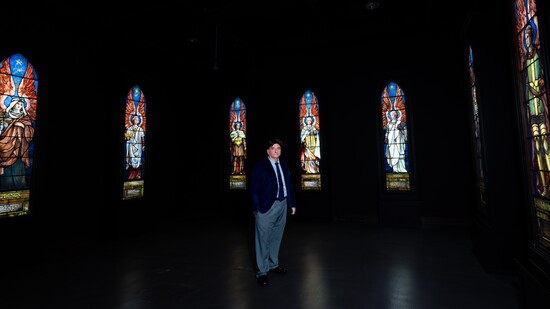
Among the most remarkable surviving examples is a set of seven monumental windows formally known as Angels Representing Seven Churches, now often described as the Seven Angels of Revelation.
Commissioned from Tiffany Studios in 1902 by the New Church Society of Glendale, Ohio, as a gift to the Church of the New Jerusalem in Cincinnati, the windows were dedicated in 1903. Each depicts the angel associated with one of the seven churches addressed in the Book of Revelation: Ephesus, Smyrna, Pergamos, Thyatira, Sardis, Philadelphia and Laodicea.
The eight-foot-tall figures are distinct, yet visually united by soaring wings, radiant stars and a jewel-like palette of blues, reds, ochres and golds. They were conceived as a single ensemble in which architecture, biblical narrative, material and light worked together.
Then the world around them changed.
In the 1960s, highway construction reshaped Cincinnati. The Church of the New Jerusalem stood in the path of that transformation and was demolished in 1964. The sanctuary that had given the windows their architectural and spiritual setting disappeared.
The Angels survived.
Removed before the building was lost, they passed into storage and eventually made their way to a Swedenborgian property in Pennsylvania. There, packed away in a barn, one of Tiffany Studios' extraordinary religious ensembles effectively disappeared.
The Seven Angels had become the Lost Angels.
In 2001, they were rediscovered. Conservators documented, cleaned, stabilized and restored the collection, allowing Tiffany's colors and craftsmanship to emerge again in transmitted light. Beginning in 2007, the complete ensemble traveled nationally in the exhibition In Company with Angels: Seven Rediscovered Tiffany Windows.
Yet touring left one question unanswered: Where did the Angels ultimately belong?
For stained glass, preservation alone is not the same as life. A window may survive safely in storage, but it cannot fully perform the function for which it was created. Stained glass needs light. It needs space. It needs viewers. And an ensemble such as this needs to remain together.
That search has now brought the Angels to Dallas.
Dr. Scott Peck, Executive Director and Curator of the Museum of Biblical Art, recognized in the collection something larger than seven beautiful examples of Tiffany glass.
"The Seven Angels represent a rare intersection of American art, biblical interpretation, architectural history and the history of stained glass," Peck says.
The ensemble has now found a permanent home at the Museum of Biblical Art.
The Seven Angels will make their Dallas debut during the Museum's annual gala on October 15, when guests will gather for an evening of dining, art and celebration among the newly installed works. The evening pairs dinner with the opportunity to experience the Tiffany windows illuminated in their new permanent home. Reservations are available through the Museum of Biblical Art website. The museum also hosts private events, giving guests the opportunity to create their own evening dining with the Angels.
The Angels can once again be experienced through the medium that gives stained glass its power: light.
They are lost no longer.
Their arrival gives Dallas something unusual. For visitors interested in Tiffany, biblical art, American design, stained glass or sacred architecture, the installation has the potential to become a destination in its own right.
There is a fitting symmetry to their story. Louis Comfort Tiffany stepped away from the future prepared for him and created an artistic legacy of his own. The Angels followed an unexpected path, then emerged to begin another journey.
Now that journey ends in Texas.
"We are now their Guardians, their Protectors," Peck says.
For decades, they waited in darkness. Now the Lost Angels will shine again.
"We are now their Guardians, their Protectors."