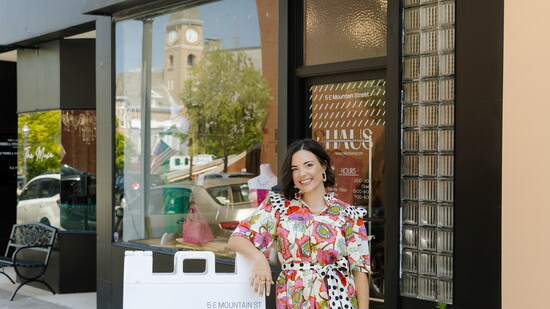
In the early hours of Saturday morning, as various vendors set up tents for the weekly farmers market, Callee Lane is readying to open the doors to Haus Collective.
Curious shoppers begin filtering through the doors of Haus Collective. They have no idea what they’ll find, and that is exactly what makes it so inviting.
One week, it might be a designer handbag that retails for hundreds of dollars. The next, a vintage leather jacket, an Anthropologie jumpsuit, or a pair of nearly new boots waiting for their second life. That unpredictability is exactly what owner Callee envisioned when she opened Haus in 2024.
“It’s like a treasure hunt,” she said. “Every Friday is so exciting because I don’t know what people are going to bring.”
Her store is more than a traditional boutique or regular consignment store, but instead intertwines the two, creating a sort of individualized closet.
The shop is made up of individual vendor booths, each rented by someone looking to clean out a closet, sell gently loved pieces, or showcase a carefully curated collection. Some vendors manage their own displays, bringing in their own decorations like disco balls and candles, while others choose a VIP option that allows the Haus team to handle pricing, merchandising, and sales.
You may not know what you will find, but the concept itself is simple.
“We’re basically Poshmark in person,” she said.
The store transforms each time new vendors come in, or the same vendors flush out the old with the new. The weekly rotation creates an experience that is constantly changing and keeps customers coming back not just to shop, but to explore the individual vibes and items of each booth.
For Callee, this was more than a successful retail concept.
Originally from Texas, she moved to Northwest Arkansas to study hospitality management and event planning before launching a career in the hospitality industry. While she enjoyed the work itself, the demanding schedule quickly became incompatible with the life she wanted after becoming a mother.
“I loved the job itself,” she said. “I just didn’t like the lifestyle that surrounded it.”
After welcoming her second child, she stepped away from hospitality with encouragement from her husband, who urged her to take time to discover what truly fulfilled her. During that search, she came across a growing business model centered around curated closet clean-outs—an idea that had begun gaining popularity in Utah.
Rather than replicate it, she gave it her own spin.
She wanted Haus to feel like an upscale boutique instead of a thrift store, offering everything from Target staples to luxury designer labels under one roof. She wanted a store that was accessible, but not overwhelming for the customer to have to dig through to find an item of clothing they liked. To further elevate the shopping experience, she added new jewelry and accessories to the front of the store, creating a space that bridges the gap between consignment and affordable, tarnish-free accessories. The dream quickly became a reality. Just three weeks after receiving the keys to the downtown space, the doors officially opened.
The inventory wasn’t something she had to purchase herself. Instead, the community filled the shelves.
“Every booth tells a different story because every booth belongs to a different person,” Callee said.
Today, more than 65 booths feature an ever-changing mix of clothing, shoes, handbags, home décor, jewelry, pottery, books, children’s items, and more. Beyond the in-store experience, Haus Collective also extends its reach online through Instagram and Facebook stories, allowing shoppers to shop the ever-changing inventory and purchase items with the confidence of knowing exactly what they are receiving.
Beyond creating an enjoyable shopping experience, Haus Collective encourages a thoughtful approach to fashion. The rise of affordable retailers has made fast fashion and rapidly changing trends more accessible than ever, often requiring consumers to weigh convenience and affordability against the significant environmental and ethical concerns that come along with shopping these retailers. Rather than criticizing shoppers, however, Callee hopes to provide an accessible alternative by providing a place for quality brands at affordable prices.
“I wanted there to be a middle ground,” she said. “A place for people to be able to access top brands for reasonable prices.”
Customers can experiment with trends without paying full retail prices while also extending the lifespan of clothing that might otherwise end up in landfills. Callee explained that many shoppers even develop a continuous cycle: purchasing pieces from Haus, wearing them a handful of times, then renting their own booth for their closet clean-out, allowing someone else to discover and love them next.
For her, the process is more than sustainability; it is about helping customers find their style and expressing their individuality.
She believes clothing remains one of the most personal ways people communicate who they are, especially as social media often pushes shoppers toward identical trends. Instead of chasing the same influencer-approved looks, Haus gives shoppers room to discover something unique and something that is completely them.
Whether it’s a vintage sweater from the 90s, an oversized statement jacket, or a colorful pair of boots, finding an unexpected piece often becomes part of discovering personal style.
“If you have on something that’s different and you show up with confidence, that’s everything,” she said.
Oftentimes, if you are browsing each booth and the items chosen, you leave feeling you met the person behind the booth.
The sense of community extends beyond customers. Many vendors eagerly anticipate rearranging their booths, restocking merchandise, and sharing their displays online. Others simply enjoy the satisfaction of knowing their once-forgotten clothing has found a new home. Those are the moments that have become the most rewarding part of owning the business, Callee explained.
She smiles when she spots one of Haus’s shopping bags around the Fayetteville Square or recognizes someone wearing jewelry purchased from the store. Each sighting reminds her that the small idea she built with the help of family has become part of the community’s everyday life.
Looking ahead, she hopes to open a second location in Rogers before possibly expanding even farther across the region.
But no matter how much Haus grows, the heart of the business remains unchanged.
Every Saturday offers a fresh start, for vendors clearing out their closets, shoppers searching for their next favorite piece, and clothing ready for another wear. And without a doubt, somewhere inside the store, there is always another unexpected treasure waiting to be discovered.