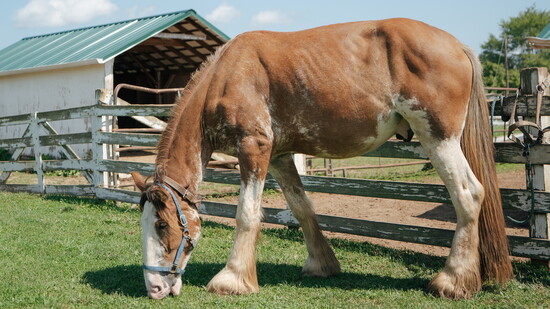
“Whole, complete, forgiven, heard, connected.” These are some of the words veteran participants in Project Horses for Forces (PHfF) use to describe their relationships with horses through the Pittstown, New Jersey-based program, which teaches “horsemanship for healing.”
Program Director Stacy Bajza explains that PHfF is not therapy, hippotherapy or counseling. Instead, the staff teaches horsemanship, giving participants an outlet through the touch of a horse or the feel of a brush moving through its mane.
Bajza believes veterans can find healing through an authentic connection with horses—one that can feel forgiving and understanding.
“It is not therapy,” she says. “They have enough of that. We call it ‘healing.’”
That philosophy is at the heart of Project Horses for Forces, which serves military veterans and active service members through horsemanship and partnerships with horses.
Former Marine Sgt. A.J. Gamboa describes Agent Gibbs, the program’s only Thoroughbred among its Clydesdales and Percherons, as her favorite horse.
“He has issues and I have issues,” Gamboa says. “We work through the issues together. Therapy is one-sided. Here, it’s a two-way street.”
As she strokes her service dog, Murphy, Gamboa adds, “I would not be where I am today if it weren’t for horses.”
The nonprofit was founded by Ruth Nortje, a physical therapist and former U.S. Olympic kayaker from South Africa. Nortje says the opportunities she found in the United States inspired her to find a way to give back. Having grown up with horses, she began volunteering with an equine-assisted program for people with disabilities before deciding to create something specifically for veterans.
She founded PHfF in 2017. This year, the organization has served 249 participants.
Nortje says meaningful moments can happen during simple interactions. A participant may be brushing a horse when the animal turns its head toward them.
“The reaction of the person is, ‘That horse just looked at me. That was for me,’” she says.
Some participants arrive with a fear of horses, but Nortje says working through that fear can build confidence and create a sense of communication between horse and participant.
“The horse will always be honest with you,” she says.
PHfF began with one program and has since expanded to three. The Outpatient Program serves veterans who travel independently to the farm, while participants in the Inpatient and Nursing Home programs are transported from facilities serving veterans.
The programs are designed to include participants of varying abilities. Training for the horses is ongoing, and Bajza incorporates wheelchairs and walkers into sessions to help the animals become comfortable around different equipment.
Participants have a say in how they spend their time at the farm. Some may stand beside a grazing horse or spend a session grooming. Others choose to ride, drive or navigate an obstacle course in the arena, either from the ground or on horseback.
For some veterans, participation eventually leads to volunteering.
Marine veteran Tommy Drogan has been involved with the program for about a year. After completing an inpatient program, he became involved with PHfF and found a connection with the horses.
“It’s a spiritual, healing journey,” Drogan says, adding that the horses “carry a greater load than I can carry. I sleep much better.”
His fondness for Sugar, a Percheron who has faced health issues of her own, is clear.
“She tends to trust me,” he says.
Staff member Kathy Hart, a PATH Intl. Certified Advanced Therapeutic Riding Instructor and Equine Specialist in Mental Health and Learning, explains that horses naturally operate with a fight-or-flight response. Once a perceived threat has passed, they release that energy and self-regulate, sometimes through a sigh, a yawn or playful behavior.
Hart says observing that process can resonate with people who may have difficulty letting go of stress after a challenging experience. The lessons, she says, can affect participants and volunteers.
Former police officer Mike Callagy is a familiar presence during sessions, helping with farm chores, feeding horses and washing troughs. He often keeps a curry comb in his back pocket, ready for a quick grooming session when he stops to visit one of the horses.
Volunteer Fran Dobler assists with participants and horse training and has become known for preparing lunch for those involved in the Outpatient Program. Dobler is not a veteran, and although her husband is a former Vietnam-era Marine, he does not participate in the program. For her, volunteering offers a way to support veterans while finding meaning in the work herself.
The programs are offered at no cost to veterans, and family members are welcome to participate, says retired Army Lt. Col. Erik Kober, president of the board. The organization recognizes that spouses and family members may be navigating challenges of their own.
Kober says the 501(c)(3) nonprofit relies on support from businesses, individual donors and fundraisers to sustain its programs.
“We are a family,” Bajza says.
That sense of connection is apparent as staff members, veterans and volunteers gather for sessions, sometimes joined by spouses, children and grandchildren. Roles begin to overlap, conversations start and laughter becomes as much a part of the experience as the horses themselves.
Among the program’s original participants was the late Harold Musselman, a World War II Army corporal who attended with his daughter, retired Navy Yeoman 1st Class Carol Kain, and her son, Andrew.
Kain has collected stories about both the horses and the people who spend time with them. She knows each horse by its personality and quirks. There is Admiral, a Belgian involved in many of the program’s activities, and Luke, a Clydesdale who lives up to the “gentle giant” description associated with large draft horses.
After sessions, when they are not gathered around the hay feeder, many of the horses are free to walk the farm grounds. Participants and volunteers can approach them, offer a greeting or spend a quiet moment nearby.
At Project Horses for Forces, those moments can be the point: time with a horse, a shared laugh, a brush through a mane or the feeling of being understood without having to say much at all.
For more information about participating, volunteering or supporting Project Horses for Forces, visit horsesforforces.weebly.com.