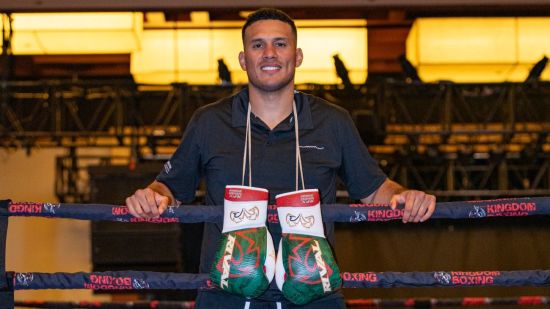
David Benavidez is coming home to win. Again. In fact, he’s never lost a fight in his life.
At 14, he sparred with his first world champion. “I held my own,” he says. Then came another champion… and another. “By the time I knew it, I’m the one beating all these world champions up, and I’m a kid.” That was when he started to believe: “Wow, I could really become something.”
A year later, he decided to give boxing everything. At 16, he turned pro. At 20, he became the youngest super middleweight world champion in history. Looking back at the career he built, he calls himself a prodigy. Then he adds, “I still am.”
Ahead of his Dec. 5 world title unification fight, we met David in his happy place: the ring.
“I feel like a modern-day gladiator. I’m in there looking to finish the guy every single round.” Before a fight, there is no soundtrack. He hears no music, no crowd. He runs through the training, the moves, the game plan. “I don’t even see people when I’m in the ring,” he says. “I’m just locked in.”
And now he’s bringing that focus back to Phoenix.
Ask David about 51st Avenue and Indian School, and he remembers “a lot of great memories” and “a lot of tough memories.” Central Boxing Gym is where he began training with his father and older brother at just two years old. Boxing was the family’s bread and butter. His brother, José Jr., started it all. His father, José Sr., gave his time and energy to building a future for his children.
By eight, David already had six years of boxing experience. His days started with a 4 a.m. run before school and continued with training afterward.
“My dad instilled a discipline in us that was not easy,” he says. “We did a lot of stuff we didn’t want to do.” His father was hard on him, and David doesn’t soften that truth. “The version of myself that I am today would not have been me if I didn’t go through that.”
Then came the year and a half away from the gym. His parents divorced when he was seven, and his father and brother eventually left for California to pursue boxing. At 13, David weighed 250 pounds.
“I gained about 120 pounds in seven months. One day I looked at myself in the mirror and I couldn’t recognize myself.”
He returned to boxing to lose weight. The gym gave him something bigger. “I felt like a part of me left when I stopped boxing,” he says. He never assumed he would become a world champion. He promised himself that, whatever happened, he would leave everything in the ring.
“If it doesn’t happen for me, at least I know I gave 100% of my heart and my soul into boxing,” he says. “And that’s what led me to be here.”
For David, boxing is not simply a sport. “I don’t feel like the individual chooses boxing. I feel like boxing chooses them. This life was made for me.” It is also where he releases emotions he carried from his parents’ divorce and years of being pushed to his limits. He calls it therapy. “I like beating people up,” he says. “Feels good.” Then comes the line you don’t expect from a sport built on punishment: “At the end of the day, there’s something beautiful in this brutality.”
Phoenix shaped him outside the gym, too. His older brother was tough, he says, and sometimes made him fight at school. David learned to defend himself in and out of the ring. “Phoenix is a tough place to come out of,” he says. “I’m happy to have had a role model like my brother to teach me how to be tough.”
Mike Tyson, David’s idol, gave him the “Mexican Monster” nickname. They first met at Central Boxing Gym when David was a child. Years later, Tyson called him a Mexican Monster during a podcast conversation. David says Tyson has given only one person a nickname. “Mike Tyson gives me a nickname, so I’m gonna stick with it.”
The monster stays in the ring. Outside it, David says he is a nice person. “You have to learn how to flip that switch on and off.” His wife and three children get his softer side. His five-year-old son, Anthony, already trains with David and his grandfather, trainer José Sr. Fans call him the “Baby Monster.”
Phoenix has seen David win at home. In 2021, he headlined at Footprint Center, where November 13 was proclaimed “David Benavidez Day.” The following year in Glendale, he stopped David Lemieux in three rounds to win the interim WBC super middleweight title.
On Dec. 5, he faces Michal Cieslak at Desert Diamond Arena, with the cruiserweight titles on the line. David says he is proud to bring a fight of this magnitude back to Phoenix, where he has family and friends.
“I have eight championship belts and I’m going for number nine.”
Back home in the Valley, life has come full circle at Central Boxing Gym. José Sr. has bought and reopened the century old Phoenix gym he once managed. When David was about eight, his father says, Central was his playground. Now murals of David and Mike Tyson look out from above the entrance.
“There’s so much history here,” José Sr. says. “I want to keep it the same. Everything the same.”
David is glad the gym is still standing. “It’s like a way to always remember our roots,” he says. His father now owns the place where those roots took hold.
When asked what advice he gives his children, David says, “Find whatever it is that you want to do, and outwork every single person. Put work in consistently. Have a vision in your head, and don’t stop that vision until you make it come true. Win.” Then he adds, “Pray to God.”
FIGHT NIGHT
David Benavidez faces Michal Cieslak in a cruiserweight title unification bout Saturday, Dec. 5, at Desert Diamond Arena in Glendale. Fight night begins at 5 p.m. Arizona time, with the event streaming on DAZN and Prime Video PPV. Tickets and details at desertdiamondarena.com.