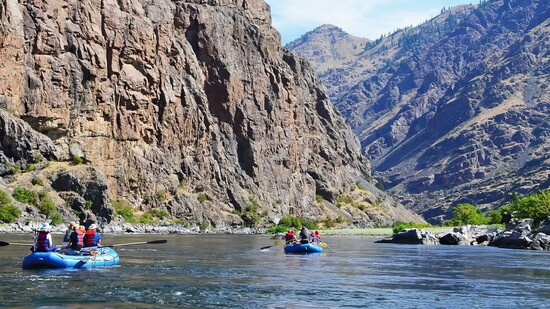
Hells Canyon has a way of changing your sense of distance. Somewhere between the towering canyon walls, the roar of whitewater, and the quiet stillness of a riverside sunset, it becomes hard to believe this place has been here all along, hidden in plain sight along the Idaho-Oregon border.
At more than 7,900 feet from river to rim, Hells Canyon is the deepest river gorge in North America. Yet despite its scale, many Idahoans spend years driving past the region without ever seeing what lies below its rugged walls.
The experience begins early, when the morning air still carries a cool edge and the Snake River reflects the canyon walls like glass. Guides move quietly around camp, coffee brewing while breakfast sizzles on camp stoves. Before long, dry bags are packed, rafts are loaded, and the river begins pulling everyone deeper into the canyon.
And that's when Hells Canyon truly reveals itself.
The scale is impossible to appreciate from photographs alone. Steep rock walls rise thousands of feet overhead while the Snake River winds through the landscape in long bends, alternating between calm stretches and pulse-raising rapids. Eagles circle high above the cliffs. Bighorn sheep appear unexpectedly along rocky ledges. In quieter moments, the silence feels almost surreal.
Then the river changes.
The guides call out instructions as the raft approaches another rapid, paddles dig into the water, and suddenly the calm gives way to crashing waves and cold spray. The whitewater delivers excitement without overshadowing the landscape itself. First-time rafters and seasoned adventurers alike find themselves laughing, soaked, and immediately ready for the next set of rapids.
But a day on the river isn't only about adrenaline.
Between rapids, boats drift through stretches of water where the canyon slows everything down. Some jump in for a swim while others cast lines into deep pools where smallmouth bass, trout, and sturgeon thrive. Some simply lean back and watch the canyon pass by. Along the shoreline, hidden trails lead to historic ranches, ancient pictographs, and quiet overlooks that offer glimpses into the people who lived here long before recreation arrived.
By late afternoon, the pace softens again as rafts pull onto remote beaches for the evening. Camp settles in while meals are prepared and the canyon shifts into shadow. By dinner, strangers who met only days earlier are sharing stories as though they've known one another for years. The river has a way of doing that.
On one side of camp, someone points toward a bighorn sheep high on the canyon wall. Nearby, another guest watches the last light fade from the cliffs while the river slips quietly past. Earlier in the day, they were charging through rapids. Now, no one seems in much of a hurry to be anywhere else.
And then come the stars.
Far from highways, cities, and phone screens, the night sky over Hells Canyon feels impossibly clear. It is often the moment people remember most. Not the rapids themselves, but the feeling of complete escape.
For outfitters who spend their seasons on this stretch of river, that reaction is familiar. Guests arrive expecting whitewater and leave talking about the canyon itself—the scale of the landscape, the wildlife, the silence, and the unexpected sense of connection that comes from spending several days beyond the reach of everyday routines.
In an era when many vacations revolve around crowded attractions and carefully curated itineraries, the canyon offers something simpler. Days are measured by the rhythm of the river, meals are shared around camp, and evenings end beneath a sky filled with stars.
For many travelers, Hells Canyon becomes more than a rafting trip. It becomes a reminder that some of the West's most remarkable places remain surprisingly undiscovered.
Sometimes the unforgettable adventure is much closer than you think.